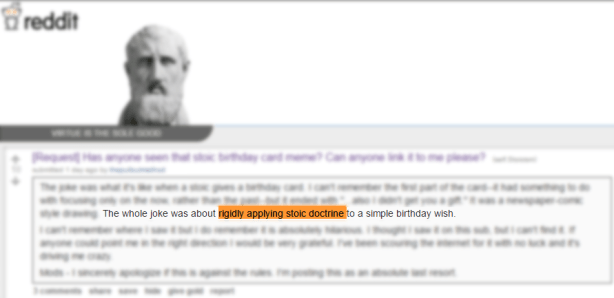
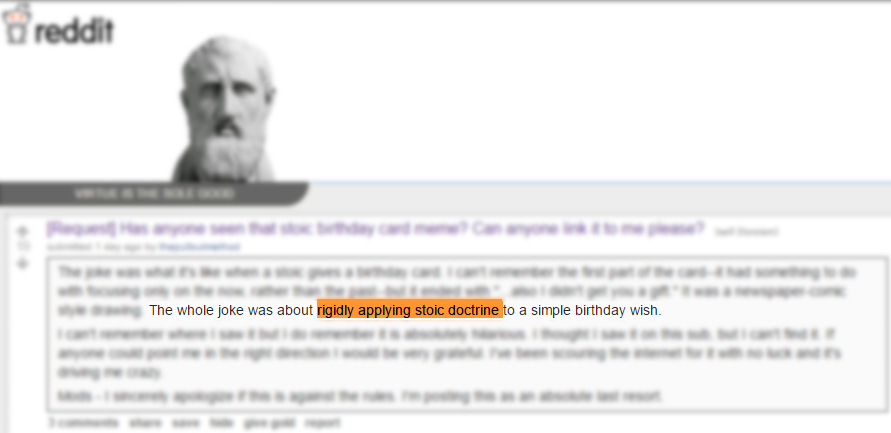
I came across a post on reddit, and the poster had made this statement. “The whole joke was about rigidly applying stoic doctrine to a simple birthday wish.”
The joke itself was funny, but what stood out to me was the statement “rigidly applying Stoic doctrine.” I have seen this criticism from others, in more serious contexts, and it got me thinking.
There is a real problem with modern Stoicism, that harkens back to the “box of my favorite things with Stoicism scrawled on the side.” Many moderns need to water down Stoicism so as to maintain other beliefs to which they have already granted assent. This is not a new trend.
There was a pretty serious Romanizing of Stoicism which attempted (successfully) to knock of the rough edges of the Cynic-inspired Hellenic school. The Greek school of philosophy needed to be molded to be more palatable to the Roman culture. Even their Cynics were reduced. It is worth nothing, that this process brought Stoicism to its height.
Nearly every stage of Christianity has taken something from the Stoics, whether it’s Augustine and Origen, Justus Lipsius, or moderns. The pagan worldview of the Stoics needs to be mitigated to combine with Abrahamic doctrine. And so it was.
It’s pretty recent phenomenon that there is a sizable group of people interested in understanding Stoicism qua Stoics. Not as Christian Stoics, or Roman Stoics, or any other thing. This is a new revival.
Of course, some moderns need to handle and deal with orthodox Stoic positions when it confronts their metaphysical positions (atheism, theism, deism, etc.), their political opinions, their commitment to social causes, and more.
And so more watering down occurs. A lot of it does: a redefining of virtue, a redefining of preferred indifferents, a white-washing of the theology of the ancients, turning the Dichotomy of Control into a trichotomy, and more besides.
Which brings me to the original point: the problem of “rigidly” adhering to the doctrine.
Do we want to progress on the Stoic path?
Is there any possibility of attaining εὐδαιμονία?
Do we believe that we can actually be virtuous?
Is Sagehood possible for us?
If any of these are true (not even all), then anything other than rigid adherence is inappropriate. Epictetus (always via Arrian) gives us this directly:
τηλικούτων οὖν ἐφιέμενος μέμνησο, ὅτι οὐ δεῖ μετρίως κεκινημένον ἅπτεσθαι αὐτῶν, ἀλλὰ τὰ μὲν ἀφιέναι παντελῶς, τὰ δ᾽ ὑπερτίθεσθαι πρὸς τὸ παρόν.
“Having such important aims remember, then, that you must undertake them not moderately stirred but that you must totally give up some things and defer others for the time being.”
— Epictetus, Enchiridion 1:4.
μετρίως κεκινημένον means something like “to be stirred up within measure” or “moderately stirred up.” We might say “halfheartedly.” Philosophy is not something to do a little bit, or else we’re no better than mountebanks. Hobbyists. Indeed, we need to throw ourselves into it wholeheartedly.
Epictetus says we must totally give up some things, and postpone others. Yet we have Stoics claiming there is no ascetic training component of Stoic practice.
So when I see this claim of “rigidly applying doctrine,” what I see is someone scrambling to maintain their preexisting biases. This claim is a last-ditch attempt to avoid confronting the cognitive bias of half-doing Stoicism. To avoid the incontrovertible conclusion that there is a conflict which must be resolved.
Internal conflicts are not small things, humans will go to great lengths to solve them. We also go through great lengths to delude ourselves that they exist, because we have a core understanding that we cannot hold two contradictory opinions. Each one needs justification, or a situational disposition, or a subjective stance. Or else we have to let go of some things.
What a horror would it be if our practice of philosophy changed us, changed our minds!


 Mountain Stoic
You must be logged in to post a comment.