The Philosopher’s Cloak

Standard

So, one of the things I’ve been thinking about quite a bit is socratesthe philosopher’s cloak.  This will be the topic of one of the Episodes of the nascent TubCast, and I’m still working through my thoughts and ideas on the issue.  The philosopher’s cloak is the simplest of garments, really.  The basest protection from the elements, the minimum required for modesty, and requiring very little care and very little to make.

It calls to mind the Spartans, classic philosophers such as Socrates and Diogenes of Sinope, and other fundamental figures in the intellectual history the west.

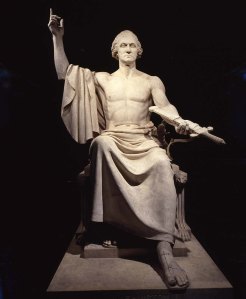
The philosopher’s cloak has become a symbol of wisdom so powerful in western culture that we apply it to folks who really have no right to it.  washigntonTake this photo of a statue of the first US President George Washington (right).  Here, a man of the late 1700s is depicted in the classical garments which are, truly, as far removed from his period as they are from our own.  Yet, to drape Washington in the mystique, the tradition, and the heritage of the west, of democratic republicanism, one has but to drape him also in the philosopher’s cloak:  and that heritage becomes self-evident to all in the west.

The pallium or tribōn was ubiquitous for Hellenic philosophers, and it had fallen out of fashion in favor of the chitton, and other garments.  (Sidebar:  Musonius mentions the chitton, sort of an extra-long, tunic-like shirt in his lectures; stating folks should wear one, not two.  And better yet, a philosopher’s cloak).  As it had fallen out of fashion amongst the laity, it stands to reason that we can say it made the philosopher stand out.  Diogenes referred to his cloak, small bag, and staff as his uniform, and I think for practicing philosophers that’s an appropriate model of thought for it.

This got me thinking on the ideas of a ‘philosophical uniform,’ and what that means for modern practitioners.  Anciently, the cloak can had several functions, firstly that it meets the barest natural needs of the human creature.  Secondly, it calls out clearly to all who would see it that “this person lives differently.”  It might also have other messages attached to it that a related: this person is wise, this person is studying virtue, this person is religious or holy, etc.  But, It is also a message to one’s own self:  “I chose to discard fashion.”  “I’m focused on other things.”  “I am intentionally living.”  “When I put this on, and take this off, I will do so with virtue in mind.” Of course, there is the ever-present risk of vanity in such things as well: ‘I want to be seen in a certain way.’  ‘I want a certain kind of attention.’  ‘I want to look special.’

If we look at philosophical and religious clothing the world over, generally it causes a person to stand out, but I suspect that in the times these traditions were established, that may not have been the prominent reason.  Instead, rather, it generally hearkens back to an early time viewed as closer to nature, closer to “real living,” and closer to our telos of practice.

From the prayer shawls of the Jews, to the robes of a Buddhist monk, to the Roman collar of the Catholic priest:  all of these set one apart, and say, “I’m doing something important.”  “I’m doing something different.”  “I’m living intentionally.”

Stoicism has had a hiatus of approximately 1500 years.  The traditions which are now accepted as common place for other creeds, schools, and faiths are notably absent for we prokoptontes.  That puts us in a tough position.  We necessarily must interpret, create, and change things which otherwise might have already been handed down.  In the eyes of many, that weakens our claims to legitimacy.  However, we who feel called should not be turned aside by such impressions, but we should take to heart the warning that such things can also carry.

No Stoic that I know of believes unequivocally that he or she is doing things in exactly the way that Epictetus, Marcus, or Musonius did, or suggested.  Such a claim is on the face, silly.  We should, however, be wary of interpretations that change core doctrines to the point that we should call it something else.  There is a hedonic element in much of the conversation we see on online Stoic communities, which is a serious departure from the tradition.  We do have a duty to the tradition to enrich it, while maintaining its core.  Drifting too far away might be the right path for some, Stoicism has never claimed to be the one, only, and true path anywhere, but we should have the integrity to call that, then, something else if that’s what we’re doing.  But I digress…

Should we, if we adopt a philosophical uniform, consider whether or not we would stand out?  Or should we instead focus on blending in.  Should we choose something which sends a message to us, every day, while dressing and undressing “I choose to live my life differently than most,”  and do so in such a way that the passerby is none the wiser?

Is it vanity for us, absent the 2,000 year tradition, to stand out?  Should we be like Diogenes, calling out to the passerby to change his ways by our mere presence?  Or should we quietly work to show how our lives have changed, without ostentation or performance?

What say you?
Should a modern Stoic philosophical uniform stand out, or blend in?


21-Aug-2015:  Please see the continuation of this train of thought:  The Philosopher’s Cloak (MK-II).

On belief

Standard

The question of belief is a core one for many modern folks.  The thing that seems to exemplify the modern or post-modern struggle is this search for meaning, this quest for purpose.  Most people find it in labels.  “I’m this,” or “I’m that,” but “I’m never this one,” etc.  We take labels like American, European, Brazilian, White, Black, Brown, Male, Female, Trans, Christian, Muslim, Atheist… Stoic?

A lot of folks these days are finding some meaning in the label Stoic.  This resulted in many folks taking a box, cramming all the things they like into it, and writing “STOICISM” on the side.  Which means that many others say, “Hey, you can’t put that in a box called Stoicism, it belongs in some other box!”  And oh, are the arguments heated!

They are heated, because at the core when we’re attacking the label we’re attacking the identity of the person who searched for meaning and found it in that label.  Is finding meaning in a label the best way to do it?  Probably not.  I’ve found some meaning in that label myself, and of course I think the things I’ve stuck in my box should be there.

They’re my beliefs.

What are the nature of beliefs, since this seems tied intrinsically to meaning?  I don’t think that I know.

The strict, or Orthodox Stoic position would be that there are types of impressions called kataleptic impressions, which come with a degree of surety. Such as, if standing outside, under the sun, feeling its warmth, you are presented with the impression “it is day.”  You kind of know that to be true, it carries some ineffable quality of truth with it.  If you were standing outside, under a dark sky, with thousands of stars overhead, the impression “it is day” would not carry the same weight.

I’m not sure I find this argument too convincing (don’t tell Zeno, please), it feels too subjective, or wishy-washy. But, if we take a truly skeptic position, it’s kind of a non-starter for living well.  And we care about living well or else we wouldn’t be here.

The Pyrrhonian Skeptics refused judgement, “maybe we can know, maybe we can’t.” Even this they would not say they could know, but they were/are open to the possibility, where as hardline skeptics generally are not.

But one still has to act as if one can know. Anything else is some weirdly intellectual conceit.

I don’t know that I know how we come to believe, but I do know that I can’t fake it for myself for very long. I can for a little while, but ultimately I believe some things and I disbelieve others.  I can dress it up, ignore the nagging feeling inside that I’m believing something untrue… but not for long.

Eventually, I drift from that thing.  I (unproudly) have even been able to fake it sometimes for a number of years… but not forever.

That’s all I know about beliefs… which isn’t very much.

A refutation of an Epicurean “argument.”

Standard

Okay, so this post was shared on one of the Facebook groups, I replied in a comment, but I thought a more in depth refutation would be useful.  The original post will be in plain text, with my in-line refutations in Bold and off-set.  Strap in.


Why do I speak harshly about “Stoicism”? Hopefully many of you don’t even know what Stoicism is, and consider it to be just another forgotten ancient philosophy.

An attempt to cast Stoicism in a negative light because it is pre-modern.  Fails, because the Epicurean school which he espouses is just as old, so if Stoicism is bad because it’s old, then Epicureanism must be also.

Unfortunately, that is not entirely the case. The essence of Stoicism is well summarized in the graphic which I will link below, and which started the recent exchange. You could substitute any number of other philosophies or religions as a similar target, but in truth the basic ideas of all of these get smashed together in a stew as “stoicism.”

Explicitly states that he will be arguing against some sort of synthetic mish-mash, not Stoicism-proper.  Prepare for the onslaught of Strawman Arguments! 

That stew represents the great majority of thought in both religion and secular philosophy in the modern world.

Oh?  Care to prove that? 

Epicurus spoke for the right of each individual to pursue pleasant living, but he was not so blind as to believe that every individual can achieve that. There are many obstacles to pleasant living. And what is the greatest obstacle?

I guess we have to figure that our for ourselves?

Viewpoints that allege that there is a “higher purpose” than to live pleasantly, and that seek to substitute their own view of what men should strive for in place of that which Nature provided when she gave us the faculty of happiness.

Incomplete sentence, I’m not sure what the author is alleging here.  I assume that it is the position that pleasure is the highest good.  This is the same axiomatic difference between the Schools… again.

Modern stoicism seeks to brush under the rug its soggy foundations, and to try to convince people that “virtue” is worth living for in and of itself.

This is an axiom of the Stoic school, and indeed most of the Socratic schools.  It’s an axiom, which means it either needs to be accepted or rejected.  Not proven.  What’s a soggy foundation and why does that matter for this discussion, even if it were a thing?

The modern stoics assure you that you can reject their “divine fire” origin of the universe, you can reject their Spock-like worship of “logic” over the facts of reality, and you can reject their praise of a life of anesthesia from all pain (AND joy) as the goal of living. You can reject all these, they say, because “our goal is happiness too!”

Some modern Stoics, typically the athiests, make this statement that you can rejected Stoic Phyiscs.  Not all do.  I see it as romantic and poetic language which bears shocking similarity to modern physics.

I assume ‘Spock-like worship’ is an ad hominem of sorts.  

There are eupathos or ‘healthy emotions’ like cheerfulness in Stoicism.   [LINK:  Donald Robert’s site].  The Epicurean is either ignorant of this or is ignoring it to score debate points.  Either way, no-go.

But what a perversion of a word! Modern Stoicism likes to talk about “happiness” without ever defining the term in recognizable ways.  But when you dig deep enough, you will always find that Stoic happiness has nothing to do with pleasure.

The term eudaimonia which is translated poorly in English by ‘happiness’ has very little to do with hedone or pleasure. This is an axiomatic difference between Epicureanism and Stoicism. Congrats! They’ve re-stated the 2,000 year old distinction between the schools. Again.  Well done.

Additionally, nearly every modern Stoic source devotes significant time (and early) to explaining the (admittedly) jargony way we use the word.  It’s an unfair characterization that we “hide” the meaning.  Stoicism does have a very particular and specific vocabulary, and this was used as a critique even during the early and middle Stoa.  It’s a fair point, but not enough to dismiss the School in its entirety.

Instead, you will find the stoics snuggling up to “pain” as if it is somehow valuable in itself.

Like the pain experienced when we exercise for health?  Some hardships are for a higher good than mere pleasure.   Methamphetamine intoxication might feel good, but destroys the body.  This is why pleasure cannot be a good nor an evil, it’s an indifferent. 

They have always done this and they always will. And that is because the essence of Stoicism is the rejection of the faculty of pleasure given us by nature.

I would say it’s the domestication of pleasure, not the rejection.  I suspect this is a distinction the author might not appreciate, however.

There were specific groups in the ancient world who were labeled “enemies of the human race” for their intolerant religious views.

Oh?  Which ones?  Is making “enemies of the human race” even advisable?  Seems kind of tyrannical… we’ll come back to that.

Well my friends the intolerance of the stoics for the pleasure of the ordinary man on the street beats far stronger in the heart of the establishment today than the irrationality of religion ever did.

Marcus said “educate them or put up with them,”  that’s kind of the definition of ‘tolerance,’ no?  

There is also an argumentum ad populum.  At one point, most folks believed slavery was right.  They were wrong, and the popularization of this idea didn’t make it right.  The Stoics will not force you to stop chasing pleasure, the fickle thing it is, but we might try and suggest you re-think the choice.

Suddenly Stoics are the establishment?  I thought it was a dead and forgotten ancient philosophy?

In seeking to dowse the flames of what they call emotional turbulence, they are really dowsing the flame of ALL emotion, especially the joy and delight that they hate so much.

Asked and answered, see eupathos.  [LINK:  Donald Robert’s site]

And their views have gradually leached so deeply into society that otherwise well-meaning people can no longer interpret even Epicurus himself in any way other than consistently with their ascetic view of human life.

Unsubstantiated assertion.  Is Stoicism old and meaningless or so powerful to obliterate all other interpretations?  Which argument are we having?

Even here, we see loose talk of “painlessness” as the goal of life, and “tranquility” as the absence of all engagement with the world, as if that were possible for any but the dead (whom the stoics emulate as best they can).

Stoicism does not assume mere tranquility is good (Irvine is the exception, here), but ‘human excellence’ virtue or arete is.  If it were mere tranquility, we could all take opium every waking moment to achieve that.  Hey… that almost seems like an Epicurean option!  

Epicurean philosophy arose in a garden where people were truly devoted to pleasure – the alpha and omega of a blessed life.

This is assumed to be a ‘good’ but that is the point of contention between the two Schools.  Stating the axiom isn’t useful in the debate.

Asceticism and hatred of joy and delight were the furthest things from their minds.

Actually, Epicurus states one should live simply so that the pleasure taken in material things is more dear and sharper.  Eating simple foods allows you to enjoy the sweet all the more.  The author seems ignorant of *both* school in the discussion.  

A normal person can tell the difference between Epicureanism and Stoicism, you know, because of the spelling.

The Epicurean movement would never have prospered in the ancient world had it been

Is this true?  On what grounds?

— it would have been immediately recognized by all as the hypocrisy which does truly exist, in Stoicism.

Unsubstantiated  claim of hypocrisy.

Nietzche nailed this on the head far better than I can.

We actually agree on this point.

For those who have not seen this quote, it is one to read over and over again, and to internalize til the understanding behind it becomes second nature:

“You desire to LIVE “according to Nature”? Oh, you noble Stoics, what fraud of words! Imagine to yourselves a being like Nature, boundlessly extravagant, boundlessly indifferent, without purpose or consideration, without pity or justice, at once fruitful and barren and uncertain: imagine to yourselves INDIFFERENCE as a power–how COULD you live in accordance with such indifference? To live–is not that just endeavoring to be otherwise than this Nature? Is not living valuing, preferring, being unjust, being limited, endeavouring to be different? And granted that your imperative, “living according to Nature,” means actually the same as “living according to life”–how could you do DIFFERENTLY? Why should you make a principle out of what you yourselves are, and must be? In reality, however, it is quite otherwise with you: while you pretend to read with rapture the canon of your law in Nature, you want something quite the contrary, you extraordinary stage-players and self-deluders! In your pride you wish to dictate your morals and ideals to Nature, to Nature herself, and to incorporate them therein; you insist that it shall be Nature “according to the Stoa,” and would like everything to be made after your own image, as a vast, eternal glorification and generalism of Stoicism! With all your love for truth, you have forced yourselves so long, so persistently, and with such hypnotic rigidity to see Nature FALSELY, that is to say, Stoically, that you are no longer able to see it otherwise– and to crown all, some unfathomable superciliousness gives you the Bedlamite hope that BECAUSE you are able to tyrannize over yourselves–Stoicism is self-tyranny–Nature will also allow herself to be tyrannized over: is not the Stoic a PART of Nature? . . . But this is an old and everlasting story: what happened in old times with the Stoics still happens today, as soon as ever a philosophy begins to believe in itself. It always creates the world in its own image; it cannot do otherwise; philosophy is this tyrannical impulse itself, the most spiritual Will to Power, the will to “creation of the world,” the will to the causa prima.”

This person then has the rest of the argument backwards. Reasoning what is natural is not a prescription for nature to follow, it is for us to follow. They’ve read Nietzsche. Cool. Did they understand what they read? Probably not, since their interpretation of Stoicism is so far off.
Self-tyranny is a contradiction. That’s called “freedom of choice.” If one wants to be a mere pleasure seeking robot, one can do that. It’s not advisable from a Stoic perspective, however it’s possible. If I seek to regulate my behaviors and thinking, that’s my choice. There’s not external force involved, which a tyranny necessarily has. The term is totally irrelevant to the discussion.

There is one philosophy that does NOT become a system based on “logic” with true believers who think they can “reason” their way into telling Nature what to do.

Why is “not based on logic” something worth while?  Are we looking for divine revelation, or maybe something that just reinforces our biases?  Hang on, if ‘logic’ is such an evil, why make a (poorly formed) argument against the Stoics?  Isn’t that an exercise in logic?

There is one philosophy that does NOT seek to create the world in its own image, and to dowse the flame of joy and delight which is the motive power of every living thing.

Suggesting that folks live according to the world *as it is* is not trying to re-shape it to one’s own nature.  It’s a standard practice in debate to (in good faith), to portray your opponent’s positions accurately and well.  That’s not happening here.

There is one philosophy that does not rebel against, but indeed elevates to the center, the faculty that Nature gave us to live our lives.

I’m going to be honest, I don’t know what this means.  It’s probably not our ruling faculty, the hegemonikon of reason, though.

There is one philosophy that recognizes “Divine Pleasure, the Guide of Life” as the true “goddess of nature” for both men and all other living things, and yields to her the respect and gratitude to which she is entitled. And that is the philosophy of Epicurus.

This person has systematically redefined words, then argued against these straw-definitions, and thinks they’ve done something worth while. They’re wrong, there, too.  By simply parroting the basic position of the school, while failing to support them, the author acts as if the argument is won, but it hasn’t even been argued in good faith.

Over all: congrats on the sophistry.

On ascetic practices in Stoicism

Standard
“Lo, God has sent you one who shall show indeed that it is possible. ‘Look at me, I have no house or city, property or slave: I sleep on the ground, I have no wife or children, no miserable palace, but only earth and sky and one poor cloak. Yet what do I lack? Am I not quit of pain and fear, am I not free? When has any of you ever seen me failing to get what I will to get, or falling into what I will to avoid? When did I blame God or man, when did I accuse any? Has any of you seen me with a gloomy face? How do I meet those of whom you stand in fear and awe? Do I not meet them as slaves? Who that sees me but thinks that he sees his king and master?’ There you have the true Cynic’s words…”
— Epictetus, Discourses III.22

The Stoics are descended from the Cynics, through Zeno of Citium who studied under Crates.  Indeed, Epictetus mentions in his Discourses Diogenes of Sinope more often than he does Zeno, the very founder of the Stoic School.  Both the Stoics and the Cynics hold that virtue is the only good, and the only thing necessary for eudaimonia.  On this, they agree.  On the matter of things indifferent (Gr: ἀδιάφορα), they differ heartily.

Desmond, in his book “Cynics, notes that Epictetus is one of the more Cynical of the Hellenic Stoics.  While this is true if you are comparing them to the Roman Stoics as a standard, it’s not true if you consider that we should be doing that comparison the other way ’round.  The Roman Stoics should be measured against their earlier Greek forebears.  The Romans, especially Seneca, Cato, and Marcus, had a level of material wealth and social role obligations that their Hellenic cousins simply never did.

The Romans took the tripartite study of philosophy, and discarded much of the things which did not mesh with their cultural norms.  The Cynic’s parrhesia (Gr: παρρησία), or freedom of speech, and their flouting of social norms were entirely contrary to the Roman values of decorum and social compliance.  From Cicero on, we have a trend of Romanizing the rough edges, the Cynic edges, off of Stoicism.  However, to ignore this lineage, and the Cynic-like tendencies of the early Stoa is a mistake.

So, the Cynic lives with his wallet or sack, worn-out cloak, and staff.  This is his uniform, and the extent of his worldly possessions.  The Cynics were practicing a voluntary austerity and asceticism which set them apart from the wider Hellenic culture.  They made plain their distaste for the material preoccupations of their day, and history is replete with annotations, aphorisms, and quotes holding up their mirror of non-conformity to the wider culture.

So, what sorts of ascetic practices, looking to our Cynic forebears for inspirations, might the aspiring Stoic adopt today?

  • Simple food:  The Cynics extolled the virtues of the lupin bean, and simple lentil soup, and crusty bread.  Lupins are expensive and hard to come by where I live, but lentils are cheap and readily available.  Zenonian Lentil soup might be a good start.
  • Simple drinks:  The Cynics praised the drinking of water over other choices, although Diogenes did say his favorite wine was “someone else’s.”  Note:  “The Water-Drinking Cynic” (Hydrokyon).
  • Simple clothes:  The Cynics had a uniform, and indeed many Stoics did, too.  The tribōn or philosopher’s cloak, minimalist protection from the environment.  The modern might reduce the wardrobe to a few identical pieces.  Jeans, a solid color t-shirt, and a light jacket, maybe?
  • Simple, natural grooming:  A simple, utilitarian hair cut, not for style but to remove what’s useless or in the way, and for men an uncut beard.
  • Simple shoes:  Barefoot if possible, for most of us it may not be, sandals might be a reasonable substitute.
  • Rough sleeping:  Avoid the soft beds, sleeping instead on the ground or a rough pallet, with naught but a simple blanket or cloak.
  • Walking:  Which errands could we rather walk for, instead of taking our vehicles or public transportation?

Ascetic training was a core part of ancient Stoic practice, and it has been sadly divorced in the modern times.  At minimum, if we will not practice these labors daily, once a month we should expose ourselves to some hardship so we might inure ourselves from the fickleness of Fate.

Is asceticism a part of your Stoic practice?  Why or why not?  Would you consider adding it to your practice?

Musonius’ Stoic

Standard

Musonius Rufus has a variety of prescriptions for the aspiring Stoic.  Some of which might be surprising to those not familiar with what he have left of his writings.

If you’ve not read Musonius before, there’s a version available here.

Musonius’ Stoic can be male or female.  One of the very forward-thinking classical Stoics, Musonius notes that men and women both should study philosophy.  In the same way that philosophy can make good men better, the same holds true for women.  While Musonius does see some differences between the sexes, both biological and cultural, our ruling faculties, our souls are of a common nature.

“Moreover, not men alone, but women too, have a natural inclination toward virtue and the capacity for acquiring it, and it is the nature of women no less than men to be pleased by good and just acts and to reject the opposite of these.”
— Lecture III

Musonius’ Stoic would dress simply, wearing enough clothes to protect the body, but not cater to some vane and vicious desire.  He argues that we could wear a cloak or simple garments like a chiton.  The modern Stoic might choose a “uniform” of sorts.  A pair of jeans, a solid colored t-shirt and simple jacket.

“…he said that one ought to use clothing and shoes in exactly the same way as armour, that is for the protection of the body and not for display.”
— Lecture XIX

Musonius argues against sandals, and says his students should go barefoot, but the modern Stoic might choose sandals over closed shoes for the reason of not covering the body more than necessary.

“…going barefoot gives the feet great freedom and grace when they are used to it.”
— Lecture XIX

Musonius Stoic would have a simple hair style, maybe a cheap buzz-cut for men, as the purpose of such grooming is to remove excess, not to style and primp.

“He used to say that a man should cut the hair from the head for the same reason that we prune a vine, that is merely to remove what is useless.”
— Lecture XXI

If the Musonius’ Stoic is male, then he should be bearded so far as he is able to grow one.

“… neither should the beard be cut from the chin (for it is not superfluous), but it too has been provided for us by nature as a kind of cover or protection. Moreover, the beard is nature’s symbol of the male just as is the crest of the cock and the mane of the lion; so one ought to remove the growth of hair that becomes burdensome, but nothing of the beard; for the beard is no burden so long as the body is healthy and not afflicted with any disease…”
— Lecture XXI

If one passed Musonius’ Stoic while he or she was taking meal, we would find that person eating what we would call a mostly raw or at least vegetarian diet, eating fresh local foods in season, eschewing meat-products.

“As one should prefer inexpensive food to expensive and what is abundant to what is scarce, so one should prefer what is natural for men to what is not. Now food from plants of the earth is natural to us, grains and those which though not cereals can nourish man well, and also food (other than flesh) from animals which are domesticated. Of these foods the most useful are those which can be used at once without fire, since they are also most easily available; for example fruits in season, some of the green vegetables, milk, cheese, and honey. Also those which require fire for their preparation, whether grains or vegetables, are not unsuitable, and are all natural food for man.”
— Lecture XVIIIA

If Musonius’ Stoic invited us over for the evening, we would find the living arrangements to be simple, understated, and utilitarian.

“Since we make houses too for a shelter, I argue that they ought to be made to satisfy bare necessity, to keep out the cold and extreme heat and to be a protection from the sun and the winds for those who need it.”
— Lecture XIX
‘Whatever is difficult to obtain or not convenient to use or not easy to protect is to be judged inferior; but what we acquire with no difficulty and use with satisfaction and find easy to keep is superior. For this reason earthenware and iron and similar vessels are much better than those of silver or gold, because their acquisition is less trouble since they are cheaper, their usefulness is greater…’
— Lecture XX

We would also probably find Musonius’ Stoic to be in the presence of a spouse or partner, as he would say we are fitted by nature one for the other.  The family, he argues, is the support for all of society, and the philosopher, too, has a duty here.

“Again when someone said that marriage and living with a wife seemed to him a handicap to the pursuit of philosophy, Musonius said that it was no handicap to Pythagoras, nor to Socrates, nor to Crates, each of whom lived with a wife, and one could not mention better philosophers than these.”
— Lecture XIV

Likely, Musonius’ Stoic would also have a garden, or in some way produce some of their own food.

“…it would not be unreasonable to consider it even better for a strong person, namely earning a living from the soil, whether one owns his own land or not.”
— Lecture XI

The picture Musonius paints of the Stoic student is an interesting one.  The Stoic lives an almost Spartan, utilitarian life.  He or she focuses on family, community, and living simply.  Musonius sets a pretty strict prescription for how we aspiring Stoics should live.

Most of us cannot wrap a simple cloak about ourselves while go about our daily occupation, but can we simplify?  Yes, very likely.  Can we cut back on eating out, eat more local, fresh, and in-season foods?  Can we take the time to prepare meals for ourselves and our families which are healthy, and nourishing to the body?  Probably.

We may not measure up to Musonius’ descriptions, but we can definitely make progress closer to it.

On the grounding of ethics

Standard

One of the common assertions used to discard the classical tripartite study of philosophy is ‘Stoic Ethics are not founded on their Physics.’  This assertion, often phrased as a demand for proof that the Ethics do follow from the Physics.  It’s very easy to ask a hard question, and it’s not as easy to answer it.  Many new Stoics find themselves floundering at this question, and in the inability to argue well, the case is lost.  So let’s look at the question:  Are Stoic Ethics predicated on Stoic Physics?

All human fields of study are built on axioms.  Axioms are unproven assertions that are taken for granted.  In mathematics, one such assertion is that 1+1=2.  Everything else is built on this, now while there are some who claim to prove that 1+1=2, the average person, the average university student even, cannot prove this (especially if you find “succession” and “recursion” arguments unconvincing).  It’s an axiom, for most.

Stoicism has some axioms as well.  Let’s look at some core axioms to Stoic Philosophy:

1.)  The existence of ‘adequate impressions’ or katalepsis (Gr: κατάληψις). (Epistemology, Logic)
2.)  Eudaimonia (Gr: εὐδαιμονία) as the telos of human life, and virtue is the only good, and the only thing necessary for it. (Ethics)
3.)  The cosmos is conscious and providential. (Theology, Physics)

You might wonder why I bring up these axioms, and that’s precisely to prove the point that at some point, some unproven thing must be accepted.  Else:  we’re forced to acknowledge that the Pyrrhonians are correct, (but I bet they still drive with their eyes open).  Understand:  such assumptions exist.  We’ll come back to this later.

Now, Physics as the classical Stoics understood it, was the study of nature (Gr: φύσις).  Their assumption was that without understanding the cosmos as it is, how can we begin to understand our right place in it?  For them, this included the natural process of the universe, human psychology, and all other things relevant. It’s a solid question, one which prompted the scientific inquiry (which may have become a preoccupation or end-in-and-of-itself, since) of the past five hundred years.

Now, the Epicureans argued that the infants’ crying out for food, warmth, and comfort is pleasure seeking behavior.  It was this, they argued, that showed the basic impetus for action is seeking of pleasure, and avoidance of pain.  The Stoics disagreed, they argued that the infants’ crying out for those things were indicative of an instinct for self-preservation.

You might think that’s splitting hairs a little finely, since these things are both pleasurable and life sustaining, but it is not.  For instance, let us look at exercise of the body.  Many people will say the enjoy it, but this is after the body is well accustomed to it.  Take your average couch potato and begin him on a running or weight training regimen.  This will very likely extend his life in the long run, it’s healthy.  But is it pleasant?  Most assuredly not.  In fact, the body is broken down, injured, exhausted.  Health decreases on the short term during this adaptation phase.  Here we can clearly see there is a difference between what’s preserving behavior and what’s pleasurable behavior.  The Epicurean then, is stuck seeing pleasure later in life, while the Stoic is then concerned with preservation of things valuable (which will reasonably extend beyond the self, shortly).

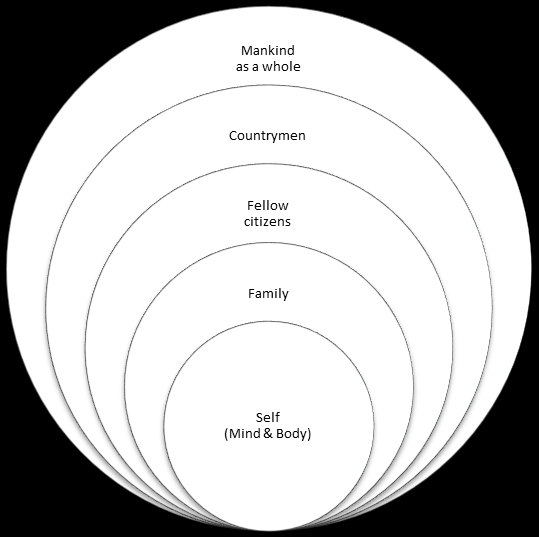
So, this natural instinct for self-preservation, this affinity for one’s own self is an interesting trait.  The classical Stoics thought so, too.  In more advanced critters, like humans, we see this affinity for one’s self extended to others.  Many animals show it, however, as an affinity for family members.  Some extend it towards their whole species.  Humans, as rational and socials critters, can extend it beyond all the others not just to our species, but indeed to all rational creatures.  This is called Oikeiôsis (Gr: οἰκείωσις).  This expansion of self-interest is the motivation for rushing into a burning building to save children, or the stranger who reaches out and pulls a pedestrian out of the car’s path.  For Stoics, it’s not a just a mere description, but a mandate for individual action and judgments.

oikeiosis

Oikeiosis and the domains of affinity.

The process of this affinity is to “make things like family.”  We start by treating our fellow townsfolk as family, our fellow citizens in the state as neighbors, and foreigners as our countrymen.  We can even extend this in the future to other rational creature and treat them like siblings in the Logos.

Effectively, we’re extending each circle by one.  So family is treated as self, citizens, like family, etc., per the image to the right.

Oikeiôsis is a key Stoic ethical doctrine, and it is founded on the study of nature, on their physics.  How so?  Only by watching animals become aware as they are of themselves, and taking care of this possession of their lives as a natural function.  Then we see the social animals, even going so far as to sacrifice their lives for their societies, and to us, as rational and social animals as shown.  This Ethical maxim, this injunction to make others “like family”  is based on their observation of the universe and the things and creatures in it.

One might argue “Yes, but this principle doesn’t have to be founded on physics.”  This is an unconvincing argument, because they were.  While it’s true, that such a ‘good behavior’ might be a mere social construct, when we are doing historical analysis, it behooves us to take into consideration what the folks themselves said they believed.  We might disagree with the conclusions, but it still needs to feature into the discussion; which (some-but-not-all) folks who want to discard Stoic physics seem reluctant to do.  Additionally, to digress slightly on the question of social constructs, just because a thing is a social construct doesn’t necessarily devalue it, or make it unimportant.  I’m not sure why this has become a catch argument these days, it’s not a reasonable objection.  Not wantonly killing innocents might just be a social construct, but it’s a good one.

So, do we need to believe in a two-thousand year old understanding of nature to be good people?  Nope, not in the slightest.  But if we want to understand a school of thought, even if we set it aside in favor of something else, we do need to understand appreciate what brought it about.  And when we’re talking about Stoic Ethics, that means an investigation into Stoic Physics.  Just as the axioms previously discussed, the foundation of Stoic Ethics in particular should be accepted as founded on their Physics.

Can you divorce Stoic Ethics from Stoic Physics?  Yes of course.  But should you?  Ah… that’s the question.  I would offer, no, you should not.


For more on the applicability of Stoic Physics to the modern understanding of the universe, please see this entry:  In defense of the conscious and providential universe.

On the unity of philosophy

Standard

“The first difference between a common person and a philosopher is this: the common person says, “Woe to me for my little child, for my brother, for my father.” The philosopher, if he shall ever be compelled to say, “Woe to me,” stops and says, “but for myself.” For nothing which is independent of the will can hinder or damage the will, and the will can only hinder or damage itself.”

— Epictetus, Discourses III.19


Classically, the various schools of philosophy, specifically those who traced their lineage back to Socrates, saw themselves as being closer or farther from that progenitor.  However, they recognized in the others a certain validity in aim.  Not looking back to Socrates, but Democritus, the Epicurean sought virtue through pleasure (albeit a strange, pseudo-ascetic sort), his being a philosopher would not inherently be questioned.

“Even Epicurus perceives that we are by nature social, but having once placed our good in the husk he is no longer able to say anything else. For on the other hand he strongly maintains this, that we ought not to admire nor to accept anything which is detached from the nature of good; and he is right in maintaining this.”

— Epictetus, Discourses I.23

Clearly, the main problem between the Epicureans and the Stoics is the nature of the good, of virtue, and the telos of human life.  Just some little, piddly stuff, right?  However, Epictetus (outside this quote), argues against Epicurus on the merits of his argument.  He doesn’t discard him as a sophist, but treats his argument on a level footing, as an equal.

“Then, if he is thus prepared, the true Cynic cannot be satisfied with this; but he must know that he is sent a messenger from Zeus to men about good and bad things, to show them that they have wandered and are seeking the substance of good and evil where it is not, but where it is, they never think; and that he is a spy, as Diogenes was carried off to Philip after the battle of Chaeroneia as a spy.”

— Epictetus, Discourses III.22

The Cynics, as the forbears of the Stoics, get a softer handling.  Indeed, Epictetus references Diogenes of Sinope, the Cynic par excellence,  more often than he does Zeno of Citium, the very founder of the Stoic school.  What we can learn from these excepts is that the ‘rival’ philosophers still saw a certain fraternity in the process (excepting maybe the Cynics, as they’d say we’re all focused on the fluffery of life rather than virtue).  They might disagree with the conclusions reached, but the process of philosophical examination is the unifying factor.

So what does that mean for us?  Well, it seems to point in this direction:  that reason is a process not a product.  What I mean by this is that we can imagine it as a ‘black box.’  We feed it certain inputs, it does its thing (when functioning correctly), and it gives us outputs.  Does it not stand to reason, that we should pay the very closest attention to what the inputs are?  Herein lies the rub.

If we feed the ‘box’ shoddy material, we’re going to get shoddy out.  It should be clear that the outputs are how we can determine the quality of the inputs, then, correct?  And, it is these outputs over which we argue.

No one of the ancient schools questioned the basic axiom that eudaimonia was the goal of human life.  Today, no average citizen will question that we should ‘do what’s good’ in our lives.  These types of large categorical statements are not in debate, generally.  Think on that.  How many people have every said to you that the goal of human life should be destruction of pleasantness?  None, it runs contrary to the basic axioms of western civilization.  Now, what does it mean to ‘do what’s good?’  On these specifics is where the disagreement arises.

(For American readers), the liberal says that the welfare state helps the poor, and the conservative says that the welfare state bleeds dry the middle class.  Regardless of the validity of the arguments, both are arguing from a moral question: namely, how do we help people?  Partisans of either stripe will argue the other side is in fact not trying to help people, but a discussion with the average individual of either side will show that to be false.  Politicians at the top-tier might be so minded, but the average voters are not.

“Observe yourselves thus in your actions, and you will find to what sect you belong. You will find that most of you are Epicureans, a few Peripatetics, … But show me a Stoic, if you can. Where or how? But you can show me an endless number who utter small arguments of the Stoics. For do the same persons repeat the Epicurean opinions any worse? And the Peripatetic, do they not handle them also with equal accuracy? who then is a Stoic?”

— Epictetus, Discourses II.19

So, are philosophers (Stoics) born or made?  A philosophically inclined “nature v. nurture” question, then.  Will someone prone to hedonism more so than the average tend to see value in Epicureanism or Stoicism?  My suspicion is that it’s a combination of both, we’ll leave it unanswered for now.  Which leads us to the next point:

Stoicism in the twenty-first century as we are currently seeing it has two main camps.  The Orthodox traditionalists and the Modern atheists are each arguing they represent the ‘truer’ form of Stoicism.  What lesson, if any, can we take from the classical schools of philosophy in this issue?

Will we see the atheist Stoics as fellow travellers on the path, or as godless deviants, derailing our anciently established traditions?  Will we look at the Orthodox Stoics as magically-oriented “believers” who need a supernatural story rather than their own reason, or will we see folks who also are interested in goodness, truth, and wisdom but see a different way?

Are atheist and deists born or made?  Does it matter?  Or, instead, should we see brothers and sisters on the Path of the Sage, understanding that reason is a process and not a product?

There’s plenty of room in “big tent” Stoicism, are you trying to share in the experience, or trying keep folks out?

“That then which makes a dog beautiful, makes a horse ugly; and
that which makes a horse beautiful, makes a dog ugly, if it is true that their natures are different.”

— Epictetus, Discourses III.1

A Stoic rap? Sure, why not.

Standard

So a dear friend of mine sent me a video for a song which is more introspective, more important, than most popular music today is.  I watched the video and read the lyrics, and the poetry and content is moving and thought-provoking.

I felt moved to respond with what might be Stoic advice in kind.


The question about life is insane
It’s not the struggle, the hardship, the pain.
Humans are here, and we’re reasonable.
We’re here to find the truth, the logic; the main
Thing we need to see is virtue and vice.,
To know what’s good, what’s bad, we’re fraught for lack of advice.
 
But it isn’t heavenly reward,
so much as it’s our internal words
Where we can find, not rewind, what we’ve got to fill the time.
And our morals, our lessons, come from our minds.
It’s not divine, but it’s time to set aside the rhythm and rhyme.
To discover for ourselves, and not for fear of heaven nor hell.
 
It’s our nature, our fate, to reason and love, and sometimes to hate.
There’s nothing outside, but the universe is god, and the cosmos divine.
Seek to stand straight, not straightened. 
Sometimes we bend, we break, but our fate is the same, we’re waitin’
For some truth,  for nature, for god.

But we can’t see where we are, without the perspective,
Our natures are reflective, and not for god we’re awed, we stand and plod
through life without direction. 
But for men and women, we’re a collection of projections
Given no quarter other than what we find,
and the line is divine, to fill the time with prime, sublime

Excellence.

On Robbin Williams and Suicide

Standard

Suicide if undertaken for the right reasons is not an evil in Stoicism. Socrates committed suicide, Seneca also. However, if it’s merely a means of escape from your obligations and trials, it’s not virtuous.

Seneca wrote “The wise man will live as long as he ought, not as long as he can.”

But if your life has ripened, like a fruit, and is best at this moment, then plucking it is reasonable. Or if continued existence would destroy your moral or rational nature, a sagacious person might undertake it.

Epictetus: “The door is always open.”

What Dreams May Come

That being said, most folks are not in that position, and if someone is troubled and suicide is a thought they are entertaining, then they should probably ask for help, as we would be obligated to give it as we were able.  We do not know under what pain he was living, and it’s difficult to “armchair quarterback” his decision.  We can look at the context, and the social roles he had.  His children are adults, his family secure.  He did excellent work, and he struggled (not always, but sometimes successfully) with his demons and flaws.

I don’t think anyone undertakes Robin’s decision easily. I hope he finds some solace and relief in what may come after. I hope he knew the lightness of heart that he brought to many.

This is the advice I gave to some friends on Facebook:

When someone we are attached to leaves us, rather than lament at losing him or her, instead think that he has returned home.

We never possessed them, we merely borrowed them for a time. When the owner of something we’ve borrowed asks for it back, no matter how, we should return it with gladness for having experienced it.