Research for the Rule of Musonius

Standard
Book 5:  The Rule of Musonius

Book 5: The Rule of Musonius

I am currently working on writing The Rule of Musonius, which is a prescriptive Rule based on the Lectures and Fragments of Musonius Rufus.  It is aimed at restoring a part of Stoicism which has laid dormant for close to 2,000 years.

In many ways, the Christian tradition preserved a goodly portion of it, but it has not been a part of the philosophical practice since theology and religion took “philosophy as a way of life” and left the philosophers with only academics.

The Stoic monasterium and monarchi were folks who went into retreat, often seclusion, for philosophical purposes.  It is the foundation of western monasticism, and many authors credit the Stoics with the idea and the vocabulary( including words like monastery, monk, and Anchorite) which the west still has today.

The Rule of Musonius will take the prescription laid out for his students and expand upon them to produce a program and system of self-regulation for philosophical purposes.  It will likely be called either austerity or asceticism in some way.

At this early time, the writings will be geared towards solitary practitioners, but eventually a re-founding of the Stoic Monasterium would certainly be a thing to see.  Since that is the case, it is inherently self-regulatory, but at some point the monasterium would be run in some fashion, which the Rule will lay out.  These sorts of entries necessarily will not be based in the literature, and will be in separate chapters from the canon prescriptions.

Before release of the eBook, I will be doing a series of experiments (currently with an N of 1, unless others are interested), and reporting qualitative (maybe subjective) findings.  Once that’s complete, and the writing, the book will be released for popular (read: niche) consumption.

On the Stoic acceptance of Fate.

Standard

Fate gets a lot play in Stoic circles, and we even use it to poke fun at our fellow philosophers, the Cynics.  It starts out with a typical Cynic-style chreia.

On a road there is a dog tied to the cart.  The dog cannot help being tied to the cart, it is merely the situation as he finds it.  The cart begins rolling down the road, headed to some destination or other.  The dog has two choices:  he can fight against the rope and cart, pulling, getting dragged, yelping, and struggling; or, he can trot along side the cart to wherever it is going.

Regardless, the dog is going where the cart is going.  There’s no helping that.  The only choice is whether he goes willingly, and thus makes it easier on himself and more enjoyable, or he gets dragged biting, snapping, and pulling the whole way.

This is the Stoic conception of Fate, generally.  Now, we as modern practitioners tend to break it down into a few more types and genera.  We can view Fate as the chain of causes across the whole cosmos which is cause => effect.  If a thing is dropped on Earth, it is fated to fall, generally (unless it’s nature is otherwise, like helium).  It is a simple, mechanistic view of the universe.  This is the modern, atheist view.

Some might view Fate as the will of God, or the cosmos.  Nature’s Providence.  The “good end” to which all this is moving.  This would be the theological view.  Some others view Fate as a force itself, something if not godly, then at least worthy of being capitalized.

So how does fate and nature and our choices all mesh?

Another chreia, then:

A cylinder has a certain nature for roundness.  And when it is pushed, it rolls.  The cause is the pushing, but it’s nature determined what happens.  The cylinder rolls while the block slides.  Similar causes, affected by their nature, yielding different results.

Causes yield effects.  This is made more complicated as rational creatures are causa sui or ’causes in themselves.’  Namely, we have some measure of free will which is also a cause.  Unlike the previous example, we are both the shape and the push.  We have a certain amount of flexibility, to be true to our nature or fight against it.  To push, or to be inert.

As rational creatures we are a causa sui.
(This accpetance both of determinism and free will is called Compatiblism, more here.)

To my mind, a mixing of the two main camps is the better thought model:

An unending chain of universal causes from the beginning of time has been shaped to provide *me*  (and you), with the opportunity for virtue.  We are not enslaved by the vicissitudes of Fate, no.  It instead provides us with the situations, contexts, and possibility to exercise the greatest value humans are capable of:  excellence.

So, how can we, in the face of this cosmic test, do anything but try to meet it with the best we have to offer?  That is our Fate… if we choose it.

On the unitary nature of the cosmos

Standard

We often read about the classical Stoics as being monists, with a squirrely dodge of active/passive functions. Yet here, Epictetus seems to clearly be discussing bodies and souls as two distinct parts… right?

We do see the description of the world-soul or God, that we are in some way part and parcel of that nature, but it seems like he’s setting up a dualist perspective here… isn’t he?

“Have the very leaves, and our own bodies, this connection and sympathy with the whole, and have not our souls much more? But our souls are thus connected and intimately joined to God, as being indeed members and distinct portions of his essence.”
— Epictetus, Discourses i.14.1

So, is this a mere short-hand of speech, a way to speak to his particular audience, does it represent a doctrinal position, or is it something else entirely? How does this excerpt jive with the conception of Stoics being strict monists?

Stoic monism can be a tricky thing, for one because all of the Western tradition has been touched by Cartesian Dualism, this fundamental separation of spirit and body, or mind and body (for a more secular twist).  This idea, that we are some sort of spirit-thing inhabiting a body, that there is a core and irreconcilable divide between what’s physical and what’s conscious runs so deep in Western thought that it is difficult even to grasp the notion that there are other ideas, let alone what they’d look like in the mind of a real person.

I admit, freely, this is a challenge for me, the basic tenet of the West (and the East in many ways) is “I am more than this body.”  Even if we, after careful deliberation, come back to this position, it behooves us to give a good-faith attempt at the classical idea, since we are interested in other, related classical ideas.

So, what is Stoic monism?  How do we attempt to parse this cosmos in which we find ourselves?  The classical Stoics posited that nothing exists which is not a body.  This is in direct opposition to the idea of Platonic forms in which there is some ideal version “good,” or as for more mundane things, there is not just this cup, there is an ideal of “cupness” which all cups are in some measure closer to or further from.  Now, there is a category of things which “subsist” rather than exist (incorporeals), but that’s beyond the scope of this essay, and is essay-fodder for another time.

Let us say, then, that every thing in existence is a body.  This is a necessary consequence of a definition, common at the time, whichsaid that a body (primarily, there are other qualifiers) is anything which can act or be acted upon.  The classical Stoics were focused on creating an inclusive theory of the world, in that it needed to account for all it could, be internally consistent, and leave nothing out.  So,then to say that important things like the soul, consciousness, or honor exist, how do we account for them?  Well, what about things like “justice,”  or “liberty,” or “hate.”  Are these bodies too?  Actually they are.  Now hang on a minute, you might reasonably here ask, I thought we didn’t stomach the idea of “cupness” but now you’re telling me that “justice” is a body?

Indeed, that’s the case.  The Stoics would not fall into the rhetorical Platonic trap of saying “all things exist are a body, but ‘honor’ isn’t a body, so honor doesn’t exist.’  Their system confronted this challenge head on.  “Yup, honor is a body too.”  Since the definition of body is “anything which acts or is acted upon” and some folks undertake certain actions or refrain from the based on ideas like honor, liberty, duty, etc. these are necessarily bodies as well.

So, in a previous essay, I discussed that consciousness or mind might be a developmental stage of matter.  This wasn’t just a hypothetical “what if” it’s borne of the need to to posit an idea which meets the data we see in the universe, and is in line with the core doctrines of our School.  If mind is a function of matter, then we do not need to accept that “I am more than this body,” since the body includes this thing which I experientially identify with:  my ruling faculty.  This can be done when we understand ‘the breath of life,’ pneuma.

The Stoics have a conception of a thing called pneuma (Gr: πνεῦμα) or breath.  It is the active type of body.  There are two types of bodies, the active and the passive, but both are still bodies, both are still matter.  Thus, we maintain a monist perspective.  Pneuma is a body which pervades and permeates everything.  Classically these are conceived as one kind of stuff, merely two principle functions of it.  But, as John Sellars does in Stoicism, even if we give the dualists the benefit of the doubt, our conclusion stays the same.

Modern westerners say “but two things cannot coexist in the same space-time.”  The classical Stoics had several ideas of how things mix, and that matters (pun intended) while talking about active pneuma mixing with the passive matter.  Here are the types:

  1. Juxtaposition:  The parts of two substances are next to each other but remain separate when mixed:  take salt and sugar for instance.
  2. Fusion: in which a new entity is created from the mixing: take the use of oils and spices while cooking.
  3. Total blending: That every part of the new mixture contains both the elements of the mixed parts, but such that they retain their qualities, and could in theory be separated again:  take water and wine (extracted with an oil sponge, I’m told this works).

So, if pneuma  and passive matter are indeed separate, but mixed, like third way, we have a homogeneous substance of which its constituents parts can still be extracted, but in the mixture is one whole.  Thus, still a monist perspective.

So, what is pneuma?  It is the active, generative principle of the universe.  Theist or Deist Stoics would say it is God enlivening the cosmos (regular or passive matter).  This mixture of pneuma in passive matter is why the classical Stoics said that the universe was effectively God, being enlivened by this active sort of body.  Pneuma is that which acts, and the rest of the cosmos is that which is acted upon:  the definition of bodies met, and the system whole and intact.

Pneuma has several  quality which occur in various configurations, we’re told, the first of which is called tension.  The amount of pneumatic tension in a body determines its apparent substance.  It’s what makes a stone different from a log, both being made up of the same elements.  Pneuma as ‘physis’ is the enlivening force of the cosmos, which makes living things live.  Then, it has the quality of ‘psychê,’ which gives the basic sort of ‘animal soul’ to things which move.  Finally, we have the ‘logica psychê’ which is the power of reason and judgment in mature humans (and possibly other critters as well).

Pneuma exists across all scales of the universe: on the micro-level, our own ruling faculty, and again on the cosmic scale as the world-soul, the Logos, or God.  In this explanation of passive bodies and active bodies, we maintain that only bodies exist (meeting the definition requirements) with an internally consistent schema, and the core doctrines of the School intact.

“There is but one light of the sun, though it be intercepted by walls and mountains, and other thousand objects. There is but on common soul, though divided into innumerable particular essences and natures.”
— Marcus, Meditations xii.23.

Now, whether you think this pneuma is “woo stuff” of a magic-seeking mindset, or a good explanation of something humans have been desperately trying to understand for millennia, one must recognize the accomplishment of and beautiful structure of such a system which posits an interesting alternative to the basic premise of Cartesian Dualism.

Live enough, and be good while you may

Standard

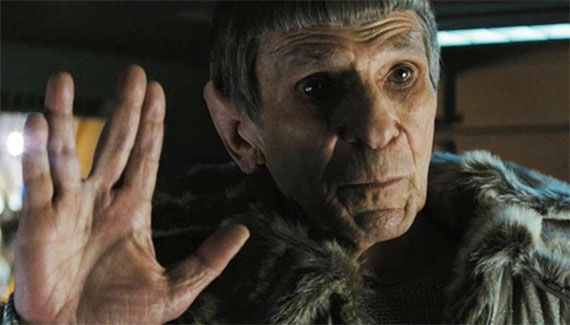
The Vulcans were inspired by a misunderstanding of Stoic philosophy,  I’ve read.  Their rigour in logic is commendable,  but we students of Stoicism can see clearly that something there is lacking.

Namely, an understanding of eupathos, or the healthy emotions, such as cheerfulness and well-wishing.  The person who lives and loves as a Stoic is not a robot, and is not torn between two natures as was Mr. Spock.

Looking at the passing of the actor who presented to many folks the archetypal representation of logic over passion, I find myself in a thoughtful mood.  Some of which is the ‘momento mori’ whenever such a figure passes, and also about impressions.  Both the fantasia of our school and the marks we leave on others as we pass.

The Japanese say that a person dies twice, once at physical death and once again as the last living person who remembers our name also dies.

We could stand by the walls of the temple and inform every passerby that it is *our* name inscribed there, for posterity to see.  But eventually,  this too will pass away.  The memories of Mr. Nemoy and Mr. Spock will probably have a bit more playing time than mine will.  But this, too, is okay.

Live enough, and be good while you may.

image

My personal Stoic logo

Standard

Stoicism is sharply lacking in easily identifiable iconography.  In some ways, this makes sense, since Epictetus’s injunction:

“Never call yourself a philosopher, nor talk a great deal among the unlearned about theorems, but act conformably to them.”

—Enchiridion, 46

However, keeping in mind that his audience was mostly aristocratic boys, boys whom he was trying to turn into men, the injunction is actually one against vanity and puffed-up-edness, not identifying with the School.  Philosophers of the day were known by their School, and it’s fine and appropriate that we could be, too.  The warning against vanity is still relevant, however.

We recognize the Star of David, the Crucifix, the Christian fish, the Islamic Star and Crescent.  Some will know the Nine Pointed Star of the Bahá’í Faith, the Hindu Wheel of Life, the Buddhist Heart, the Khanda of the Sikhs, etc.  Stoicism has no classic iconography, and it’s something which I think it is sort of lacking.  Some friends and I bandied about a few different designs, the one I started with was a simple Greek Lambda, for the Logos on a black circle.  It had a certain Spartan feel (intentional), but eventually I came up with a different one which I quite liked a bit better.

Stoic_Logo_lamp

(Copyright submitted 2015)

This is a representation of Epictetus’s Lamp.  It reminds us of the story of the stolen silver lamp, the price of being vicious (to be faithless and base), and to not be overly concerned by external things.  It is emblematical of the creative fire which is pneuma and the logos, the illumination of philosophy in the darkness, and the obligation to light the way for others so far as we are able, Fate permitting.  The lamp is circumscribed by a circle which has no beginning and no end; and which reminds us to keep our passions within due bounds, that the only good and evil are our own moral good and evil, and to delimit the present.  The colors of the logo are black and white, which signify the harsh division between virtue and vice, between making progress and vulgar living, between the dark and the light. Overall, I’m very pleased with the design.  I will use this as a personal icon for my Stoic practice, what it means to me, and the context in which my actions take place.  If other folks have made their own symbols, I would be interested in learning about them. A few others currently exist, for those who are interested: – The four-pointed flameNew Stoa and The College of Stoic Philosophers have several symbols as well.

Eudaimon New Year!

Standard

We often wish people a Happy New Year today, and I thought I would take a Stoic twist on that and offer you a Happy New Year. For those of us interested in philosophy, what constitutes a “happy new year” is a little bit different than the mundane way that that salutation is used by most people.

We know that eudaimonia is often translated as “happiness” in English but carries a deeper meaning for us. We seek to keep our internal states in a manner conformable to nature, to exercise our faculties excellently, and above all to give mindful attention to ourselves, our thoughts and judgements, our actions, and our social roles.

Even if the folks wishing you well don’t quite mean what we might by the greeting, use it as a reminder for living our philosophy each day.

So in the spirit of the new year, I wish you excellence, virtue, and happiness.

Eudaimon New Year!

On things indifferent, and TV.

Standard

Nuggets of wisdom from tv which the Stoics would likely approve of:

“It’s nicer, it’s easier… but it’s not *better*.”
— Надеҗда (Elizabeth Jennings, The Americans)

Taken out of context,  of course.  It can be taken as a reminder to focus not on the indifferent things, like comfort, but for we philosophers, those things which contribute to our eudaimon excellence.

It’s an interesting phemonon when one’s perspective starts to shift to filter things through a given lens.  A short bit of mental reprieve from the work week in the form of t.v. becomes a moral lesson in philosophy which surely the writers did not intend.

What bit of entertainment has lessons next week? Tune in, same Bat-time….

Stoic practice on autopilot.

Standard

So I found myself taking a Stoic approach today.  Every six months, my job hinges on a skills test.  I was getting a little stressed because I had some rust to shake off and the test was a new one.  But I had this thought, “I’m having anxious thoughts.  I’m entertaining feelings of stress. If I fail then I fail.  Nothing else.” 

And sort unbiddenly, I took a mental step back.  The thoughts and impressions were still there but on the outside and something I was “looking” at, and not something happening to me per se.

Anyway, it certainly felt like progress!