SLRP: LXXVIII. The Healing Power Of The Mind (Part 1: 1–6)

Standard

Seneca,

This letter of yours I have read rather recently.  A friend, Chris Fisher, recommended it to me while I was wallowing in self-pity… I mean, Stoically handling an affliction of gout.  I found the letter to be the most helpful thing I’ve read on the subject.  This first part we’re reading today is the introduction, but the reminders and advice are timeless.

As I understand it, you too, dear Seneca, were afflicted with gout, so I’m sure you’re aware of the struggles that can provide.  Before I had experience that level of pain, I hadn’t quite understood the gravity of the problem.  It’s one of those problems that we don’t generally have much sympathy for, give hardly any public notice to, and those who suffer secret their pain away quietly.

Your advice, and now almost-daily cherry juice, has been a great help.  I look forward to refreshing the rest of the letter.

Farewell.


Part of Michel Daw’s Reading Plan of Seneca’s Letters.

Camp Seneca: Day 3- On the Precepts

Standard

“Whatever principles you put before you, hold fast to them as laws which it will be impious to transgress.  But pay no heed to what any one says of you, for this is something beyond your own control.”

— Epictetus, Enchiridion 50.


Epictetus uses the word ‘precept’ a handful of times.  Six, in fact, in Long’s translation.  In the text, several different words are used in the instance in which Long places the word ‘precept.’  Sometime it’s only hinted at, or filled in like in this example.  Here, he says “[to Zeno is given] the office of teaching precepts.” Higginson uses “[the office] of dogmatical instruction.” What we’re looking at from Arrian is «ὡς Ζήνωνι τὴν διδακαλικὴν καὶ δογματικήν.»  In other instances, other words are used, and the common rendering is ‘precept.’  For this reason, I’ve chosen to use that word in the Rule of Musonius’s Seven Precepts.

So why do we need precepts?  Are we pretending we’re some sort of trappings of other religions?  Are we trying to fluff ourselves up, looking for a tradition which we lack?  All of these criticism might be leveled at the practicing προκόπτων. They should be answered, if possible, and if not set aside.  Look to Epictetus Enchiridion 50, above, and there is the justification for the Stoic, however.

“If you want to improve, be content to be thought foolish and stupid with regard to external things.”

— Epictetus, Enchiridion 13

If you want to improve… in the native Koine, that is εἰ προκόψαι θέλεις.
προκόψαι is the same root whence comes προκόπτων: προκόπτω. Greek often has interesting etymologies, προκόπτω breaks down to something like “to cut away in front” so: “to forward, to work, to make progress.” It can also be rendered as ‘to improve,’  ‘to profit,’ or ‘to advance.’

But, we can also look at it metaphorically, and see the ‘cutting away’ as progress.  Epictetus’ motto is ‘endure and renounce,’ and what is renouncing but a ‘cutting away’ of that which is not needed?  Via negativa, seeks to use the removal of what is not good or what is harmful, to leave what is good and helpful.  Often, you see this in Christian theological circles as a way to understand God by noting what God is not, but you can also find this idea in minimalist and simple living groups.  The second sort is more appropriate for our concerns, since the Stoic conception of divinity doesn’t really allow for “what isn’t god” beyond the vice of rational creatures.

The idea of progress as ‘cutting away’ is an interesting one for the nascent προκόπτων.  It give us a place to start.  The Sage would likely be able to experience all kinds of sense-impressions, thoughts, experiences, etc. without damaging her state of εὐδαιμονία, but we are not yet Sages.  The use of precepts to focus and regiment our training is good one, so long as the focus is on inculcating virtue and progress, and not the actions, inactions, and restrictions themselves.  That’s a narrow edge to walk.

Then, what we’re seeing here, if we want to do the actions of a προκόπτων, we must be prepared for these things. So let the criticisms come. If they’re valid (we may be wrong, we lack Stoic Sages to learn from directly), then accept the criticism and change. In this case, what matters the criticism if it helps us? If they’re not valid, then what does it matter?

We’re advised to formulate philosophical rules for ourselves and adhere to them firmly. As if they were divine laws. Keeping in mind, one of the heaviest charges which could be laid at the time was impiety: the charge which lead to Socrates’ death. And it’s this very charge we’re advised to use as a mental model for our own practice.

That’s not a small thing.

So it’s with this in mind that I’ve used Musonius as a basis for extracting practical precepts. We have in Epictetus the The Three Disciplines, and these are an excellent foundation for Stoic practice. But it’s not the beginning and end. Indeed, we’re advised to train the soul (which The Three Disciplines do well) and also the body and soul together, which the Rule of Musonius does.

Together, these ten points provide an excellent framework for building a modern Stoic practice. And it is with these that I’m training during the 28 day period of Camp Seneca.

I hope that clarifies and grounds the practice of having precepts, and maybe encourages you to build your own system, or to adopt this one.

See you tomorrow.


This is part of the 2016 iteration of Camp Seneca.

SLRP: LXXVII. On Taking One’s Own Life (Part 2: 12b – 20)

Standard

Seneca,

The closing of this letter is very a good piece of rhetoric.  I don’t mean to diminish it, I’m just noting it’s well composed, and the ferver is appropriate to the corrective nature it.

“Will you not borrow that [Spartan] boy’s courage, and say: “I am no slave!”? Unhappy fellow, you are a slave to men, you are a slave to your business, you are a slave to life. For life, if courage to die be lacking, is slavery.”

I do wonder if Epictetus was familiar at all with Seneca.  I always assumed that Epictetus’ calling his students “Slave!” whenever he was making a severe correction was due to his own training under Musonius, and also his life in slave condition before philosophy.  I wonder if he might have heard this story about the Spartan boy, too, though?

You are afraid of death; but how can you scorn it in the midst of a mushroom supper?

I’m personally not a fan of mushrooms, so that supper might be more conducive to me to dispise the perils of death… but in all seriousness, this harkens back to the ascetic training which we need to undergo (Link 1, Link 2, Link 3, Link 4).  We might talk a good game while living in a palace, but the possibility for self-deception is too high there.

You wish to live; well, do you know how lo live?

That’s the rub, isn’t it?  Mostly our worry over life and death is based in a fundamental fear.  The fear of the unknown.  The fear of missing out.  The fear of what’s to come.  The fear of nothing.  The one thought that recently has been mildly helpful in this regard comes from Marcus, and viewing what came before life as death as also.  Such a great span of time in this universe unravelled and unspun while we did not exist.  The same void, the same nothing that existed then might exist after.  That parallel is oddly comforting.  Also from Marcus, if there are gods, and if there is life after death, it will be towards the good.  And if there is not, that too is towards the good.  This is becoming a better cause of a surcease of those worries for me.

You are afraid to die. But come now: is this life of yours anything but death?

Hmm.  There’s an almost Buddhist feel to this question.  Life as dukkha.

That is the answer which should be given to men to whom death would come as a relief. “You are afraid to die; what! are you alive now?”

Farewell.


Part of Michel Daw’s Reading Plan of Seneca’s Letters.

Camp Seneca: Day 2- On Intoxicants

Standard

“[D]runkenness is nothing but a condition of insanity purposely assumed.

— Seneca, Moral Letters, LXXXIII. On drunkenness


One of the things that mark this period of training which is not covered by the Rule of Musonius, is the abstaining from intoxicants.  For me, this means alcohol and caffeine.  It’s a fortuitous twist of fate that I stopped taking caffeine about three weeks ago, so I’ll simply be maintaining that.

Musonius doesn’t cover the consumption of alcohol or other intoxicants, for that we look to Seneca.  In the above cited Letter, he makes reference to a syllogism (like many of the early Stoic ones, poorly formed) in which Zeno proclaims the good man will not be a drunkard (note:  this is an interpretation, he states the good man will not get drunk, but I find Seneca’s argument compelling here).  But, also, we have this:

When he was asked why he, though so austere, relaxed at a drinking-party, he said, “Lupins too are bitter, but when they are soaked become sweet.” Hecato too in the second book of his Anecdotes says that he indulged freely at such gatherings. And he would say, “Better to trip with the feet than with the tongue.”

— Diogenes Laertius, Lives of Eminent Philosophers 7.1. Zeno

So we have a bit of confusion on this issue.

Epictetus mentions drunkness on several occasions, mostly in relation to getting in debates with the drunk, or teaching the drunk.  We also have this:

“That a man is a drunkard who takes more than three glasses; and though he be not drunk, he hath exceeded moderation.”

— Epictetus, Fragments No.3 (Carter’s transl.)

So it’s fair to say that we don’t have an total prohibition on the consumption of wine/alcohol.  However, for this period of training, we’ll be abstaining entirely as a practice.  A Stoic need not be a teetotaler, but clearly moderation is key.  Three glasses of wine might be a pretty lenient view of moderation, come to think of it.  Maybe their glasses were smaller than ours?  It seems fair also to say that while a Stoic might consume alcohol, she won’t become habitually drunk.  I think this reasonably extends to other substances which may have varying degrees of legality in different jurisdictions.

So, questions of law and other things aside, for the purpose of this training, we will be abstaining entirely from intoxicants (whatever that may mean for you).  For me, that’s alcohol and caffeine.  If we find this to be difficult for ourselves, that should prompt an internal discussion about moderation, self-control, and unhealthy behaviors.

Looking forward to hearing back from you all on how the training is going.


This is part of the 2016 iteration of Camp Seneca.

SLRP: LXXVII. On Taking One’s Own Life (Part 1: 1 – 12a)

Standard

Seneca,

Today’s letter begins a discussion on suicide, a perennial topic in your Letters, dear Seneca.  I do rather like the description that ‘philosophy is training to die,’ and this fits well in that vein.  A few things stuck out at me.

“Do not torment yourself, my dear Marcellinus, as if the question which you are weighing were a matter of importance. It is not an important matter to live; all your slaves live, and so do all animals; but it is important to die honourably, sensibly, bravely. Reflect how long you have been doing the same thing: food, sleep, lust, – this is one’s daily round. The desire to die may be felt, not only by the sensible man or the brave or unhappy man, but even by the man who is merely surfeited.”

Especially this: Reflect how long you have been doing the same thing: food, sleep, lust, – this is one’s daily round.
It’s an interesting tact to take to help frame the question for Marcellinus.

No one is so ignorant as not to know that we must at some time die; nevertheless, when one draws near death, one turns to flight, trembles, and laments.

Well, many have this fret long before the time comes, but still, point well taken.

You were born to be subject to this law; this fate befell your father, your mother, your ancestors, all who came before you; and it will befall all who shall come after you. A sequence which cannot be broken or altered by any power binds all things together and draws all things in its course.

Farewell.


Part of Michel Daw’s Reading Plan of Seneca’s Letters.

SLRP: LXXVI. On Learning Wisdom In Old Age (Part 4: 26b–35)

Standard

Seneca,

I finished your last letter today, and it had several morsels on which I could chew.

“None of those whom you behold clad in purple is happy… None of those who have been raised to a loftier height by riches and honours is really great. Why then does he seem great to you? It is because you are measuring the pedestal along with the man.”

Despite the fact that we intellectually know what’s valuable, what’s admirable, what’s honorable, and what’s virtuous we make incorrect judgments.  We have decades of habit, in action, thought, and intention to overcome.  It requires a constant reminder and training to undo what we’ve done thoughtlessly.  Whether by accident or intentional volition, we train ourselves and our judgments.  It’s far better to train intentionally that thoughtlessly.

“Today it is you who threaten me with these terrors; but I have always threatened myself with them, and have prepared myself as a man to meet man’s destiny.”

Our training in part inoculates us against the loss of apparent-goods.  When we know that we can do without the varied and multiple indifferents in life, we’re better able to choose virtue.  Choosing virtue when it’s easy is one thing, but when it’s hard, when it puts us at risk, when it goes against our lusting-desires… that’s another thing entirely.

‘We sometimes hear the inexperienced say: “I knew that this was in store for me.” But the wise man knows that all things are in store for him. Whatever happens, he says: “I knew it.” ‘

Farewell.


Part of Michel Daw’s Reading Plan of Seneca’s Letters.

Camp Seneca: Day 1- On Food

Standard

Obligatory Disclaimer:  This is not medical, nutritional, or dietary advice.  Seek professional opinions for these things.  

Don’t get hurt, that would make both us sad, Stoic or not.


So, at first one might ask why someone would undertake such a project, the Stoics weren’t ascetics, right?  I think I’ve rehashed that question often enough (Link 1, Link 2, Link 3, Link 4), but it’s still commonly heard, esp. on the internet.

“Therefore upon the learning of the lessons appropriate to each and every excellence, practical training must follow invariably, if indeed from the lessons we have learned we hope to derive any benefit.”

— Musonius Rufus, Lecture VI: ON TRAINING.


That seems pretty straightforward to me, and coupled with:

“And since habit has established a strong predominance, because we have acquired the habit of turning our will to get and our will to avoid only to what lies outside our control, we must set a contrary habit to counteract the former, and where impressions are most likely to go wrong there employ training as an antidote.”

— Epictetus, Discourses III.12:  ON TRAINING


And lest we forget our training period’s namesake:

“When shall you put it all into practice? For it is not sufficient merely to commit these things to memory, like other matters; they must be practically tested. He is not happy who only knows them, but he who does them.”

— Seneca, Moral Letters LXXV. ON THE DISEASES OF THE SOUL.


So, that issue (I hope) being resolved, let’s look at the most startling of the Camp Seneca practices for this period.  Restricting food to one meal a day.  Why might we do that, and more importantly, why is this a Stoic practice at all?  For this, we’re going to turn to Musonius.

“First of all,
      (1) the man who eats more than he ought does wrong, and
      (2) the man who eats in undue haste no less, and also
      (3) the man who wallows in the pickles and sauces, and
      (4) the man who prefers the sweeter foods to the more healthful ones, and
      (5) the man who does not serve food of the same kind or amount to his guests as to himself.
 There is still another wrong in connection with eating,
      (6) when we indulge in it at an unseasonable time, and although there is something else we ought to do, we put it aside in order to eat.”

— Musonius Rufus, Lecture Lecture XVIIIB ON FOOD


As Musonius (via his student Lucius) notes that unlike some rarer circumstance, we are faced with eating daily, and sometimes twice a day.  Maybe Musonius is a bit more optimistic about whence we’re starting, because now most westerners eat three meals daily, and there is often snacking between.  Some health folks suggest six smaller meals throughout the day (although this is challenged in some health/fitness quarters).  Regardless of where we fall in the “three to six range,” it is fair to say this is a challenge we are faced with often.

In the second portion of the lecture on food, Musonius notes a variety of places one can go wrong during a meal.  I’ve broken them down and numbered them for ease.  He notes six opportunities for failure in self-control.  It is my experience that number (5) is practically a non-issue, the politeness culture and sense of hospitality that is common in American and European communities(I’m sure others as well, but this is the extent of my experience) renders it moot.  Guests are usually given the best of what’s available, and seconds or even thirds are often foisted on them with or without consent.  God help the person who doesn’t want food while visiting a grandma, even is she’s not your grandma!

But, the others are ripe for our inspection.

Restricting ourselves (for a time) to one meal a day will cause a shift of attention.  Many meals are taken thoughtlessly.  The working lunch, the sandwich in the car on the way to an event, “what are we doing for dinner tonight, honey?”  When we pare down the opportunities, we will necessarily be a bit more mindful in our choices with what remains.  Additionally, this should help solve (1) and (6).

However, my suspicion is that items (2), (3), and (4) may actually become a greater issue on which we have to focus.  This is not problematic, though.  Now, you’ll notice, we’ve cut down our problem areas in regards to food by half.  We only have three things to which we must really pay attention.

As a youngster, I spent some time in the summer with a religious community,  a Benedictine monastery in the Illinois Valley.  Meal time is very regulated (unsurprisingly).  Meals are taken in silence, and there are several readings which are read aloud.  If you look at other traditions across the globe, mealtime is given an equally weighty treatment.  An effect of this sort of formalism is a necessary slowing down of the drives and desires in regards to food.  In a quiet, meditative environment we are able to focus more on what we’re doing.

This takes care of items (2) and (3).

Of course, in an intentional community, with community meal preparation, (4) is often taken care of by someone else.  We do not have this luxury, however.  We are required to exercise an extra portion of σωφροσύνη.  In item (4) we may be especially challenged.  There are a couple  of modes from which we can choose.

Any choice we make here should be in consult with medical personnel, and be tailored to our health needs.  Individual responsibility is required.

The first, being that in having a fairly severe caloric deficit, we might choose foods which are calorically denser.  This is an added difficulty, for one of the Musonian precepts is to avoid animal-flesh as food.  This is common to see in Buddhists monks (most of whom outside of China, Japan, and Korea) are not vegetarian; and I’m told they can put away a goodly amount of food in their one meal.

The second option, if health allows for it, is to simply go without.  What we are doing is a form of intermittent fasting, and there a wide variety of programs.  Some who will fast for 16 hours, and feed for 8.  Or 20 and 4, or what have you.  Restricting ourselves to one meal is on the end of the IF spectrum, where effectively we’ll be fasting for 22 or 23 hours a day, and adding the fact that some will be abstaining from meat, it’s not going to be an easy thing.  To date, I think the longest I’ve intentionally gone without food (while not sick) is something like 36 hours.  I do expect this to be a challenge for me, as I have a lot of work to do on the ‘moderation with food’ issue, as my belt size will attest.

It is my hope that this exercise is a good context for which to have a greater experiential understanding of self-control.  It may also contain opportunities for courage and fortitude.  It is of the utmost importance that we remember all of our training must be motivated towards virtue:  or simply put, we’re in the wrong.

So, if you’re adopting my program for Camp Seneca, let me know in the comments.  If you using some other regimen let me know also in the comments.


This is part of the 2016 iteration of Camp Seneca.
The Nature of Good and Evil

Standard

“The battleline between good and evil runs through the heart of every man.”

— Aleksandr Solzhenitsyn


When talking with atheists and anti-theists, the problem of evil in the world is often brought up.  The common argument is that if evil exists, then God cannot be omniscient, omnipotent, omnibenevolent, omnitemporal, and omnipresent (premise).  Evil does exist, therefore God is not these things (conclusion).

This argument has several issues for Stoics, suppressed premises, which are all too common, aside (such as “a God that exists must be the “5 Omnis” type).  The God of the Stoics is not a personality moving about the affairs of humans like chess pieces on a board.  God is the universe itself, the ordering principle, and generative principle found therein.  The above type of argument of against Stoic theology is wholly out of context.

The theodicy of other faiths, traditions, creeds, whathaveyou are not a one to one compatible thing with Stoicism.  In part, because the isssues they attempt to resolve are not all present in Stoic theology.

The Stoic position on Good and Evil are personal, internal, and moral.  There is no great evil force wrecking havoc in an otherwise peaceful world.  What is evil, is simply a shadow cast by obstructing the light, not a force of its own.world

Good and evil, per Epictetus, lie only in the will, (Disc. I.25).

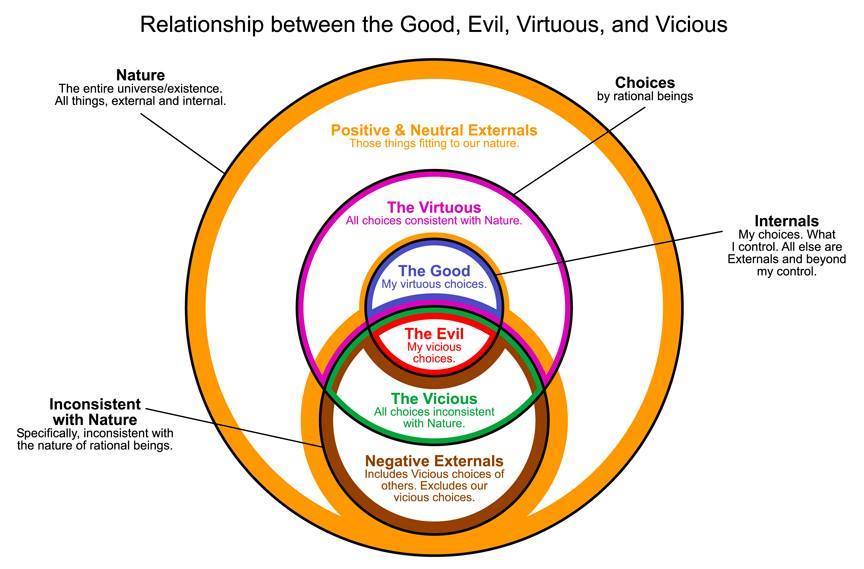
I have no idea where I found this graphic, but it’s a good distillation of the Stoic moral landscape.

The smallest circle in the center which is bifurcated contains “good and evil.”  This circle is My Possible Choices.  Outside of that we can talk about virtuous, vicious, and indifferent choices:  but Good and Evil are personal.  That’s an important distinction to be made in contrast to the idea of “cosmic evil.”  What’s in line with nature is either virtuous or indifferent, what’s contra-nature is vicious or indifferent.  Only insofar as ‘i’ am concerned, is the idea of good and evil relevant.

The Stoics do have  a sort of cosmic optimism, in that the universe is working to some beneficial end, on the cosmic scale.  What man deems a tragedy might not be so on the scale of the universe.  In just 100 years how many on earth will remember our bad days, our losses?  Maybe none.

The universe is an awful big place, scaling that up… it looks bad for human concerns as a metric for universal operation.

Stoicism and ἀκρασία

Standard

ἀκρασία (akrasia) means “to be without might,” and it’s often used in the case of a lack of moral will.  Other Hellenic schools said we might know what the appropriate course or action might be, but through weakness of will, we fail.  This failing is caused, they say, by ἀκρασία.

socrates_lawThe Stoics, however, deny that this occurs.  Instead they hearken back to Socrates who said that knowledge of virtue was sufficient.  If we are doing something else then we don’t really know.  If we truly believed that virtue were the highest good, then some temporary pleasure or social capital would not keep us from it.  Socrates is reported to have denied ἀκρασία. in Plato’s dialogue Protagoras.

Since we clearly often fail, we must not really get it.  We don’t know.

The Stoics denied ἀκρασία, they denied that you could know and not do.  The Stoics saw themselves, as most Hellenic schools, as the ideological inheritors of Socrates’ teachings, so on the face it’s not a surprise they too would deny the akratic position.  Indeed, there are other reasons as well.  The Stoics claimed that man is so constituted that he might become a Sage, even if he does in fact falls short of that mark.  ἀκρασία hold a seed of poison which makes that an untenable proposition.

What we have, goes back to the core question of good and evil.  In the wake of how thoroughly the Abrahamic faiths have shapped the cultural waters, the nature of good and evil is an important question to re-evaluate.  zoaAs early Christianity marched westward, it picked up bits and pieces of the native cultures with which it came in contact.  This was, objectively, and excellent method of proselytizing.   In the Old Testament, you’ll find mention an adversary of God, but the figure of Satan as we know it today is not to be found.  The idea of an ultimate evil to parallel the ultimate good is found in Zoroastrianism, and one of things it contributed to Christian thought.

The Stoic position is quite different.  Evil isn’t a “force” in the universe.  Instead, it is simply the shadow cast by interfering with the light.  The nature of rational creatures and free will is such that we miss the mark on occasion.

Epictetus reminds us of this in Enchiridion 27:

“As a mark is not set up for the purpose of missing the aim, so neither does the nature of evil exist in the world.”

The question of Good and Evil in Stoicism is large enough to merit it’s own discussion.   So for the moment if we allow that the common western (read: Abrahamic) interpretation is not the only one (and maybe not the correct one), let’s take it for granted the Stoics do not assent to a force of evil per se operating in the cosmos.  We’ll look at Stoic Good and Evil in a latter post.

ἀκρασία allows for a fundamental weakness in humans.  An Original Sin of sorts which despite knowing virtue (really knowing it) we choose something else.  This is entire in contrast to the Socratic (in this case optimistic) position that virtue is a type of knowledge, that it can be taught, and when it is understand it is unassailable.

SLRP: LXXVI. On Learning Wisdom In Old Age (Part 3: 18 – 26a)

Standard

Seneca,

The closing of you last letter echoed thoughts of my own.  The diminution of virtue via accepting external goods as been something I’ve warned modern Stoics against for some time.

“If, however, you accept the view that there is anything good besides that which is honourable, all the virtues will suffer. For it will never be possible for any virtue to be won and held, if there is anything outside itself which virtue must take into consideration.”

As far as I know, this focus on what’s honorable is something particular to you letters, dear Seneca.  It seems a god metric.  It easily illuminates the correct path in a situation.  What would an honorable person do? Seem to me to be an easier question to answer quickly than What would a Sage do?

“If anything except the honourable is good, we shall be hounded by greed for life, and by greed for the things which provide life with its furnishings, – an intolerable state, subject to no limits, unstable.”

The above passage seems like curse.

“[W]hithersoever I am led and summoned by honour, I will go.”

Thank you for the letter.

Farewell.


Part of Michel Daw’s Reading Plan of Seneca’s Letters.