SLRP: XLI. On The God Within Us

Standard

Seneca,

“If you see a man who is unterrified in the midst of dangers, untouched by desires, happy in adversity, peaceful amid the storm, who looks down upon men from a higher plane, and views the gods on a footing of equality, will not a feeling of reverence for him steal over you, will you not say: “This quality is too great and too lofty to be regarded as resembling this petty body in which it dwells? A divine power has descended upon that man.” “

The western conception, I think, has been muddled by a couple of millenia of Abrahamic context.  It’s hard to imagine this divine, holy man you describe and not think of him as a saint or prophet of some sort.  Maybe saint isn’t too far off, I don’t know.  The religious nature of the Stoics is on the face apparent.  Yet, there’s a lot to un-learn to grok it as it was intended, I suspect.

“The lion with gilded mane, in process of being trained and forced by weariness to endure the decoration, is sent into the arena in quite a different way from the wild lion whose spirit is unbroken; the latter, indeed, bold in his attack, as nature wished him to be, impressive because of his wild appearance, – and it is his glory that none can look upon him without fear, – is favoured in preference to the other lion, that languid and gilded brute.”

This idea that the lion, or man, is made great by what is his own and not by any sort of additition or ornamentation is a good reminder.  It’s very easy to see wealth, power, influence, property, social rank, etc. and use those as our common measure.  But as you say, Fate can sweep these away without so ever much as a ‘by your leave.’  Indeed, he gets to keep one thing and one thing only.  And this, is even on loan for a short time.  His character.

Farewell.


Part of Michel Daw’s Reading Plan of Seneca’s Letters.

CERP: Day 8 – To the Wealthy, Diogenes, Mnasos, and Lysis

Standard

VII. To the Wealthy (p. 59)
Here, Pseudo-Crates pulls no punches.  He’s attacking the false and vainglorious style of the wealthy and powerful.  Despite, it seems, their outward appearance of tunics, lupine beans, etc., it seems that they’ve learned nothing of the Cynic’s life.  It’s fashion, then.

IIRC, we read that Roman Cynicism was generally made of weaker stuff than the Hellenic sort was.  This letters seems more firmly Cynic, especially in the ‘gadfly’ or social critic role that Diogenes perfected.

VIII. To Diogenes (p. 59)
Pseudo-Crates here is lamenting, I suppose, that he has become somewhat famous… maybe infamous.  Certainly Diogenes was both.  This feels a touch disingenuous.  A quiet life for a Cynic would be entirely possible at a retreat, or community.  They could retire to some mountainplace, and be rid the cities.  They could renounce their exhortations, condemnations, and social critique.  Doing this would render them unnoticeable.

Yet, is it not the part of the Cynic to teach by example?

IX. To Mnasos (p. 61)
Ah!  A firmly Roman sales pitch, then!  As the rougher edges of Stoicism were dulled to be more palatable for Roman decorum, apparently so too does Cynicism need some polishing.

X. To Lysis (p. 61)
I had to do some looking up.  I had assumed from the context that plectrum must have been a sort of cup, but it appears to be more akin to a guitar pick.  The word “plectrum” comes from Latin plectrum, itself derived from Greek πλῆκτρον (plēktron), “anything to strike with, an instrument for striking the lyre, a spear point”.

So… what in hell does this mean?  I thought maybe it’s meant like being under a whip, but I’m not sure.

Additionally, the plea to piety and the gifts of God do not have a Cynic feel to me, but rather a Stoic one.  The claim of “nothing indecent or bad” that might happen does not seem to mesh with Cynic shamelessness (Gr:  αναίδεια).  The bit on pleasure seems to maybe fit with the “opportunistic and natural” hedonism of the Cynics, but clashes with the water-drinkers and Diogenes tossing out a sweetroll from his bowl.

The Epistles thus are challenging, and it’s an interesting experience to see what changes are made and where.


This is part of the Cynic Epistles Reading Plan.

SLRP: XL. ON The Proper Style For A Philosopher’s Discourse

Standard

Seneca,

It’s hard to believe that we’re almost through with ten weeks and forty letters.  I guess that puts us almost a fifth of the way through.  Tempus fugit, eh?

“Besides, this sort of speech contains a great deal of sheer emptiness; it has more sound than power. My terrors should be quieted, my irritations soothed, my illusions shaken off, my indulgences checked, my greed rebuked. And which of these cures can be brought about in a hurry? What physician can heal his patient on a flying visit?”

Stoic rhetoric is an interesting critter.  By all accounts, the writings of Chrysippus were more akin to technical manuals for an engine, than the prose we’re used to consuming today.  It was the writings of Hierocles, Cicero, and Seneca which brought the highly technical language down to a more common plane.

It’s sometimes hard to bridge the gap of needing to be incredibly specific with the meaning of words as a philosopher must, but also not to lose the ability to reach one’s audience.  I’ve written before about the steep learn curve of acquiring Stoic jargon, and mitigating that with the sorts of moral exhortations which the Stoics were known for.

In this project, and most of my others, I usually try to adopt a more conversational tone; something easy to read, and pleasant to think about.  There’s a good bit of highly technical philosophical treatises out there on Stoicism, and there’s a good bit of popular fluffery as well.  The lack, it seems to me, lies in handling the actually philosophy in a less academic way.

Even though I had not heard your advice, Seneca, until today.  I think I’ve been following it well.  Thank you for the letter.

Farewell.


Part of Michel Daw’s Reading Plan of Seneca’s Letters.

CERP: Day 7 – To To Hipparchia, his students, Hermascus

Standard

I. To Hipparchia (p. 55)
This is a strange piece, and short.  Shouldn’t it rather be, “come and see that not even this is a terrifying circumstance to one devoted to Philosophy?”

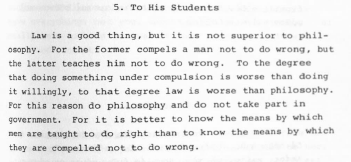
II. To His Students (p. 55)
Pseudo-Crates is talking to his students here, and he’s instructing them in the proper way for a Cynic to beg food and the other necessities of life.  Mendicant religious folks dot the history of the West, often as a footnote.  The role seems to be more common in the East than it is here.  Crates injunctions are particularly strict.

He tells his students not to accept the necesseties from just anyone, but only from other Philosophers, the virtuous.  This is because ‘virtue must not be supported by vice.’

How many Cynics starved to death, were that the case?  It is true, that the Cynics suspect virtue and even Sagehood is quite a bit more easily achieved than the Stoics think it is.  Still… the virtuous seems pretty thin on the ground in these parts.

III. To the Same (p. 55)
Pseudo-Crates seems to present a dichotomy between the mind/soul and body.  It’s unclear to me whether generally the Hellenes believed that there was a strict dichotomy, or whether they had a more holistic understanding of the self.  I’ve seen both positions claimed.

We credit Decartes with “mind/body dualism,” often called Cartesian dualism.  But as I am learning, despite the fact that more modern and European philosophers and theologians are credited with certain discoveries (Origen, Anslem, Acquinas, Decartes, and more all come to mind), they are often just rehashing the writings of the Greeks of this period.

IV.  To Hermascus (p. 57)
Say ‘toil’ one more time.
I suppose the point here is that πόνος is not to be feared or avoided.  This seems firmly in the Cynic camp, although I would expect rather a  φιλόπονος, “love of toil.”

V.  To His Students (p. 57)
Can it be more relevant?

5

VI. To the Same (p. 57)
The progress of the Cynic is much easier to grasp than the progress of the Stoic.  While I beat the drum of Stoic praxis nearly incessantly, one can’t half-ass the labors of the Cynic.  The Cynic hypocrite is immediately apparent.  One has to put up or shut up, there’s no middle of the road.

The Stoic on the other hand, more easily conceals the intent and inner states which put the lie to the philosophy.  It’s not to say that the former is greater than the latter per se, but merely that the circumstance for self-disillusionment is markedly lessened.


This is part of the Cynic Epistles Reading Plan.

SLRP: XXXIX. On Noble Aspirations

Standard

Seneca,

Your letter today touches on a point I have been thinking about lately, as well as discussing with others.  There is a trend in modern Stoicism to boil down the philosophy to set of points or “lifehacks.”  These are the tricks, which when improperly applied, are said to bring about worldly success, and every other manner of indifferent.  Yet, that’s being touted as the goal!

There are a number of “pop Stoicism” books, some are distillations of Stoic doctrine, but necessarily superficial.  Others are theurapeutic, and still more are of the “lifehack” variety.

The society today is lazy and impatient.  It demands the quick fix, material success, worldly acclaim, and every other manner of luxury.  Worse yet, it demands it immediately, without work, without cost.  It believe itself to be truly entitled to everything.

They only things it ignores are character, excellence, wisdom.

When you see these see mentioned, it’s couched in a sort of New Age ‘woo,’ which plays on all of the flaws above.  Books like “The Secret,” and variants of new-age hippy philosophy.

They all lack depth.

The idea that one might study and work for the betterment of one’s own soul is something which, if found at all, would be relegated to the church house.  And when found there, it’s only of a very particular sort.

No, the claims of philosophy are left dusty on the shelf, a mere curiosity to a handful of academics and intellectual masturbators.  Where are those living “philosophy as a way of life?”

Farewell.


Part of Michel Daw’s Reading Plan of Seneca’s Letters.

International Women’s Day and Musonius Rufus

Standard

women_greek


Today is International Women’s Day, and I thought I would take the time to discuss Musonius Rufus, the role of women in Stoic Philosophy, and the examples we have of them.  Many ancient and modern philosophers discount and discredit the role of women in intellectual pursuits.  For whatever reason, it was often assumed they were less suited to the task, or simply by nature interested in other things.

Musonius, however, takes a different tact.  In Lecture III, he notes that for all of the operative issues regarding philosophy and virtue, men and women have the same foundation on which to build.  For Musonius, both men and women are given by God the gifts of reason.  Their senses, bodies, and minds all work in a similar fashion for everything on which philosophy hinges.  More importantly, both men and women have predisposition for goodness, for virtue.

Keeping in mind, Musonius is speaking in the first century CE, and his arguments are couched in the language and thinking of that time.  He is trying to convince his mostly male audience that the women in their lives would benefit from studying philosophy, for growing in virtue.  He does this by playing to their own biases.

A virtuous person (in this case a female person), would be better suited to all roles and tasks a human being can do.  In the same way that it would make one a better husband, it would make one a better wife.  As it would make better sons, it makes better daughters.  In what conditions would justice, fortitude, wisdom, or courage be a hindrance to a woman?  None!  It’s surely just as valuable in her as anyone else.

Musonius takes this a step further in Lecture IV.  Not only are women capable of virtue, but they should be trained (read: educated) in it.  Not only should they receive education, but the very same education as males.  There is no good reason for Musonius that we should educate boys and girls differently.  This is a fairly radical proposition for the 1st century CE.  The equal access to education was not even a common western value 100 years ago; yet nearly 2000 years ago, Musonius argued for just that very point.  Quite forward thinking in this regard.

His opinions differ, however, when we get to a common crux of human relations:  sexuality.  In Lecture XII, Musonius argues for what seems a very socially conservative view of human sexuality.  Specifically, that it’s appropriate only within marriage, and only for the purposes of procreation.  The reason I mention this, is that he unequivocally states that the prescription is the same for men and women.  While the standard is very strict, it is at least fair.

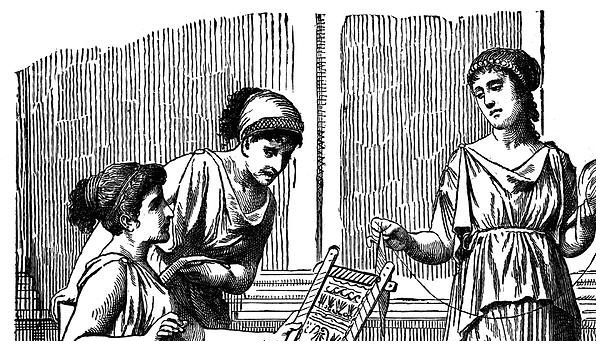
One of the issues which bears pointing out, which many moderns may take umbrage with, is that Musonius argues from a position in which the souls of men and women are the same, but that does not mean that men and women are in all ways equal.  He does note a reasonable division of labor and social roles, however.  One of his interlocutors asks about “women’s work” and how that gets addressed in Lecture IV, lines 16-21.  Musonius argues that when such things are conformable to the general physical nature, it’s appropriate.  The general trend of men’s and women’s build might predispose them to one type of work over another.  For example, he says it’s reasonable that men would do more hard labor outside, and women might work indoors.  In this, the issue is specifically the spinning of yarn.  He does not, however, state this does means that one shouldn’t learn or be able to do the work of the other.

In fact, in specific circumstance, the opposite roles may be more reasonable.  A man might work inside due to his constitution or other mitigating circumstance, and the woman outside and more physically.  Either way, he would not compel one or the other in a specific way.  While general trends exist, the specific applications vary.  A quite liberal approach, I think (not in the political sense of Anglo-American politics, mind you).

Within Stoicism, we either look towards the latter part of the era to the daughter of Cato, or back to the Cynics for specific examples of female philosophers which have come down to us through history.  The first and earlier Hipparchia, the wife of Crates the Cynic and philosopher in her own right, and the second and latter Portia Catonis.

Hipparchia left a life of comfortable wealth, and rigid social mores to marry Crates, the homeless and shameless Cynic.  She discarded everything her society valued and instead sought virtue and freedom, albeit in very unconventional ways.

“I, Hipparchia chose not the tasks of the rich-robed woman, but the manly life of the Cynic. Brooch-clasped tunics, well-clad shoes, and perfumed headscarves pleased me not; But with wallet and fellow staff, together with coarse cloak and bed of hard ground, My name shall be greater than Atalanta: for wisdom is better than mountain running.”

— Hipparchia, Greek Anthology, 7.413

I could not find the original Greek version of the Anthology online to check this, however it is worth noting that the word which is often translated as ‘courage’ can also be translated as “manliness,’ ἀνδρεία (andreia).  This is pure speculation, but I would not be surprised to find that it is this word which is in the original text of the above quote.

Portia may have even been involved in the assassination plot of Caesar, and was at least aware of it.  The recordings of her show a women of firm character, strong beliefs, and the courage of her convictions, even unto her own death by suicide.

“You, my husband, though you trusted my spirit that it would not betray you, nevertheless were distrustful of my body, and your feeling was but human. But I found that my body also can keep silence… Therefore fear not, but tell me all you are concealing from me, for neither fire, nor lashes, nor goads will force me to divulge a word; I was not born to that extent a woman. Hence, if you still distrust me, it is better for me to die than to live; otherwise let no one think me longer the daughter of Cato or your wife.”

— Portia Catonis, Cassius Dio, 44.13.4

The universality of Stoic philosophy is one of its highest selling points, I think.  It calls to the egalitarian nature in the modern westerner, and shows that it has maintained that perspective for a very long time.  Whether it’s simply the vicissitudes of history, or some other reason such as explicit bias, we have few examples of female philosophers and particularly of female Stoics from the classical period.  Nevertheless, the message of Musonius is a hopeful one, offering the fruits of philosophical practice to all rational creatures who embrace her.
CERP: Day 6 – Introduction to The Epistles of Crates (p. 10)

Standard

Introduction to The Epistles of Crates (p. 10)

We’re jumping backwards in the book today, to read the part of the introduction for Pseudo-Crates letters.  The introduction provides a useful context and information for the following Epistles.

Firstly, that anywhere between two and six authors may have contributed, and similar to the actual chronology of the men’s lives, the Crates letters were written after Diogenes’.  Indeed, the introduction suggests that the authors of the Crates letters was familiar with, and even used the Diogenes letters.

This is a neat bit of historical analysis, and I’m looking forward to the letters.  The introduction does carry a caveat, that at least one of the letters has the stamp of the Stoa on it rather than that of Pera.


This is part of the Cynic Epistles Reading Plan.

SLRP: XXXVII. On Allegiance To Virtue and XXXVIII.On Quiet Conversation

Standard

Seneca,

Maybe it’s just “blue car syndrome,” but I’ve come across the word ἀμαθία, (ignorance, stupidity, or folly, the antithesis of σοφία, “wisdom”) four or five times in the past month.  It’s not a word I’d noticed much before, nor paid overly much attention to.

The idea that philosophy is the instrument of fortitude, protection, and freedom is interesting.  Why do you have to sell Lucillius so hard on this?  Is he not already committed?  Maybe the issue is that the fruits of this particular tree are long in ripening?

Your concerns about conversation are also of particular interest to me lately.  Most of Stoic philosophy is happening online these days, and almost all of it through text.  This amounts to the ‘harangues’ which you’ve mentioned.  Shouted at the top of one’s lungs, as it were.

This is not good for sustained development of the school.  We need to get real humans in real life, face to face.  We need Stoic communities.

Farewell.


Part of Michel Daw’s Reading Plan of Seneca’s Letters.