Hey, all!
Ask a Stoic is going well, and I’d like to announce a new mini-series within it where I go over some of the Stoic Vocabulary which is often a hurdle for new students.
Hey, all!
Ask a Stoic is going well, and I’d like to announce a new mini-series within it where I go over some of the Stoic Vocabulary which is often a hurdle for new students.
I have posted ten videos at Ask a Stoic. You can view them  in a playlist, or individually.
Please remember, that you can submit your own questions either as a comment on a video, or at the main Ask a Stoic sub-page through the form. Thanks!
Playlist:
Individual videos:
The first episode of The Cynic Tubcast is up, of which I am a co-host. If you’re interested in the history of Stoicism, and the school which gave it birth, swing on by! Zeno spent some twenty years, if I recall correctly, as a student of Crates in the Cynic school before going on to found the Stoa. Looking back to the Cynics for ideas to inform my Stoic practice is what brought me to have an appreciation for those philosophers like Diogenes, Crates, and Hipparchia.
I hope you enjoy the episode! It’s been quite the adventure getting it out there!
There’s a crucial difference in appreciating something, and in being so swept up so you lose control of your faculties.
Can a Stoic sing, dance, make art, and fight? Yes, of course. But he or she should do so fully in control of their inner state. The Stoic should be attentive, and mindful, in the manner of prosoche.
Like Epictetus says, if someone gave away your body you would be upset, but every person with an evil word takes our minds and we are not upset.
If we practice against these types of losses, shouldn’t we also be concerned with “good” ones?
Remember the Spartan boy to whom pain seemed more of a good that pleasure, since pleasure can weaken us and our resolve and pain fortifies it.
We are talking about a fundamental shift in viewing the world from the way most everyone else does. Oftentimes the concept of ‘preferred indifferents’ is skewed for new students. They think, wrongly, that since it doesn’t have an apparent moral quality, that they should indulge in all manner of vices.
But this is wrong thinking. Every time we indulge, we train ourselves in indulgence. Our likes very easily become passions. Just as we do in times of trial, saying “this is indifferent” we must also do in times of pleasure. But how much harder is that!
I see a lot of hedonist Stoics (can such a thing truly be?) on the internet. I’d urge you to look at those things which so easily and thoughtlessly enslave the will. Are there contributing to your good? If not…. they’re not a preferred indifferent.
So, one of the things I’ve been thinking about quite a bit is  the philosopher’s cloak. This will be the topic of one of the Episodes of the nascent TubCast, and I’m still working through my thoughts and ideas on the issue. The philosopher’s cloak is the simplest of garments, really. The basest protection from the elements, the minimum required for modesty, and requiring very little care and very little to make.
It calls to mind the Spartans, classic philosophers such as Socrates and Diogenes of Sinope, and other fundamental figures in the intellectual history the west.
The philosopher’s cloak has become a symbol of wisdom so powerful in western culture that we apply it to folks who really have no right to it. 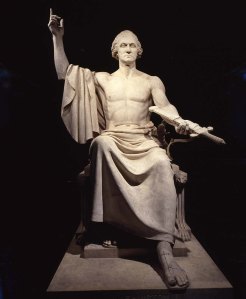 Take this photo of a statue of the first US President George Washington (right). Here, a man of the late 1700s is depicted in the classical garments which are, truly, as far removed from his period as they are from our own. Yet, to drape Washington in the mystique, the tradition, and the heritage of the west, of democratic republicanism, one has but to drape him also in the philosopher’s cloak: and that heritage becomes self-evident to all in the west.
The pallium or tribōn was ubiquitous for Hellenic philosophers, and it had fallen out of fashion in favor of the chitton, and other garments. (Sidebar: Musonius mentions the chitton, sort of an extra-long, tunic-like shirt in his lectures; stating folks should wear one, not two. And better yet, a philosopher’s cloak). As it had fallen out of fashion amongst the laity, it stands to reason that we can say it made the philosopher stand out. Diogenes referred to his cloak, small bag, and staff as his uniform, and I think for practicing philosophers that’s an appropriate model of thought for it.
This got me thinking on the ideas of a ‘philosophical uniform,’ and what that means for modern practitioners. Anciently, the cloak can had several functions, firstly that it meets the barest natural needs of the human creature. Secondly, it calls out clearly to all who would see it that “this person lives differently.” It might also have other messages attached to it that a related: this person is wise, this person is studying virtue, this person is religious or holy, etc. But, It is also a message to one’s own self: “I chose to discard fashion.” “I’m focused on other things.” “I am intentionally living.” “When I put this on, and take this off, I will do so with virtue in mind.” Of course, there is the ever-present risk of vanity in such things as well: ‘I want to be seen in a certain way.’ ‘I want a certain kind of attention.’ ‘I want to look special.’
If we look at philosophical and religious clothing the world over, generally it causes a person to stand out, but I suspect that in the times these traditions were established, that may not have been the prominent reason. Instead, rather, it generally hearkens back to an early time viewed as closer to nature, closer to “real living,” and closer to our telos of practice.
From the prayer shawls of the Jews, to the robes of a Buddhist monk, to the Roman collar of the Catholic priest: all of these set one apart, and say, “I’m doing something important.” “I’m doing something different.” “I’m living intentionally.”




Stoicism has had a hiatus of approximately 1500 years. The traditions which are now accepted as common place for other creeds, schools, and faiths are notably absent for we prokoptontes. That puts us in a tough position. We necessarily must interpret, create, and change things which otherwise might have already been handed down. In the eyes of many, that weakens our claims to legitimacy. However, we who feel called should not be turned aside by such impressions, but we should take to heart the warning that such things can also carry.
No Stoic that I know of believes unequivocally that he or she is doing things in exactly the way that Epictetus, Marcus, or Musonius did, or suggested. Such a claim is on the face, silly. We should, however, be wary of interpretations that change core doctrines to the point that we should call it something else. There is a hedonic element in much of the conversation we see on online Stoic communities, which is a serious departure from the tradition. We do have a duty to the tradition to enrich it, while maintaining its core. Drifting too far away might be the right path for some, Stoicism has never claimed to be the one, only, and true path anywhere, but we should have the integrity to call that, then, something else if that’s what we’re doing. But I digress…
Should we, if we adopt a philosophical uniform, consider whether or not we would stand out? Or should we instead focus on blending in. Should we choose something which sends a message to us, every day, while dressing and undressing “I choose to live my life differently than most,” and do so in such a way that the passerby is none the wiser?
Is it vanity for us, absent the 2,000 year tradition, to stand out? Should we be like Diogenes, calling out to the passerby to change his ways by our mere presence? Or should we quietly work to show how our lives have changed, without ostentation or performance?
What say you?
Should a modern Stoic philosophical uniform stand out, or blend in?
21-Aug-2015: Please see the continuation of this train of thought: The Philosopher’s Cloak (MK-II).
Mark, Greg, and Matt were kind enough to invite me onto the Painted Porch to guest host. This episode has an interview with Marije, who is a very talented artists and Stoic philosopher.
We got a little long-winded on some side-topics, and Marije’s interview begins someone around the 1:04:00 mark.
Stolen from Telma:
Why did the chicken cross the road?
Epictetus: And what concern is it to you what the chicken does or does not? Crossing the road is in your power, the fact that the chicken crosses the road is not.
Marcus Aurelius: Remember how so many brilliant chickens have crossed the road in the past and are now long forgotten.
Seneca: My dear Lucilius, I understand how much interest you find in the question of why the chicken may have crossed the road. Many chickens that we know have crossed the road for several reasons, and I will expose them to you. In the ancient times, we know that Xerces’ chickens have crossed the road to try to invade Greece; some chickens in Nero’s house have been spotted to cross the road in order to fornicate. [… snipping 15 pages …] But my own views on the topic may differ from that of our school. Be wary not to go too deep into theoretical questions: for what time have we left?
The question of belief is a core one for many modern folks. The thing that seems to exemplify the modern or post-modern struggle is this search for meaning, this quest for purpose. Most people find it in labels. “I’m this,” or “I’m that,” but “I’m never this one,” etc. We take labels like American, European, Brazilian, White, Black, Brown, Male, Female, Trans, Christian, Muslim, Atheist… Stoic?
A lot of folks these days are finding some meaning in the label Stoic. This resulted in many folks taking a box, cramming all the things they like into it, and writing “STOICISM” on the side. Which means that many others say, “Hey, you can’t put that in a box called Stoicism, it belongs in some other box!” And oh, are the arguments heated!
They are heated, because at the core when we’re attacking the label we’re attacking the identity of the person who searched for meaning and found it in that label. Is finding meaning in a label the best way to do it? Probably not. I’ve found some meaning in that label myself, and of course I think the things I’ve stuck in my box should be there.
They’re my beliefs.
What are the nature of beliefs, since this seems tied intrinsically to meaning? I don’t think that I know.
The strict, or Orthodox Stoic position would be that there are types of impressions called kataleptic impressions, which come with a degree of surety. Such as, if standing outside, under the sun, feeling its warmth, you are presented with the impression “it is day.” You kind of know that to be true, it carries some ineffable quality of truth with it. If you were standing outside, under a dark sky, with thousands of stars overhead, the impression “it is day” would not carry the same weight.
I’m not sure I find this argument too convincing (don’t tell Zeno, please), it feels too subjective, or wishy-washy. But, if we take a truly skeptic position, it’s kind of a non-starter for living well. And we care about living well or else we wouldn’t be here.
The Pyrrhonian Skeptics refused judgement, “maybe we can know, maybe we can’t.” Even this they would not say they could know, but they were/are open to the possibility, where as hardline skeptics generally are not.
But one still has to act as if one can know. Anything else is some weirdly intellectual conceit.
I don’t know that I know how we come to believe, but I do know that I can’t fake it for myself for very long. I can for a little while, but ultimately I believe some things and I disbelieve others. I can dress it up, ignore the nagging feeling inside that I’m believing something untrue… but not for long.
Eventually, I drift from that thing. I (unproudly) have even been able to fake it sometimes for a number of years… but not forever.
That’s all I know about beliefs… which isn’t very much.

Book 5: The Rule of Musonius
I am currently working on writing The Rule of Musonius, which is a prescriptive Rule based on the Lectures and Fragments of Musonius Rufus. It is aimed at restoring a part of Stoicism which has laid dormant for close to 2,000 years.
In many ways, the Christian tradition preserved a goodly portion of it, but it has not been a part of the philosophical practice since theology and religion took “philosophy as a way of life” and left the philosophers with only academics.
The Stoic monasterium and monarchi were folks who went into retreat, often seclusion, for philosophical purposes. It is the foundation of western monasticism, and many authors credit the Stoics with the idea and the vocabulary( including words like monastery, monk, and Anchorite) which the west still has today.
The Rule of Musonius will take the prescription laid out for his students and expand upon them to produce a program and system of self-regulation for philosophical purposes. It will likely be called either austerity or asceticism in some way.
At this early time, the writings will be geared towards solitary practitioners, but eventually a re-founding of the Stoic Monasterium would certainly be a thing to see. Since that is the case, it is inherently self-regulatory, but at some point the monasterium would be run in some fashion, which the Rule will lay out. These sorts of entries necessarily will not be based in the literature, and will be in separate chapters from the canon prescriptions.
Before release of the eBook, I will be doing a series of experiments (currently with an N of 1, unless others are interested), and reporting qualitative (maybe subjective) findings. Once that’s complete, and the writing, the book will be released for popular (read: niche) consumption.
 Mountain Stoic
You must be logged in to post a comment.