Tag Archives: Enchiridion
Koine Greek – Enchiridion 6
Standard
New Translation of Epictetus
StandardWhile I’ve been putting together those YouTube videos of the Enchiridion with Jean, he pointed me to a new translation of the works of Epictetus that I previously hadn’t been exposed to.
Franco Scalenghe runs http://www.epitteto.com/ and you can download as PDF or read as hypertext his new translation of the Enchiridion, Discourses, and Fragments. Franco’s translation attempts to keep the conversational style of the Discourses alive, in a way that some of the translations from the 20th or 19th centuries may lack for modern readers.
I’m working Franco’s translation now, and it’s an exciting new light in which to view Epictetus. I suspect it will get a permanent place right next to the Higginson translation for me.
Enchiridion now with English translations
VideoWhew!
The Enchiridion 1 video now has English translation, and reading markers throughout.
It is read by Jean Efpraxiadis, and the translation is a new translation by Franco Scalenghe.
Eventually, we’ll have translations and sight markers for all of these videos, but it is a time-intensive process.
Note: The sight markers and translation does not appear on mobile because YouTube.
Koine Greek – Enchiridion 4
Standard
Koine Greek – Enchiridion 3
Standard
Koine Greek – Enchiridion 2
Standard
Enchiridion 1:5
Standard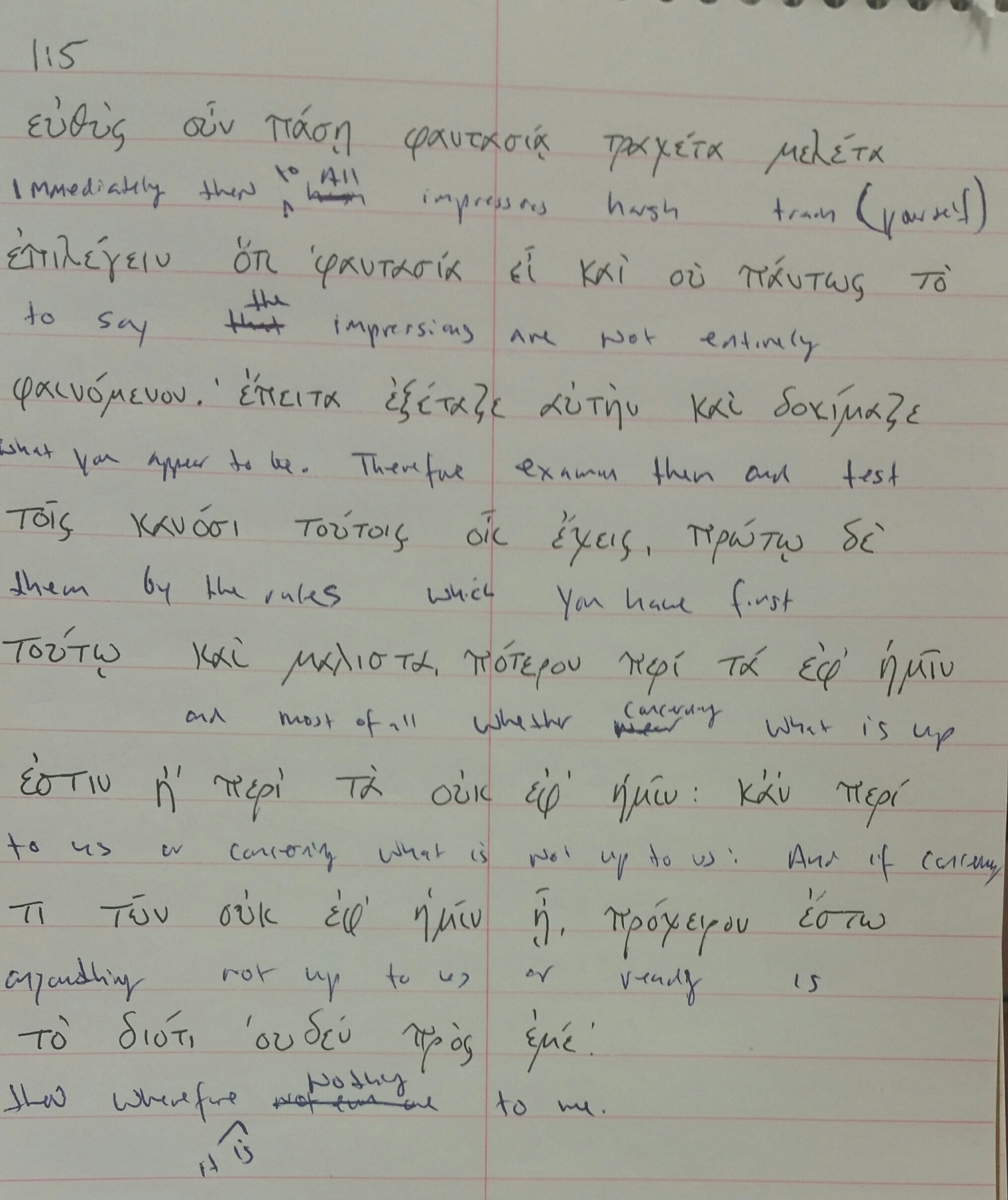
Long:
“Straightway then practise saying to every harsh appearance, You are an appearance, and in no manner what you appear to be. Then examine it by the rules which you possess, and by this first and chiefly, whether it relates to the things which are in our power or to things which are not in our power: and if it relates to any thing which is not in our power, be ready to say, that it does not concern you.”
Higginson:
“Seek at once, therefore, to be able to say to every unpleasing semblance, “You are but a semblance and by no means the real thing.” And then examine it by those rules which you have; and first and chiefly, by this: whether it concerns the things which are within our own power, or those which are not; and if it concerns anything beyond our power, be prepared to say that it is nothing to you.”
Koine:
“εὐθὺς οὖν πάσῃ φαντασίᾳ τραχείᾳ μελέτα ἐπιλέγειν ὅτι ‘φαντασία εἶ καὶ οὐ πάντως τὸ φαινόμενον.’ ἔπειτα ἐξέταζε αὐτὴν καὶ δοκίμαζε τοῖς κανόσι τούτοις οἷς ἔχεις, πρώτῳ δὲ τούτῳ καὶ μάλιστα, πότερον περὶ τὰ ἐφ᾽ ἡμῖν ἐστιν ἢ περὶ τὰ οὐκ ἐφ᾽ ἡμῖν: κἂν περί τι τῶν οὐκ ἐφ᾽ ἡμῖν ᾖ, πρόχειρον ἔστω τὸ διότι ‘οὐδὲν πρὸς ἐμέ’.”
 Mountain Stoic
You must be logged in to post a comment.