SLRP: LVIII. On Being (Part 2: 8b – 19)

Standard

Seneca,

Wow, some of this is difficult to follow in English, if I may say so.  I wonder if the more overtly coded grammar of Latin made it any easier on Luicilius?  As it is, I’m passingly familiar with the specifics of Stoic ontology, and I would probably find this easier to parse if the Greek words were included.  I wrote about Something yesterday in passing, the highest classification of which you are speaking.

From there we break down into corporeal forms which exist, and incorporeals (time, void, space, lekta) which subsist, but don’t exist.  In the modern parlance, they supervene.  Within things corporeal we have the active and passive components, matter and pneuma.

With those broad strokes, we can fill in the specifics of everything from rocks, plants, animals and man.

It might just be that spreading out this letter of a few days is not the easiest method for groking it, and after we’re done, I’ll probably go back and read it straight through.

I’m looking forward to the discussion, though!

Farewell.


Part of Michel Daw’s Reading Plan of Seneca’s Letters.

SLRP: LVIII. On Being (Part 1: 1 – 8a)

Standard

Seneca,

This letter of yours we are breaking into several chunks.  Today’s bit is a ramping up, as it were, for the discussion at hand.  You discuss the linguistic and philosophical problems of translation.  Don’t worry, we haven’t figured it out either.

Learning another language is not learning how to translate words, quid pro quo, but rather learning to think with new tools.  I’ve seen the word ὄν (but usually in the plural), translated as “some things,” and “the things which are,” and more besides.  Your translation of “that which is” seems to be in a similar vein.

Language and philosophy naturally go hand in hand.  Where I suspect your letter will bend is a place I too have gone.  I started studying Koine Greek in this most recent October.  I want to be able to read the primary texts in their native tongue.

I do wonder, however, if as a non-native speaker with no current, living language community, will I always be outside looking in?  Even at my early stages, the problems presented by ὄν and οὐσία are not small.  We see the same issue again and again with words like τι (Something), σῶμα (Body), and and ὑποστάσεω (subsistence, grounding), to name a few.

I’m looking forward to rest of this letter, because the incorporeals and the language issue are both interesting to me.

Farewell.


Part of Michel Daw’s Reading Plan of Seneca’s Letters.

SLRP: LVII. On The Trials Of Travel

Standard

Seneca,

I found two parts particularly interesting from you letter today.  The first ties into something I was thinking about yesterday.  Currently, there is a common conception that the common English word stoic with a little-S is the same as our own school.  While it may be inspired by it, they are not the same.  This misapprehension results in people’s believing that Stoics are trying to “repress their emotions.”

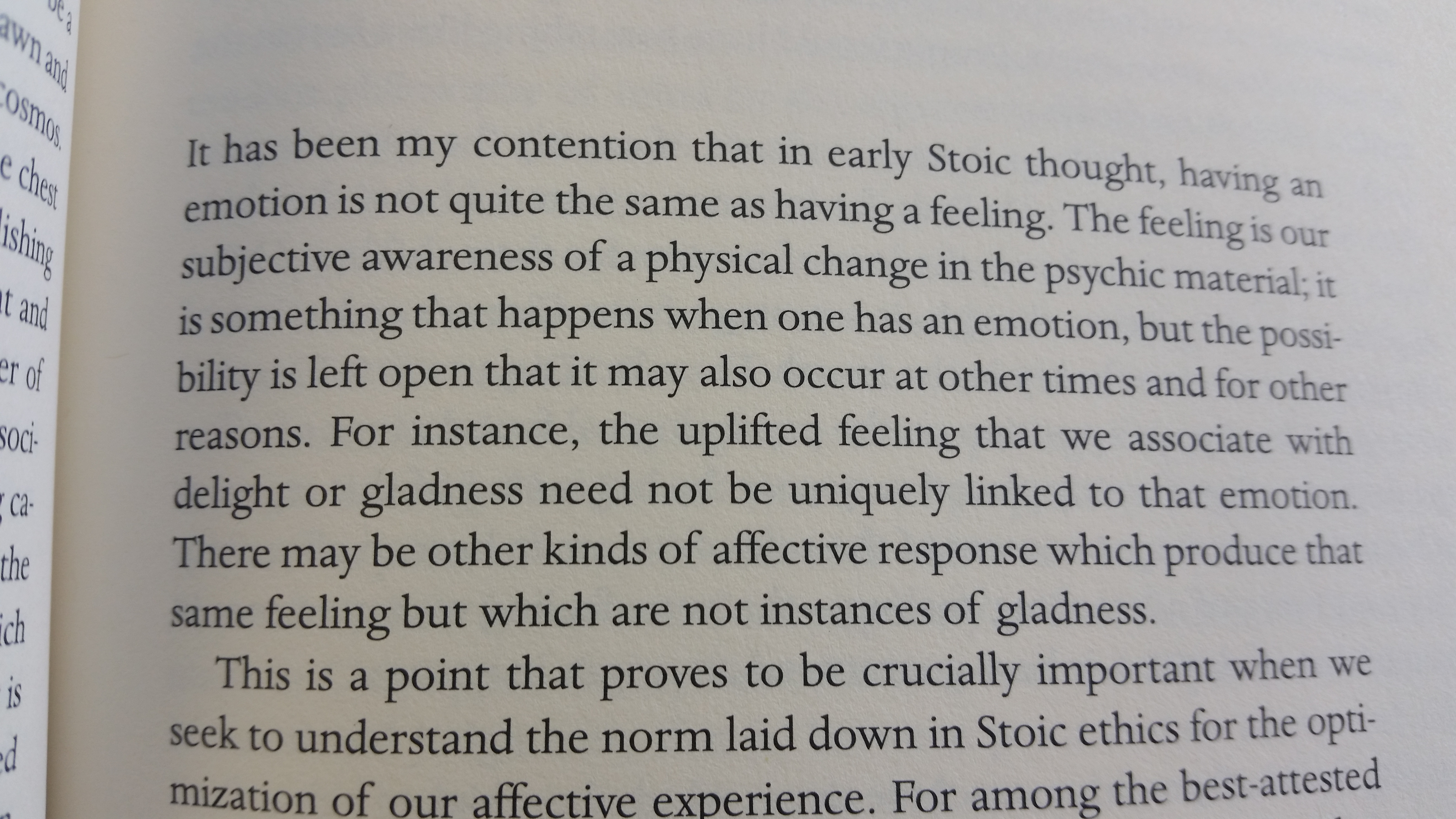
I’m reading a book by Margaret Graver, in which she note the following:

20160409_105113.jpg
Your discussion today about the physiological responses to external stimuli as different from the passions fits well in with what Graver says above.

The second part which stuck out at me was the discussion on the nature of the soul.  For modern thinkers, the very idea of the soul has a material entity is alien.  We are all mostly dyed in the Cartesian model, and the concept that the soul could be a physical thing mixed in with the body is hard to grok.

I enjoy reading and thinking about these conceptions.  Thank you for the letter.

Farewell.


Part of Michel Daw’s Reading Plan of Seneca’s Letters.

SLRP: LVI. On Quiet And Study (Part 2: 8b – 15)

Standard

Seneca,

I’ve very much enjoyed yeterday’s and today’s letter.  These thoughts have been heavy on my mind lately.  Two section stuck out at me, and I’d like to comment on them.

The first:

“For all unconcealed vices are less serious; a disease also is farther on the road to being cured when it breaks forth from concealment and manifests its power. So with greed, ambition, and the other evils of the mind, – you may be sure that they do most harm when they are hidden behind a pretence of soundness.”

In an earlier letter, I think it was you mention that men build walls and homes not for protection, but to hide away their vices.  They secret them behind many kinds of walls.  Some of stone, and some of society, and more yet words and deeds.  Yet, we should act as if all our actions are within the public view.  Whether it be from God, or from the Sage, or simply from the people wish we could be; we should act as if none of our actions are hidden.

“Men think that we are in retirement, and yet we are not. For if we have sincerely retired, and have sounded the signal for retreat, and have scorned outward attractions, then, as I remarked above, no outward thing will distract us; no music of men or of birds can interrupt good thoughts, when they have once become steadfast and sure.  The mind which starts at words or at chance sounds is unstable and has not yet withdrawn into itself; it contains within itself an element of anxiety and rooted fear, and this makes one a prey to care…”

Ah!  This was what I was getting at with yesterday’s worries.  If we retire, are we neglecting some thing.  From this, I take, that the retirement that Marcus speaks of as ‘the inner citadel’ is the same sort of retirement you’re getting at.  However, we may have to train ourselves to it.  If that’s the case, it’s not a concern really that the training looks different from the thing itself.  A boxer may lift weights, jump rope, and stand up and down on boxes daily as training, but the fight itself contains none of these actions.

Our physical retirement, then, a temporary retreat from the world to train our inner citadel is well founded.  Once that training has been complete, we can return to the city, and carry our retirement with us.

Thank you for letter, it has been a great help.

Farewell.


Part of Michel Daw’s Reading Plan of Seneca’s Letters.

SLRP: LVI. On Quiet And Study (Part 1: 1 – 8a)

Standard

Seneca,

Your letter about noise, and the trials of city life bring to mind something I’ve been chewing on lately.  That is the retreating from the city life.  Your letters seem to often suggest one retires to focus on philosophy, and I’m slowly being convinced you may be correct.  yet this passage of Marcus sticks out at me as a blaring counter-example.

“Men seek retreats for themselves, houses in the country, sea-shores, and mountains; and thou too art wont to desire such things very much. But this is altogether a mark of the most common sort of men, for it is in thy power whenever thou shalt choose to retire into thyself. For nowhere either with more quiet or more freedom from trouble does a man retire than into his own soul, particularly when he has within him such thoughts that by looking into them he is immediately in perfect tranquility; and I affirm that tranquility is nothing else than the good ordering of the mind. Constantly then give to thyself this retreat, and renew thyself; and let thy principles be brief and fundamental, which, as soon as thou shalt recur to them, will be sufficient to cleanse the soul completely, and to send thee back free from all discontent with the things to which thou returnest.”

— Marcus, Meditations, Book IV.

Marcus’ ‘inner citadel’ seems at odds with both your suggestions, and my inclinations.  Thus far, in my own Stoic journey, I’ve found that those ideas which lie at odd with my instinct tend to have been borne out.

I’ve been tossing around the idea lately of an “extended Cynic holiday” as you suggest as a monthly venture in other letters.  However, I’m thinking on the scale of weeks and months.  Maybe six or nine months all together.  I would use this time to meditate, reflect, and simplify.

As I’m currently living in a metro-area of some ten million or so people, you can imagine, I’m sure, the bucolic fantasy of a small woodland cabin, a simple iron stove, and the slow mornings watching the mountain fog descend into the hollers.

I would take the time to read, to write, to reflect.  I would do the things that you say we should, to throw ourselves into philosophy here and now, not as a mere holiday.

But, Marcus’ advice begs the question, am I running from things to which I’m averse without an eye to true goods and evils?  Am I ignoring the retreat of the soul which is available at all times, and searching for an excuse to dodge some indifferents?  I don’t think this is the case, but a good understanding of myself and the situation warrants a close examination.

Farewell.


Part of Michel Daw’s Reading Plan of Seneca’s Letters.
SLRP: LV. On Vatia’s Villa

Standard

Seneca,

Your letter touched on several topics, a couple of which I’ve been thinking on myself.  The first is the keen and sharp difference between leisure and idleness.  This moved smoothly into a discussion on how our surroundings do not determine our state of mind.  In fact, the state of mind we cultivate has primacy in importance.  We can find happiness in any place.

This issue is one which is on my heart these days.  Still in exile, doing many things which are instrumental to my exile, but which bring me no joy.  My heart is tired from it.

But, it is within my purview to look and find some happiness… even in exile.  I’m going to concentrate on that today.

Farewell.


Part of Michel Daw’s Reading Plan of Seneca’s Letters.

SLRP: LIV. On Asthma And Death.

Standard

Seneca,

I disagree, that there is not virtue for one expelled as one who goes willingly.  Even in expulsion, one has the ability to accept and assent.  To note what’s up to us, and what’s not.  Despite the fact that one’s light might be snuffed out rather than running out of wick, there is still the opportunity for virtue there.

Your letter provides much food for thought today.  Thanks.

Farewell.


Part of Michel Daw’s Reading Plan of Seneca’s Letters.

SLRP: LIII. On The Faults Of The Spirit.

Standard

Seneca,

The comparison of how an illness of the body commands all of our attention, that we set aside, business, pleasure, and all other things to remedy the problem; with that of the illnesses of the soul is well-taken.

However, it’s the case that the common man does not do this, nor even does a goodly portion of those who would call themselves philosophers.

Thank you for the letter, today.

Farewell.


Part of Michel Daw’s Reading Plan of Seneca’s Letters.

SLRP: LII. On Choosing Our Teachers (Part 2: 8b – 15)

Standard

Seneca,

“Why do you take pleasure in being praised by men whom you yourself cannot praise?”

It’s a good question.  The answer is that we must mistake praise for a good.  We seek it, we find it validating.  It supports what we do.  But, most of the time we don’t consider the source.

A careful application of praise from a good man is one thing, but we mistake a popular sort of praise which is base.  One has but to look at the internet, the never-ending stream of selfies, tweets, and updates.  Lots of people crying out for validation.

It’s a poor stand-in for the surety and confidence that comes from within.

Farewell.


Part of Michel Daw’s Reading Plan of Seneca’s Letters.

SLRP: LII. On Choosing Our Teachers (Part 1: 1 – 8a)

Standard

Seneca,

You have noted three classes of men:

  1. Those who achieved wisdom by themselves.
  2. Those who require a teacher to achieve wisdom, and want it.
  3. Those who can achieve wisdom but must be driven towards it by another.

All three of these, you say, Epicurus praises.  I vaguely recall there being three divisions in Buddhism of people who are in one of several states of progress, but it’s not really my wheelhouse, and I can’t recall them specifically.

The thing I take from this letter, is that it should be okay for us to need, ask for, and receive help in our learning and our progress.  Chance are *very* high that we’re not the first class of folks above.

Farewell.


Part of Michel Daw’s Reading Plan of Seneca’s Letters.