CERP: Day 8 – To the Wealthy, Diogenes, Mnasos, and Lysis

Standard

VII. To the Wealthy (p. 59)
Here, Pseudo-Crates pulls no punches.  He’s attacking the false and vainglorious style of the wealthy and powerful.  Despite, it seems, their outward appearance of tunics, lupine beans, etc., it seems that they’ve learned nothing of the Cynic’s life.  It’s fashion, then.

IIRC, we read that Roman Cynicism was generally made of weaker stuff than the Hellenic sort was.  This letters seems more firmly Cynic, especially in the ‘gadfly’ or social critic role that Diogenes perfected.

VIII. To Diogenes (p. 59)
Pseudo-Crates here is lamenting, I suppose, that he has become somewhat famous… maybe infamous.  Certainly Diogenes was both.  This feels a touch disingenuous.  A quiet life for a Cynic would be entirely possible at a retreat, or community.  They could retire to some mountainplace, and be rid the cities.  They could renounce their exhortations, condemnations, and social critique.  Doing this would render them unnoticeable.

Yet, is it not the part of the Cynic to teach by example?

IX. To Mnasos (p. 61)
Ah!  A firmly Roman sales pitch, then!  As the rougher edges of Stoicism were dulled to be more palatable for Roman decorum, apparently so too does Cynicism need some polishing.

X. To Lysis (p. 61)
I had to do some looking up.  I had assumed from the context that plectrum must have been a sort of cup, but it appears to be more akin to a guitar pick.  The word “plectrum” comes from Latin plectrum, itself derived from Greek πλῆκτρον (plēktron), “anything to strike with, an instrument for striking the lyre, a spear point”.

So… what in hell does this mean?  I thought maybe it’s meant like being under a whip, but I’m not sure.

Additionally, the plea to piety and the gifts of God do not have a Cynic feel to me, but rather a Stoic one.  The claim of “nothing indecent or bad” that might happen does not seem to mesh with Cynic shamelessness (Gr:  αναίδεια).  The bit on pleasure seems to maybe fit with the “opportunistic and natural” hedonism of the Cynics, but clashes with the water-drinkers and Diogenes tossing out a sweetroll from his bowl.

The Epistles thus are challenging, and it’s an interesting experience to see what changes are made and where.


This is part of the Cynic Epistles Reading Plan.
CERP: Day 7 – To To Hipparchia, his students, Hermascus

Standard

I. To Hipparchia (p. 55)
This is a strange piece, and short.  Shouldn’t it rather be, “come and see that not even this is a terrifying circumstance to one devoted to Philosophy?”

II. To His Students (p. 55)
Pseudo-Crates is talking to his students here, and he’s instructing them in the proper way for a Cynic to beg food and the other necessities of life.  Mendicant religious folks dot the history of the West, often as a footnote.  The role seems to be more common in the East than it is here.  Crates injunctions are particularly strict.

He tells his students not to accept the necesseties from just anyone, but only from other Philosophers, the virtuous.  This is because ‘virtue must not be supported by vice.’

How many Cynics starved to death, were that the case?  It is true, that the Cynics suspect virtue and even Sagehood is quite a bit more easily achieved than the Stoics think it is.  Still… the virtuous seems pretty thin on the ground in these parts.

III. To the Same (p. 55)
Pseudo-Crates seems to present a dichotomy between the mind/soul and body.  It’s unclear to me whether generally the Hellenes believed that there was a strict dichotomy, or whether they had a more holistic understanding of the self.  I’ve seen both positions claimed.

We credit Decartes with “mind/body dualism,” often called Cartesian dualism.  But as I am learning, despite the fact that more modern and European philosophers and theologians are credited with certain discoveries (Origen, Anslem, Acquinas, Decartes, and more all come to mind), they are often just rehashing the writings of the Greeks of this period.

IV.  To Hermascus (p. 57)
Say ‘toil’ one more time.
I suppose the point here is that πόνος is not to be feared or avoided.  This seems firmly in the Cynic camp, although I would expect rather a  φιλόπονος, “love of toil.”

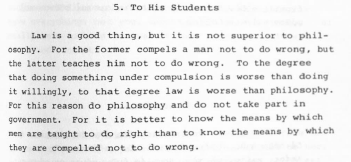
V.  To His Students (p. 57)
Can it be more relevant?

5

VI. To the Same (p. 57)
The progress of the Cynic is much easier to grasp than the progress of the Stoic.  While I beat the drum of Stoic praxis nearly incessantly, one can’t half-ass the labors of the Cynic.  The Cynic hypocrite is immediately apparent.  One has to put up or shut up, there’s no middle of the road.

The Stoic on the other hand, more easily conceals the intent and inner states which put the lie to the philosophy.  It’s not to say that the former is greater than the latter per se, but merely that the circumstance for self-disillusionment is markedly lessened.


This is part of the Cynic Epistles Reading Plan.

CERP: Day 6 – Introduction to The Epistles of Crates (p. 10)

Standard

Introduction to The Epistles of Crates (p. 10)

We’re jumping backwards in the book today, to read the part of the introduction for Pseudo-Crates letters.  The introduction provides a useful context and information for the following Epistles.

Firstly, that anywhere between two and six authors may have contributed, and similar to the actual chronology of the men’s lives, the Crates letters were written after Diogenes’.  Indeed, the introduction suggests that the authors of the Crates letters was familiar with, and even used the Diogenes letters.

This is a neat bit of historical analysis, and I’m looking forward to the letters.  The introduction does carry a caveat, that at least one of the letters has the stamp of the Stoa on it rather than that of Pera.


This is part of the Cynic Epistles Reading Plan.

CERP: Day 5 – To Croesus

Standard

IX. Anacharsis to Croesus (p. 47)
Today’s letters has a section which jumped out at me:

“We protect our cattle from wild beasts, and in return receive milk and cheese.  We have weapons, not to attack other people, but to defend ourselves, if it should be necessary.”

The letters of the Pseudo-Anacharsis have seemed to veer fairly significantly from the Cynic route as I understand it.  How do we compare the position (which I agree with, by the way), that we have weapons for defense with the chreia of Diogenes rolling his barrel around the market when the city is under siege?  They seem to be two mutually exclusive positions.

Pseudo-Anacharis harshly criticizes the Greeks, saying that they ascribe their own evils to the Gods, and that they prize nothing which comes from toil, but then they admire toil itself.  The first claim paints them to be like children, the second little better than hypocrites.

 X. Anacharsis to Croesus (p. 51)
No earthly gold, merely the betterment of character.  An interesting parting note.


This is part of the Cynic Epistles Reading Plan.

CERP: Day 4 – To Medocus, Hanno, the Son of the King,Tereus, the Cruel Despot of Thrace, and to Thrasylochus

Standard

III. Anacharsis to the Tyrant Hipparchus (p. 41)

Here, we’re encouraged to take up a “sober and thoughtful” life.  This brings to mind the ὑδροκύων, or Cynic ‘water dog,’ who would only drink water.  The call back to one’s ‘father’s beneficence’ seems to me to be a clear example of the Romanization of Cynicism.  I have a hard time imagining Diogenes relying on the shame from not living up to one’s parents as a motivator to virtue.

IV. Anacharsis to Medocus (p. 41)

φθόνος is the word here used for ‘envy,’ which can be ill-will, malice, or envy of the good fortune of others. And πτόησις is ‘vehement emotion of excitement.’ The distinction I want to draw is between the Stoic πάθος (as passion) and this Cynic word πτόησις which is also translated as passion.

The Stoic passion is also variously translated as suffering, or unhealthy emotion, sometimes even lust.

The Cynic passion is a “fluttering excitement” especially as relates to fear or terror

This is the reason having the bi-lingual texts is really important. When we see the English word ‘passion,’ esp. if we’re coming from a Stoic perspective, we have a less clear view as to what’s being said.

So the message that ‘envy and passion’ are the signs of an inferior soul means something a bit more specific than we might have otherwise thought.

V. Anacharsis to Hanno (p. 43)

Here, Anacharsis is discussing his mode of life, his clothing and food.  Both of those things have been of interest to me over the past year (see:  Philosopher’s Cloak I and II, and Rule of Musonius).  The word we see here as cloak is χλαῖνα, which is simply a large rectangular, blanket-like garment.  It bears some etymological similarity to several Indo-European languages’ word for ‘wool.’

The uniform of the Philosopher is an interesting critter, and that it was such common thing for Cynics that other philosophers were worried they might be mistaken for Cynics is interesting as well.

VI. Anacharsis to the Son of the King (p. 43)

The example of how possessions and freedom are related is the crux of this short piece.  All it takes to ascend to the Cynics’ level of freedom is to renounce those very things holding one back.

VII. Anacharsis to Tereus, the Cruel Despot of Thrace (p. 45)

The adviser role of philosophers to those in power is an interesting one and a dangerous one.  We read that it was common for wealthy and influential folks to have a live-in philosopher, a sort of “nanny of the soul.”

This short letter does not strike me as overly Cynic, however, it seems a more Stoic taste.  The Despot is told to use his sovereignty well, to protect his people.  I would think that a “Citizen of Pera” would rather deny the sovereignty of the Despot, and cast dispersion of the social hierarchies and order which brought him to his position.

VIII. Anacharsis to Thrasylochus (p. 45)

In many respects, dogs seem to understand the cosmos a bit better than the average person.  His kindness and fierceness are always appropriate in a healthy dog.


This is part of the Cynic Epistles Reading Plan.

CERP: Day 3: Letters to the Athenians, and Solon.

Standard

I. Anacharsis to the Athenians (p. 37)
Anacharsis beings with an extended argument, showing how the Greeks profess something which is biased and unsubstantiated.  They are hung up on the manner of speech (particularly of foreigners), rather than paying attention to what is said.  He shows the hypocrisy in this, as they use foreign doctors, captains, merchants, etc.

Yet, they still maintain this … for lack of a better term… linguistic nationalism or ethnocentric focus.  I’m reminded of Diogenes’ quip about where in Greece good men might be found, and his response is something like, “In Greece?  Nowhere.  But there are good boys in Sparta.”

Anacharsis also uses the Spartans as an example, citing the commendable way in which they run their affairs coupled with crude Attic.  Anacharsis is challenging the νόμος regarding a Hellenocentric view of progress and society; specific a focus on Athens as Greece-per-se.

It’s funny to note how in latter times, the hallmarks of Greek philosophy were not of the same demos nor ethnos as Athens, coming from Cyprus, Turkey, and Asia minor.  It’s a good reminder that we might fight value elsewhere than the little plot of dirt on which we were born.

II. Anacharsis to Solon (p. 39)
The same theme as above is referenced, in this case in relation to hospitality.  I don’t know enough about the Greek culture of the time, but in the West hospitality is often taken very seriously.  Guest-right, and the obligations of a host are usually traditionally formed and social enforced ideas.

The pseudo-pun about a “Spartan dog” coming from the Scythian Dog… err… Cynic, caused me to chuckle.


This is part of the Cynic Epistles Reading Plan.

CERP: Day 2 – Introduction to The Epistles of Anacharsis

Standard

Today’s reading is laying the historical groundwork for the following Epistles.  It’s pretty clearly stated that the author is not who it purports to be.  The choice of Anacharsis, being a non-Greek challenging the νόμος of the civilization is a bold one.

The introduction uses some linguistic analysis to determine approximate and relative dates for the authorship.  It claims that the language shows clearly at least two authors.

The distinction between Attic and Koine is one of grammar, word connotation, and relative complexity.  It’s currently above my paygrade to be able to tell them apart, however.

It’s interesting how linguistic analysis can be used in these context, though.  Linguistics (specifically Generative Grammar) is my academic background, so it’s nice to see it here as well.


This is part of the Cynic Epistles Reading Plan.

CERP: Day 1, Introduction.

Standard

The first section of the book calls to question of the confusion regarding the Cynic tradition.  While firmly in the Stoic camp myself, I like to read on the Cynics to inform why certain Stoic doctrines and practices are what they are.

The author’s wording makes it easy to confuse that Musonius and Epictetus were Cynics, which isn’t the case.  To call their teachings “heavily Stoicised” is a bit silly.  They were Stoics!

Generally, however, I’m looking forward to working through the Epistles.  It should take about four months, all told.


This is part of the Cynic Epistles Reading Plan.

The Cynic Epistles Reading Plan

Standard

I have found Michel Daw’s Seneca’s Letters Reading Plan very helpful for making my “to read” list smaller.  In that vein, another Facebook group I’m involved in has decided they wanted to do a Reading Plan for The Cynic Epistles.

So, to help that project along, I created a reading plan for the Epistles.  We’re going to be discussing them in the Cynic Philosophy Facebook Group.

If you’d like to follow along, here’s the page at the blog with the plan and book info:
The Cynic Epistles Reading Plan.