SLRP: LXXXIV. On Gathering Ideas (Part 2: 8b – 13)

Standard

Seneca,

I would have my mind of such a quality as this; it should be equipped with many arts, many precepts, and patterns of conduct taken from many epochs of history; but all should blend harmoniously into one. “How,” you ask, “can this be accomplished?” By constant effort, and by doing nothing without the approval of reason.

This presents an image of a sort of eclecticism, picking up bits from here and there, assembling them into one synthetic whole.  I’m not sure that I can agree, on the face.  However, with the qualifier of reason as the test, it may very well end up less scattered than it might first appear.

And if you are willing to hear her voice, she will say to you: “Abandon those pursuits which heretofore have caused you to run hither and thither. Abandon riches, which are either a danger or a burden to the possessor. Abandon the pleasures of the body and of the mind; they only soften and weaken you. Abandon your quest for office; it is a swollen, idle, and empty thing, a thing that has no goal, as anxious to see no one outstrip it as to see no one at its heels. It is afflicted with envy, and in truth with a twofold envy; and you see how wretched a man’s plight is if he who is the object of envy feels envy also.”

A clear call to renounce the indifferent things.  It’s a hard line to take, and there are many voices in our time, as there were in yours, that such a thing is one of the greatest follies.

But this perennial challenge seems to echo across time, cultures, peoples, and every aspect of human life.  There must be something there for those that answer this call.

We often wonder what the cost of truth is.  Philosophy is not a “come as you are” club, it demands you change.  It demands that you make yourself worth of Truth.  Here, the cost is clearly laid out.

How many will pay it?

Farewell.

Part of Michel Daw’s Reading Plan of Seneca’s Letters.

Cynic παρρησία isn’t always welcomed.

Standard

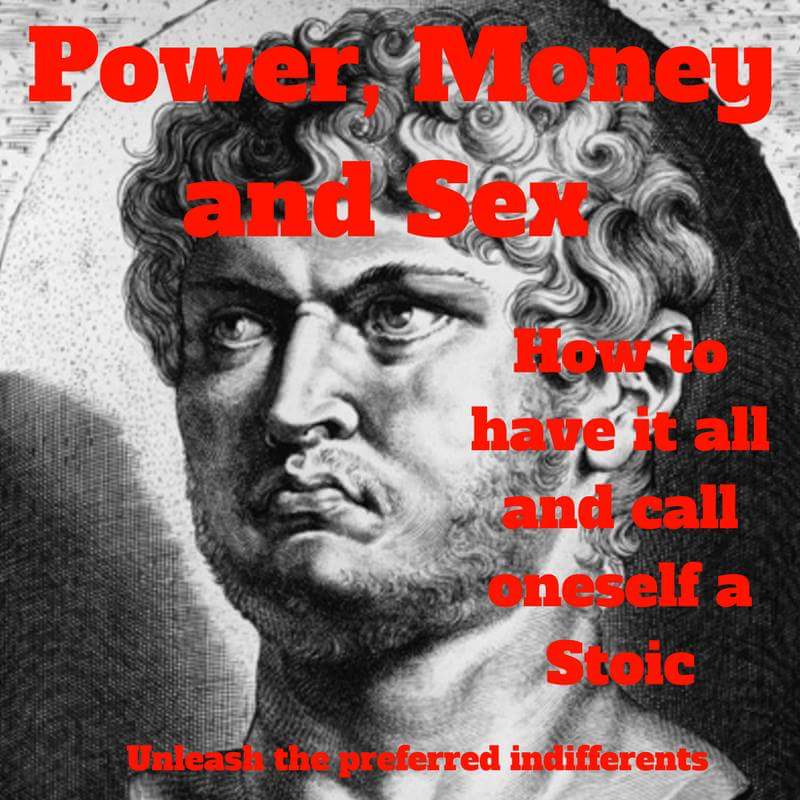
Phil Somers, posted in one of the Stoicism fb groups with a caustic but pertinent critique of consumerist Philosophy.  

He has this to say:

“So I have been slow to realise the fact that Stoicism is just a commodity that can be exploited. I used to believe it was this noble philosophy, but now I see it is so much more. So here is a preview of my new e-Book on Stoicism. Pricing to be announced shortly…”

 Some folks took umbrage with his post, but as is often the case, Phil has an ability to cut through the surface of the issue and strike at its heart. 

Deciding to make money from philosophy is not something one does lightly if they’re doing it with a full heart, and I think most are.  It’s a narrow edge to walk.  The best way, I suppose, would be to put out whatever you’re doing and if remuneration happens, it happens.

A danger exists if sales becomes an end, or a goal.  If the desire to bring in dollars shapes the discourse, then we can wonder quite far from the path.  Of course lots of money can be made by saying “use this philosophy to get money, sex, and prestige.” It is probably significantly harder to make money saying, “virtue is the sole good, the results of your action have no moral worth only your intent does, give up worldly desires, and align yourself consonant with nature.”

That’s a much harder sell.

Even philosophers have to eat, and most of us don’t live in a ceramic jar.  Musonius talks about right livelihood, and other Stoics have as well.  Teaching classes is an endorsed career  for a philosopher, and selling books seems decidedly in that vein. 

I took Phil’s reminder to keep the goals of Philosophy in mind, stay humble, and hold yourself to a high standard. The Stoics and Cynics are sibling schools, and the παρρησία of our closest relative can only make us better philosophers.

Thanks, Phil.

SLRP: LXXXIV. On Gathering Ideas (Part 1: 1 – 8a)

Standard

Seneca,

[M]y passion for literature makes me lazy and careless about my body…

You and me both.  This first part of the letter explicitly states something I’ve come to know, but hadn’t distilled so concisely.  Through writing, we form and organize those things we’ve taken in, and this leads to a synthesising and framing of the information in a new and more useful way.

It is often when I sit down to write, either for myself alone or for the blog, that I find ideas have coalesced and grown in new directions.

When I sit at the keyboard to explain a topic or facet, my understanding deepens.  We learn as we teach, and even when the student is our own self, this holds true.

I look forward to the rest of the letter.

Farewell.


Part of Michel Daw’s Reading Plan of Seneca’s Letters.

Email list

Standard

the-at-signFor those of you who have been following the blog for the past two and a half years, thank you.  If you wouldn’t mind also signing up for the email list, I would certainly appreciate it.

I won’t spam you, and you’ll get a first crack at news, ebooks, and other philosophy-related stuffs.  Thanks again.

— MountainStoic.com

Update: The Stoic Bookshelf

Standard

bookshelf-organization

One of the most frequently used pages by visitors on the blog is The Stoic Bookshelf.  I’ve been very good about buying new books, mediocre at reading new books, but entirely atrocious at updating that list.

So, I’ve made some updates and additions there.  That page will be undergoing a pretty serious overhaul in the coming weeks.  But, for the time being, head over and see what’s new.

Plutarch: On Curiosity

Standard

I have just finished reading the section of Plutarch’s De Moralia “On Curiosity.” The Greek word in question is a bit difficult to translate, so you also see “On Being a Busybody” used.

You can read it here:  http://penelope.uchicago.edu/Thayer/E/Roman/Texts/Plutarch/Moralia/De_curiositate*.html

The thrust of the essay, is an argument against the sort of curiosity which feeds on knowing the failings of others.  The gossipy nature, the uncovering of secrets, etc.  So the essay both argues against this, showing how this nature is at the extreme leading to things like adultery; and it offers a therapy to undo these habits.

 The fact that gossiping and nosiness are habits is an important one.  If you will permit the liberty, I’ll transpose some of his exercises to the utility of today as well as note the examples given.

Plutarch suggests that we not read every bit of graffiti, or signage that we pass.  That this little intrigue reduced our ability to study and descent important things, and trains the moral will into insinuating ourselves into things not our business.

He suggests that when we’re walking, we don’t peek in the doors of neighbors.  We might also practice not checking out the workspace of our colleagues, and keeping our attention outside of their offices, cubes, or desks where we might work.  Turn the gaze inward, to the self, and not to others.

Plutarch suggests that when a letter arrives, we delay opening it for a time.  This can be true for email, push notifications for smart phones, and the other ten-thousand digital intruders of the day.  We may even block those things into chunks: to check email once or twice a day, turn off the push notifications from Facebook, YouTube, or our favorite Stoic blogger, and instead only give a set amount of time to these things each day.

One of the things which Plutarch mentioned, is that the person who loves to uncover secrets also loves to share it.  I suspect that the second part is easier to wrangle than the first.  We might adopt an purposeful silence, not sharing the social tidbits which we might uncover.  This will lead in time to a reduction in the former.

I suspect that part of the allure of sharing gossip is being perceived as the person “in the know.” Restricting such speech, then, will immediately curtail this feedback.

Plutarch remarks that the very people who seek out such knowledge are the ones we hide it from, and so the work of the gossip is twice as hard.

While not a Stoic work per se, this fits nearly into many philosophical settings.  It’s short, and I recommend it to your reading.

It is important to remember how we train the moral will, and what small things lead to greater.

SLRP: 1.LXXXIII. On Drunkenness (Part 2: 8 – 19a)

Standard

Seneca,

[D]runkenness is nothing but a condition of insanity purposely assumed. Prolong the drunkard’s condition to several days; will you have any doubt about his madness? Even as it is, the madness is no less; it merely lasts a shorter time.

The thrust of your letter thus far, is that while philosophy does not require teetotalism, however this would not be to counter purposes, it does require moderation.  There seems to be a but of a conflict with what we’re reported of Zeno, that at one time he said the good man does not get drunk, and at another that even the beans are improved by soaking.

Maybe we expect a but much from Zeno.  Either way, the question of intentionally altering human consciousness, specifically for recreation or relaxing, is certain one which philosophy ought to be able to answer.

I agree with you, that when we look at the very early Stoics, while their conclusions often seem to me to be correct, their arguments are often lacking.

Drunkenness kindles and discloses every kind of vice, and removes the sense of shame that veils our evil undertakings. For more men abstain from forbidden actions because they are ashamed of sinning than because their inclinations are good.

It just so happens that this week I was discussing αἰδώς with a group of Stoics.  We were discussing its English translation, which is often rendered as ‘shame.”  I provided “shamefast,” which often gets incorrect reported as ‘shame faced,’  and we came to the understanding that it is the pre-emptive feeling (a good passion) which alerts the good person to a possible future moral failing.  It is a moral self-respect which a good person has which does not permit him or her to do a certain morally corrupt thing.

Here, Seneca, you seem to look down on this pre-emptive sort of avoiding evil, but I’m not sure that you’re correct here.  Indeed, especially as those of us training, this kind of feeling is useful measurement device.

How often do the Stoics admonish us to live as if all our deeds were public, as if all our thoughts were commonly available to others.  The purpose of recollecting to ourselves in the evening is to being the habit and thought that our actions, no matter how secret, will get exposed if only to ourselves before bed.

I think the argument that the person who does not exercise the due control over appetites, over food and drink, indeed does wrong.  This is a useful reminder for many of us moderns.

I thank you for the letter, and look forward to tomorrow’s.

Farewell.


Part of Michel Daw’s Reading Plan of Seneca’s Letters.

SLRP: LXXXIII. On Drunkenness (Part 1: 1 – 7)

Standard

Seneca,

“At any rate, it is thus that we should live, – as if we lived in plain sight of all men; and it is thus that we should think, – as if there were someone who could look into our inmost souls; and there is one who can so look. For what avails it that something is hidden from man? Nothing is shut off from the sight of God. He is witness of our souls, and he comes into the very midst of our thoughts – comes into them, I say, as one who may at any time depart.”

I have not been doing a very good job at doing the morning and evening review.  I will take your letter as an invitation to begin the practice again.  I think I will change the manner somewhat, however.

Previously, I would do so quietly and internally while waiting for sleep.  I also tried handwriting out in a journal using a three-fold set of questions:

  • That which I did well the day.
  • That which I did ill the day.
  • That which I have left undone.

Yet, I think this too narrow a focus, and doesn’t provide for the kind of introspection and review that the exercise required.  Henceforth, I will think I type out my review, beginning with a diary-like accounting of the day, and then finishing by way of summary with my three points above.

Thank you for the timely reminder.  Although the purpose of today’s letter has yet to be uncovered, this was a needed sentiment.

Farewell.


Part of Michel Daw’s Reading Plan of Seneca’s Letters.

SLRP: LXXXII. On The Natural Fear Of Death (Part 3: 19 – 24)

Standard

Seneca,

You cannot “still braver go,” if you are persuaded that those things are the real evils. Root out this idea from your soul; otherwise your apprehensions will remain undecided and will thus check the impulse to action.

This is the most poignant reminder in today’s letter.  The purpose of our training is not in mere logical exercises or tricks, but to root out false beliefs, and in their place leave assents to true propositions according to nature.

It’s an interesting idea that the Sage might not have to be brave to face a death such as the Spartans saw at Thermopylae, but since his beliefs are founded on correct assents, he knows death is no evil, and this experiences no fear which needs to be combated with bravery.

Thank you for the reminder and food for thought.

Farewell.


Part of Michel Daw’s Reading Plan of Seneca’s Letters.

SLRP: 5.LXXXIII. On Drunkenness (Part 3: 19b – 27)

Standard

Seneca,

When the strength of wine has become too great and has gained control over the mind, every lurking evil comes forth from its hiding-place. Drunkenness does not create vice, it merely brings it into view…

It has long been my contention that intoxication of this sort does not bring about new evils.  It simply rearranges priorities.  As you note, the lustful man does not hide his vice, nor does the cruel man but become more cruel.  Alcohol and the like seem not to create new evils, but only bring them to the surface.

There are, perhaps, other more rare vices which do seem to change the quality of the person, if not with a single use but through prolonged exposure.  The heartily addicted sometime seem this way.

It is still due to ignorance that mean do evil:

[T]hat what men call pleasures are punishments as soon as they have exceeded due bounds

All are deprived of truth against their will.  It is through a misunderstanding good and evil that folks seek escape or (incorrect) therapy for their passions.  You will sometimes see it claimed that addiction is moral problem, not a criminal one.

I generally agree with this sentiment, but would take a Stoic turn.  It’s not that person needs to be saved to change their behavior, but that they must instead learn to distinguish between what’s good and evil, and what’s up to us and what’s not.  In short, they must learn to diaresize, and master the προαίρεσις.  It’s not a moral failing, but a moral blindness.

Farewell.


Part of Michel Daw’s Reading Plan of Seneca’s Letters.