SLRP: LVIII. On Being (Part 1: 1 – 8a)

Standard

Seneca,

This letter of yours we are breaking into several chunks.  Today’s bit is a ramping up, as it were, for the discussion at hand.  You discuss the linguistic and philosophical problems of translation.  Don’t worry, we haven’t figured it out either.

Learning another language is not learning how to translate words, quid pro quo, but rather learning to think with new tools.  I’ve seen the word ὄν (but usually in the plural), translated as “some things,” and “the things which are,” and more besides.  Your translation of “that which is” seems to be in a similar vein.

Language and philosophy naturally go hand in hand.  Where I suspect your letter will bend is a place I too have gone.  I started studying Koine Greek in this most recent October.  I want to be able to read the primary texts in their native tongue.

I do wonder, however, if as a non-native speaker with no current, living language community, will I always be outside looking in?  Even at my early stages, the problems presented by ὄν and οὐσία are not small.  We see the same issue again and again with words like τι (Something), σῶμα (Body), and and ὑποστάσεω (subsistence, grounding), to name a few.

I’m looking forward to rest of this letter, because the incorporeals and the language issue are both interesting to me.

Farewell.


Part of Michel Daw’s Reading Plan of Seneca’s Letters.

CERP: Day 30 – Diogenes Ep. 35.

Standard

XXXV. To Sopolis, do well (p. 145)
Well.  This is an interesting one.  Ps-Diogenes begins with a critique of a teacher, and then also of a coach.  That moves quite directly into one of his stories of “manual labor,” as it were.

Diogenes’ main point at the beginning is that one should be consistent, and not teach what one doesn’t know.  Then, turns around and flouts the cultural nomos, by a fairly forthright discussion of sexual mores.


This is part of the Cynic Epistles Reading Plan.

SLRP: LVII. On The Trials Of Travel

Standard

Seneca,

I found two parts particularly interesting from you letter today.  The first ties into something I was thinking about yesterday.  Currently, there is a common conception that the common English word stoic with a little-S is the same as our own school.  While it may be inspired by it, they are not the same.  This misapprehension results in people’s believing that Stoics are trying to “repress their emotions.”

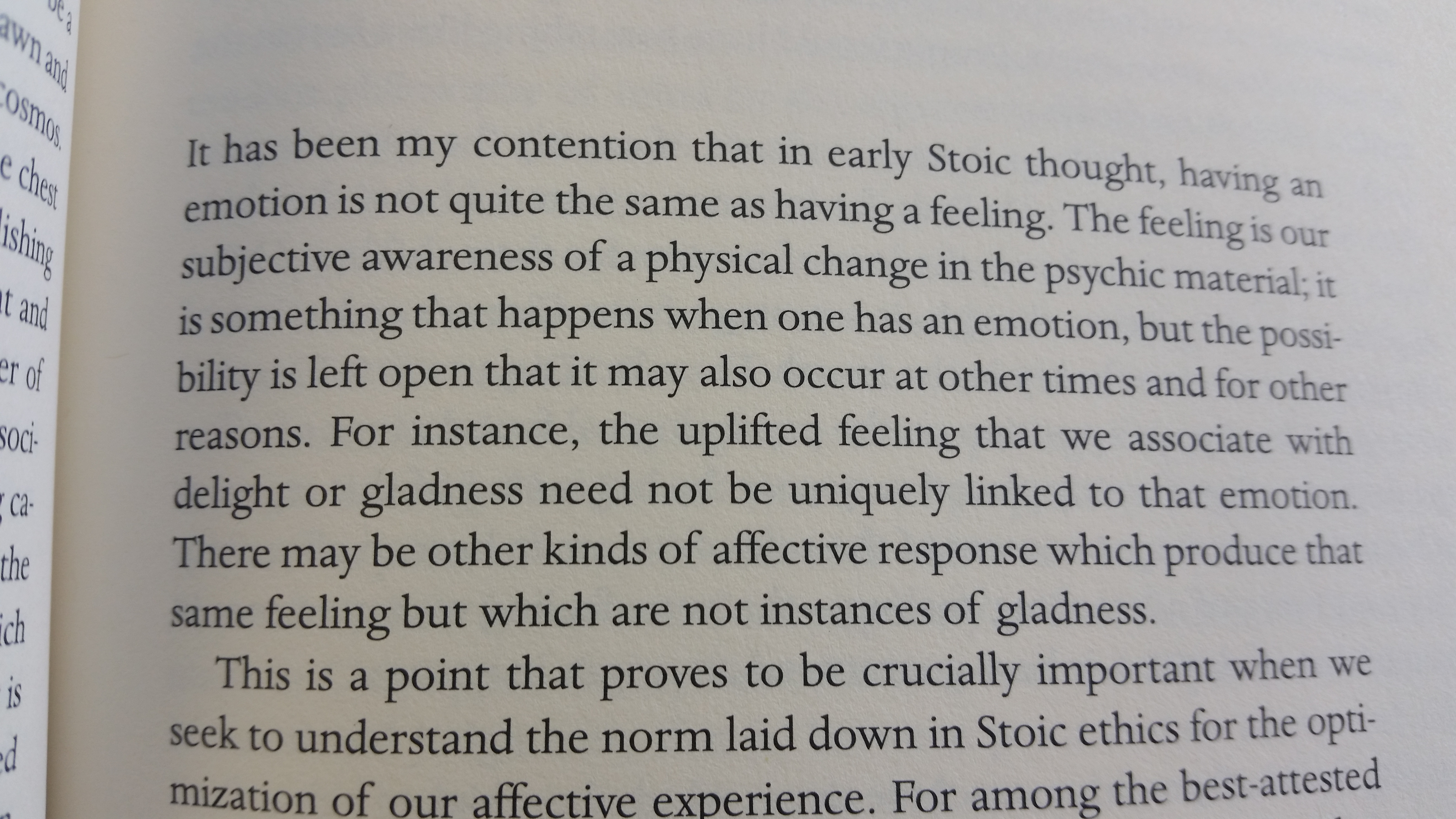
I’m reading a book by Margaret Graver, in which she note the following:

20160409_105113.jpg
Your discussion today about the physiological responses to external stimuli as different from the passions fits well in with what Graver says above.

The second part which stuck out at me was the discussion on the nature of the soul.  For modern thinkers, the very idea of the soul has a material entity is alien.  We are all mostly dyed in the Cartesian model, and the concept that the soul could be a physical thing mixed in with the body is hard to grok.

I enjoy reading and thinking about these conceptions.  Thank you for the letter.

Farewell.


Part of Michel Daw’s Reading Plan of Seneca’s Letters.

On emotions and habits

Standard

Chrysippus is quoted by Galen and Cicero in making the following determination about fear.  The issue with fear is not that a present thing is evil but rather that an evil thing is present.

This is a very important distinction.  We may find ourselves amidst an emotion or passion, and try to coach ourselves that a present thing is indifferent.  But, and I think most of our experiences bear this out, often this kind of self-talk fails to ameliorate the impassioned state.

We are not likely to fix every passion in the moment this way.  This make sense when we look at the distinction presented above.  Since we are dealing with the impression that an evil thing is present we are dealing with old assents. 

These previous assents of which items or classes of items are good, evil, or indifferent have been built up and reinforced by us for decades.

What we are doing with the self-talk is very slowly building up new assents.  We’re changing our storeroom of classifies objects and classes.  We do this unit by unit, time after time.  It’s a slow and laborious process.

This is why the regimens of Musonius, Epictetus, and Marcus are firmly grounded in habit forming behaviors.  They knew that the change was not immediate.

We cannot (yet?) remember at every junction to reevaluate our goods, but we can build habits in the interim.

CERP: Day 29 – Diogenes Ep. 33 and 34.

Standard

XXXIII. To Phanomachus, do well (p. 141)
This is a longer, and somewhat different version of the chreia in which we hear “If I were not Alexander, I would want to be Diogenes,” and Diogenes replies that he too would want to be Diogenes.  This is interesting, I don’t recall ever hearing about Diogenes gluing pages of a book together before.

I suppose that this is an allegorical denial of academic, superficial, or (for lack of a better word) “uppity” knowledge.  So, Diogenes sits in his τρίβων, sitting in the sun, living his wisdom and with both his actions and his life he show the academic knowledge to be worthless.

XXXIV. To Olympias, do well (p. 143)
Diogenes here is arguing for the Cynic mode of life.  Interestingly, he does not credit Antithenes and Socrates for his practice, but to Hera, Heracles, Odysseus:  the gods and heroes of Greece.

It is very interesting to me, that the praxis of Cynicism require the most argument.  The practice is a natural extension of the doctrine.  You can’t assent to the second while denying the first.  They are one and the same.

Yet, today (apparently) as then, the arguments are need to convince folks to do the thing.  But just like the gluing of the book, the lived philosophy should be the argument, not the intellectual logic of the thing.


This is part of the Cynic Epistles Reading Plan.

SLRP: LVI. On Quiet And Study (Part 2: 8b – 15)

Standard

Seneca,

I’ve very much enjoyed yeterday’s and today’s letter.  These thoughts have been heavy on my mind lately.  Two section stuck out at me, and I’d like to comment on them.

The first:

“For all unconcealed vices are less serious; a disease also is farther on the road to being cured when it breaks forth from concealment and manifests its power. So with greed, ambition, and the other evils of the mind, – you may be sure that they do most harm when they are hidden behind a pretence of soundness.”

In an earlier letter, I think it was you mention that men build walls and homes not for protection, but to hide away their vices.  They secret them behind many kinds of walls.  Some of stone, and some of society, and more yet words and deeds.  Yet, we should act as if all our actions are within the public view.  Whether it be from God, or from the Sage, or simply from the people wish we could be; we should act as if none of our actions are hidden.

“Men think that we are in retirement, and yet we are not. For if we have sincerely retired, and have sounded the signal for retreat, and have scorned outward attractions, then, as I remarked above, no outward thing will distract us; no music of men or of birds can interrupt good thoughts, when they have once become steadfast and sure.  The mind which starts at words or at chance sounds is unstable and has not yet withdrawn into itself; it contains within itself an element of anxiety and rooted fear, and this makes one a prey to care…”

Ah!  This was what I was getting at with yesterday’s worries.  If we retire, are we neglecting some thing.  From this, I take, that the retirement that Marcus speaks of as ‘the inner citadel’ is the same sort of retirement you’re getting at.  However, we may have to train ourselves to it.  If that’s the case, it’s not a concern really that the training looks different from the thing itself.  A boxer may lift weights, jump rope, and stand up and down on boxes daily as training, but the fight itself contains none of these actions.

Our physical retirement, then, a temporary retreat from the world to train our inner citadel is well founded.  Once that training has been complete, we can return to the city, and carry our retirement with us.

Thank you for letter, it has been a great help.

Farewell.


Part of Michel Daw’s Reading Plan of Seneca’s Letters.

CERP: Day 28 – Diogenes Ep. 32

Standard

XXXII. To Aristippus, greetings (p. 137)
So here, Ps-Diogenes is responding to several criticisms about the lifestyle of his school of philosophy.  The most striking rebuke is that the things which Greeks and Romans praise in Socrates are scorned in Diogenes.  Granted, Diogenes turned them up to eleven, but the point still stands.

I’m not sure what social role the plant chicory had in Rome or Greece at the time.  I know of it as a way to stretch coffee when you’ve run out.  I guess maybe that’s indicative of being a poor person’s food?

The word in the text is σέρεις, but the form I was able to look up is σέρις and is defined by Liddell and Scott as a kind of endive or chicory.  Endives and the chicory I know are two pretty different plans, so I’m not sure which one is referenced here.

Or, it could be a language issue.  For instance, in Serbo-Croation, garlic and onions are basically the same plant, you distinguish between the two by saying “black onion” for onion, and “white onion” for garlic.  Maybe it’s something similar?  I don’t know, it’s instances like this that made me wish I knew more about the language and the cultures.

Tangents aside, the issue here is how one can disdain the philosophers when they praise Socrates, and when they critics live such morally bankrupt lives themselves.  “Unholy men” is a pretty strong phrase, but I’m sure the Ps-Diogenes means it.


This is part of the Cynic Epistles Reading Plan.

SLRP: LVI. On Quiet And Study (Part 1: 1 – 8a)

Standard

Seneca,

Your letter about noise, and the trials of city life bring to mind something I’ve been chewing on lately.  That is the retreating from the city life.  Your letters seem to often suggest one retires to focus on philosophy, and I’m slowly being convinced you may be correct.  yet this passage of Marcus sticks out at me as a blaring counter-example.

“Men seek retreats for themselves, houses in the country, sea-shores, and mountains; and thou too art wont to desire such things very much. But this is altogether a mark of the most common sort of men, for it is in thy power whenever thou shalt choose to retire into thyself. For nowhere either with more quiet or more freedom from trouble does a man retire than into his own soul, particularly when he has within him such thoughts that by looking into them he is immediately in perfect tranquility; and I affirm that tranquility is nothing else than the good ordering of the mind. Constantly then give to thyself this retreat, and renew thyself; and let thy principles be brief and fundamental, which, as soon as thou shalt recur to them, will be sufficient to cleanse the soul completely, and to send thee back free from all discontent with the things to which thou returnest.”

— Marcus, Meditations, Book IV.

Marcus’ ‘inner citadel’ seems at odds with both your suggestions, and my inclinations.  Thus far, in my own Stoic journey, I’ve found that those ideas which lie at odd with my instinct tend to have been borne out.

I’ve been tossing around the idea lately of an “extended Cynic holiday” as you suggest as a monthly venture in other letters.  However, I’m thinking on the scale of weeks and months.  Maybe six or nine months all together.  I would use this time to meditate, reflect, and simplify.

As I’m currently living in a metro-area of some ten million or so people, you can imagine, I’m sure, the bucolic fantasy of a small woodland cabin, a simple iron stove, and the slow mornings watching the mountain fog descend into the hollers.

I would take the time to read, to write, to reflect.  I would do the things that you say we should, to throw ourselves into philosophy here and now, not as a mere holiday.

But, Marcus’ advice begs the question, am I running from things to which I’m averse without an eye to true goods and evils?  Am I ignoring the retreat of the soul which is available at all times, and searching for an excuse to dodge some indifferents?  I don’t think this is the case, but a good understanding of myself and the situation warrants a close examination.

Farewell.


Part of Michel Daw’s Reading Plan of Seneca’s Letters.
CERP: Day 27 – Diogenes Ep. 31.

Standard

XXXI. To Phaenylus, do well (p. 133)
Today’s letter is of the Ps-Diogenes recounting his converting  a renowned fighter to philosophy.  He uses several clear and formal arguments to convince the pankratiast that his achievements mean little, and the greater fight would be with himself.

The prize of the battle against the soul is much more valuable than a laurel, palm, and entourage.

I’ll admit, while interesting I don’t care overly much for these “conversion” stories.  They do provide an interesting window into the Romanization of proselytizing of those philosophers, however.


This is part of the Cynic Epistles Reading Plan.