http://existentialcomics.com/comic/130
Epictetus was Hardass Professor

The comic continues at http://existentialcomics.com/comic/130 .
http://existentialcomics.com/comic/130
Epictetus was Hardass Professor
The comic continues at http://existentialcomics.com/comic/130 .
Long:
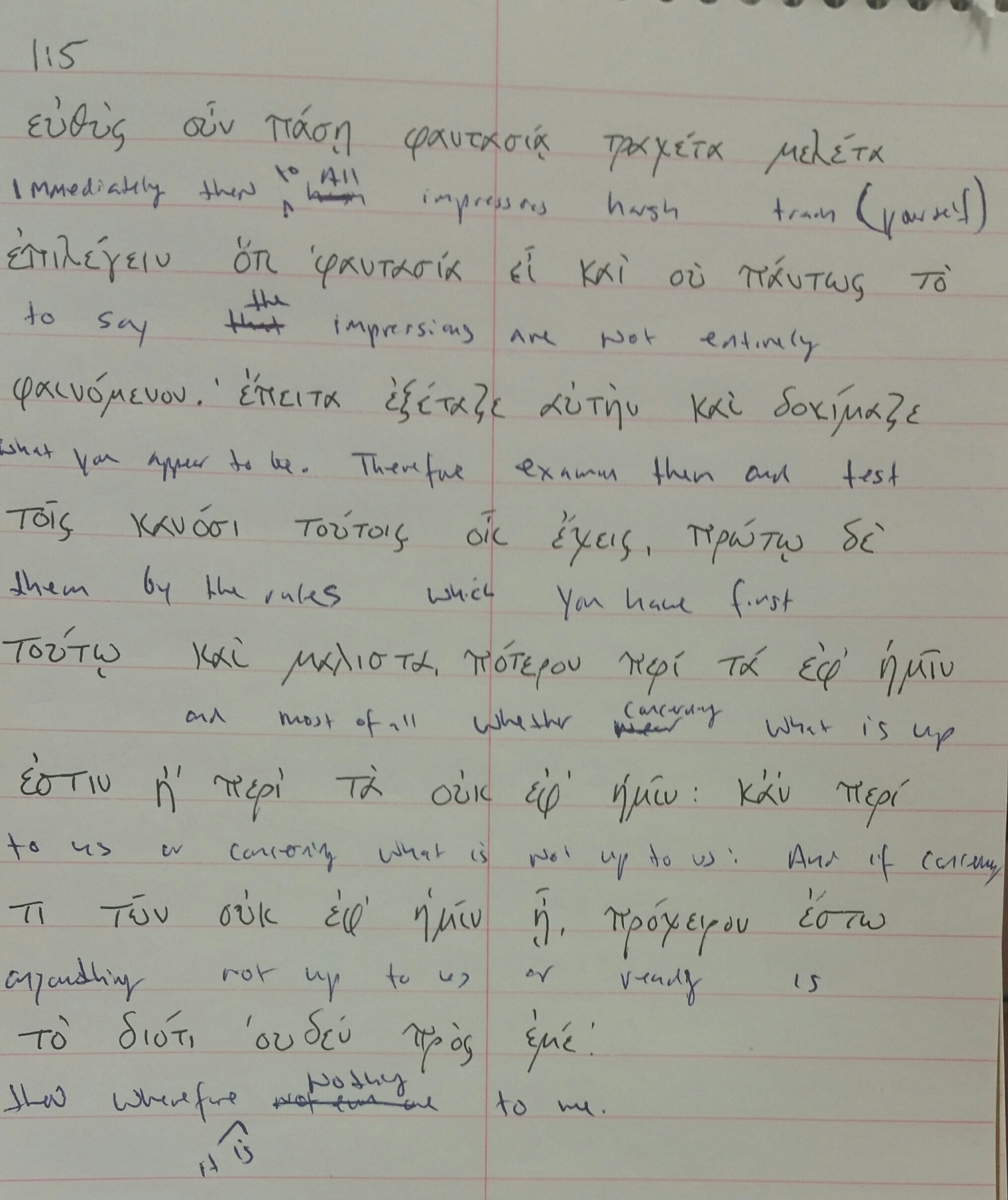
“Straightway then practise saying to every harsh appearance, You are an appearance, and in no manner what you appear to be. Then examine it by the rules which you possess, and by this first and chiefly, whether it relates to the things which are in our power or to things which are not in our power: and if it relates to any thing which is not in our power, be ready to say, that it does not concern you.”
Higginson:
“Seek at once, therefore, to be able to say to every unpleasing semblance, “You are but a semblance and by no means the real thing.” And then examine it by those rules which you have; and first and chiefly, by this: whether it concerns the things which are within our own power, or those which are not; and if it concerns anything beyond our power, be prepared to say that it is nothing to you.”
Koine:
“εὐθὺς οὖν πάσῃ φαντασίᾳ τραχείᾳ μελέτα ἐπιλέγειν ὅτι ‘φαντασία εἶ καὶ οὐ πάντως τὸ φαινόμενον.’ ἔπειτα ἐξέταζε αὐτὴν καὶ δοκίμαζε τοῖς κανόσι τούτοις οἷς ἔχεις, πρώτῳ δὲ τούτῳ καὶ μάλιστα, πότερον περὶ τὰ ἐφ᾽ ἡμῖν ἐστιν ἢ περὶ τὰ οὐκ ἐφ᾽ ἡμῖν: κἂν περί τι τῶν οὐκ ἐφ᾽ ἡμῖν ᾖ, πρόχειρον ἔστω τὸ διότι ‘οὐδὲν πρὸς ἐμέ’.”
I. King Darius greets Heraclitus of Ephesus, a wise man (p. 187)
Darius of Persia writes to convince Heraclitus to come to him and explain his teachings, since they seem to fly in the face of the common understanding but still bear the stamp of a reasoned position. Not only does he make the request, but he offers what he suspects will be enticing benefits.
II. Heraclitus to King Darius, Son of father Hystaspes, greetings (p. 189)
Heraclitus replies: “Nah.”
This is part of the Cynic Epistles Reading Plan.
Seneca,
Today’s letter touches on a tough subject for most folks. Grief is a hard thing. I’m not sure that I entirely agree that our greiving is for others, but I do entirely agree that our watching over ourselves contributes to the extended suffering.
It’s a funny thing, our intuition, whether natural or acculturated, is such that after a great loss, if we find ourselves enjoying some small thing or laughing, we reprimand ourselves severely. As if our every waking moment is to build a monument of grief. The extent of our pain is not a measure of our love, and that’s a strangely bitter pill to swallow.
My reading today was just the first part of the letter, and I look forward to finishing it.
Farewell.
“Aeschylus at the Isthmian games was watching a boxing-match, and when one of the men was hit the crowd in the theatre burst into a roar. Aeschylus nudged Ion of Chios, and said, “You see what a thing training is; the man who is hit says nothing; it is the spectators who shout.” ”
— Plutarch, How a Man May Become Aware of His Progress in Virtue.
How a Man May Become Aware of His Progress in Virtue.
This is an argument against several Stoic positions are relates to the Sage and the conversion to wisdom. Plutarch takes issue, as most folks might, with the idea that all vices are equal, and if one has one vice you effectively have them all.
Who would deny the degrees of difference between a lie about a man's beard, or condemning Socrates to death? Or a lie to your boss about something in your personal life, and murder?
Our common sense experience of the world and the systems we've created in it recognize these distinctions. But the classic Stoics did not. Let's look at why that might be.
The problems with the common conception and Plutarch's argument are the external focus of them. The Stoic positions is not to be used in matters of jurisprudence, or punishment, or to correct the behavior of others. Rather, it's a tool for ourselves to correct vicious intent.
If we are trying to divest ourselves of vice, and instill virtue, then we must account for every wrong, no matter how small. The Stoic position that all evils (here as always, our own moral evil) are equal prevents us from deluding ourselves about the nature of our intent.
"Well, I may have lied to my spouse about this small thing, but at least I stopped doing something worse. So that's okay…"
The Stoic cannot with any intellectual integrity make such a justification.
Plutarch's opening assumption focuses on comparing the actions of two humans, which is an inappropriate use of the doctrine.
Despite that, and the general polemic nature of the piece, this discussion does tell us quite a bit about the Stoic positions which we don't see in many other places.
It's well worth the read time.
Introduction: The Epistles of Heraclitus (p. 22)
This introduction is laying the scholarly and chronological context for the following letters. While there are only 9, we’re still looking at multiple authors, at least two possibly more.
The fact that scholars were divided as to the Cynico-Stoic nature of the letters versus a Jewish authorship is interesting. Heraclitus is an interesting figure, almost a zen poet of the west. Reading his fragments is a very different experience than reading a Stoic treatise, for instance.
This is part of the Cynic Epistles Reading Plan.
Seneca,
I find it interesting that you would Demetrius in high regard. There seems to be a trend of Stoics looking to the Cynics admirably. Epictetus speaks so highly of Diogenes as to whisper Sage in the same breath, for instance.
You often get short shrift, Seneca, for an opulent lifestyle. I find it especially interesting as we’ve gotten to known each other better over these past four months (!), that the letters which make it into the abridged versions generally exclude your focus on training and simple living. Of course, there’s the “take a few days of the month” bit, but this is generally viewed as mere lip service.
The ‘rich inner life’ of the Stoic philosopher is sometimes hard to see when first learning about the school, and I think that letters like these may help clarify the point.
See you next week.
Farewell.
XLIX. untitled: “The Cynic to Aroueca…” (p. 181)
The allusion to the philosopher as “doctor for the soul” is an interesting one. Reminds of me of the stigma which is placed on mental health issues, or at least the ones in the DSM-5. We don’t see the same prejudice against folks with “diseases” of their desires and aversions, with their passions ruling their lives. In fact, a certain amount of this sort of suffering is viewed as normal, or even healthy. So, like the Cynic says, choose the doctor well.
L. To Charmides, greetings (p. 181)
“Those who propose to cure others of what they haven’t been able to cure themselves.” I saw a documentary about Buddhist hermits in China, and one of the interviewers asks the monk to teach something of Zen. He replies, ‘there’s nothing to say, it’s all in the text. I can’t save someone else if I haven’t been able to save myself.’ Or something along those lines.
LI. To Epimenedes, greetings (p. 183)
So, this and the previous letter both speak to appearances versus actual reality. The decorated but empty box, the promise of virtue, but laziness in the doing. This is a good thing to keep in mind.
This is part of the Cynic Epistles Reading Plan.
Seneca,
What we have of the Stoics seems to present a paradox to the modern reader. Of course, the Stoics often did (and do) go against the popular opinions of the times, so it’s really not all that surprising. How is it then, that a school of thought which tells its students to accept what life brings you, not passively, but actively to desire that things are the way they are does not produce herds of slavish followers? Instead, it seems to produce bold men of action. Cato, Marcus, Musonius, Epictetus, and (yes, even yourself), Seneca. All of these either lived boldly and/or died well.
That’s remarkable.
“The man who does something under orders is not unhappy; he is unhappy who does something against his will.”
There is a certain psychological boon to having a mental conception of an outside presence. For modern monotheists of the Abrahamic stripe this means very specific things. Theologians may debate the “economics” of the passion, death, and resurrection of their savior and precisely what that means; but it is much harder to doubt the balm that such an “off putting” of responsibility can provide.
Stoics are in a tighter spot. Of course, the atheists are right out of the frying pan an into the fire: it’s all on you, best of luck. But the theist/deist Stoics are not necessarily in a much better position. The Stoic divinity, Nature, Providence, Logos, what have you, isn’t a personal force there to provide you with some sort of reconciliation or amelioration with the world and your life.
The Stoic divinity will not pull you out of the ground and plop you into a cushy afterlife to hang out and bask in the presence of the one. Ain’t happening.
In fact, unless you be a Sage, your soul won’t live on after death. And even if you were a Sage, you wouldn’t make it past the ἐκπύρωσις. So tough luck there, mate.
The only chance for Stoic salvation, if I may, is in the here and now. Heaven or Hell is what we make it, this life. With every choice we train our moral will, and we produce either virtue or vice.
We may not have the emotional, psychological bandage that others do, but we sure as hell (pun intended) have an urgency, a motivation.
Farewell.
 Mountain Stoic
You must be logged in to post a comment.