
The Enchiridion begins with this line:
τῶν ὄντων τὰ μέν ἐστιν ἐφ᾽ ἡμῖν, τὰ δὲ οὐκ ἐφ᾽ ἡμῖν.
Long translates this as:
“Of things some are in our power, and others are not.”
Higginson translates it as:
“There are things which are within our power, and there are things which are beyond our power.”
Carter as:
“Some things are in our control and others not.”
White as:
“Some things are up to us and some are not up to us.”
The Koine ἐφ᾽ ἡμῖν translates literally as “on us,” and thus the variety of interpretations in English. In modern English we’re apt to say, “No, that’s ‘on you,‘ meaning it’s your responsibility or prerogative.
In modern Stoicism there is a trend, which if I recall correctly goes back to Irvine, to set-up a Trichotomy of Control, which is: things which are up to us, things which are up to us somewhat but not entirely, and things which are not up to us.
Strictly, under the Dichotomy of Control, the only things which are up to us are opinion, movement towards a thing or impulse, desire, and aversion. Basically, our intent and moral will. And that hard line with which we circumscribe these very small number of things necessarily excludes all else. This is the traditional, orthodox position.
Irvine’s heterodox interpretation seems to me to stem from the experiential observation that while we cannot guarantee how are our actions will end in the world, we can influence some part of it, more or less. I can intend to help someone out, and I can influence someone to do so with me. Although their choice is not up to me, I can plant the seed, and arrange the environment in such a way as to be conducive to that end. Seems reasonable.
Philosophy comes to bloom in Ethics. It was the primary focus of the Roman Stoics, and it is often the sole focus of the modern practitioners. The ethics and the teleology matter, no question there. I suspect that this is crux of the issue with the Trichotomy.
For the traditional Stoic, she can rest content knowing her actions had a virtuous intent even if they fall short of “doing good” from an outside perspective. This seems to be a generally distasteful position for the modern Westerner.
We see this a lot in social situations, especially in instances of perceived power and perceived oppression: “I don’t care what you meant, I care what you did.” This post-modern perspective holds each person’s opinion and emotional response up as a rule for other folks’ actions… something which the traditional Stoic would likely deride.
I suspect that this move to a Trichotomy is a reasonable attempt at divorcing traditional Stoicism from its theological and teleological bent, and place it in a tract more conducive to modern atheistic Stoicism. While we are all endeavoring to transplant a 2000 year old philosophy into the modern world without 2000 years of tradition and development; we must be cautious in what and how much we change. At some point, if we change enough things, intellectual integrity should require that we change the title of thing. You might not be wrong to change it, but is it still Stoicism after the change?
Irvine’s position allows for the perspective that doing external actions will take a place equal to keeping our own moral will in line with the Logos and laws of reason. It represents a core and significant change to traditional Stoic doctrine… which Epictetus himself called “δόγματα/dogmata,” the basic tenets of our school.
While it is observably true that this seems to be the case, is it a good mental model for the practicing Stoic? Is it a good doctrinal position? Let’s examine that. If there is this third class of things, and the Stoic is frustrated in their attempts there, have they lost a ‘good-per-se’? This is the necessary and proper question to ask. If we have an influence there, then this thing must necessarily influence our own virtue. It must be treated to some degree as a good-in-and-of-itself.
Accepting the Trichotomy will have cascading tiers of effects within Stoic thought. If it’s a good-per-se, and we fail in these endeavors, what does that say about our progress to virtue? If we intended to good, but didn’t do enough ancillary things to bring it about, have we in fact done something anti-virtuous? At this point, have we arrived at a conception of virtue which is closer to the Peripatetics and Academics than it is to the Stoics and Cynics? A position which requires some material and external factor in Stoic virtue ethics?
I would argue, that indeed such is the case. If we accept the Trichotomy of Control, we will necessarily shift our conceptions of virtue (if we’re to maintain intellectual integrity) to things which are outside of our control; and this is an unacceptable consequence when seen with the lens of the core tenets of Stoicism. Therefore, the Trichotomy should be denied, and the traditional Dichotomy of Control as noted by Epictetus and others maintained.
Massimo aruges for the Trichotomy in his piece from March of this year. In it, he quotes Irvine:
“Stoics would recommend, for example, that I concern myself with whether my wife loves me, even though this is something over which I have some but not complete control. But when I do concern myself with this, my goal should not be the external goal of making her love me; no matter how hard I try, I could fail to achieve this goal and would as a result be quite upset. Instead, my goal should be an internal goal: to behave, to the best of my ability, in a lovable manner.”
However, there is an error here, a misreading. What is being focused on is still the intent, what’s “up to us.” To intend to be a good partner is up to us. You might do things which you think will make your wife love you, but that’s actually a weird, economic position on love. How many unrequited lovers in the ‘friend zone’ treated their would-be-partners as love-machines which convert kind acts to love? The fact is, you can’t make your wife, or anyone, love you; and thus, reasonably, you must focus solely on the intent of being a good partner and/or friend… or at least a good person will do so.
There’s nothing here which extends to an intermediary state of intent, so while arguing for the third, heterodox category, the example given still falls within the traditional Dichotomy. In every instance of focusing on the intermediary state of intent, the proponent of the Trichotomy points to something which rightly falls under the Dichotomy. As such, the Trichotomy is an illusion which only points to something in the Dichotomy.
How we set about to fulfill our obligations and roles under the paradigm of οἰκείωσις/oikeiôsis is an internal action. It is a question of intent and moral will. To suggest that since most of the classical Stoics we know about were “men of action” shows that they valued these external things is also an error.
First, we are likely only to know about those who had great effects, public renown, and/or elicited strong emotions from their contemporaries. Second, these folks believed they had roles and obligations to their peoples. Whether one succeeds at those roles is not however necessarily of consequence to the philosopher.
Now, many folks who are ‘men of action’ do value those external things. But we’re not talking about those men, we’re talking about philosophers. It is simply a necessary step that a philosopher whose intent is to execute an obligation will try to do it excellently, even if they fail. In the instance in which it doesn’t fail, they are then perceived by the wider and untrained people as men of action, which does not refute the traditional position.
The Trichotomy is untenable in Stoic though under these two conditions, both unacceptable consequence to virtue, and the fact that it still points to intent under the Dichotomy.
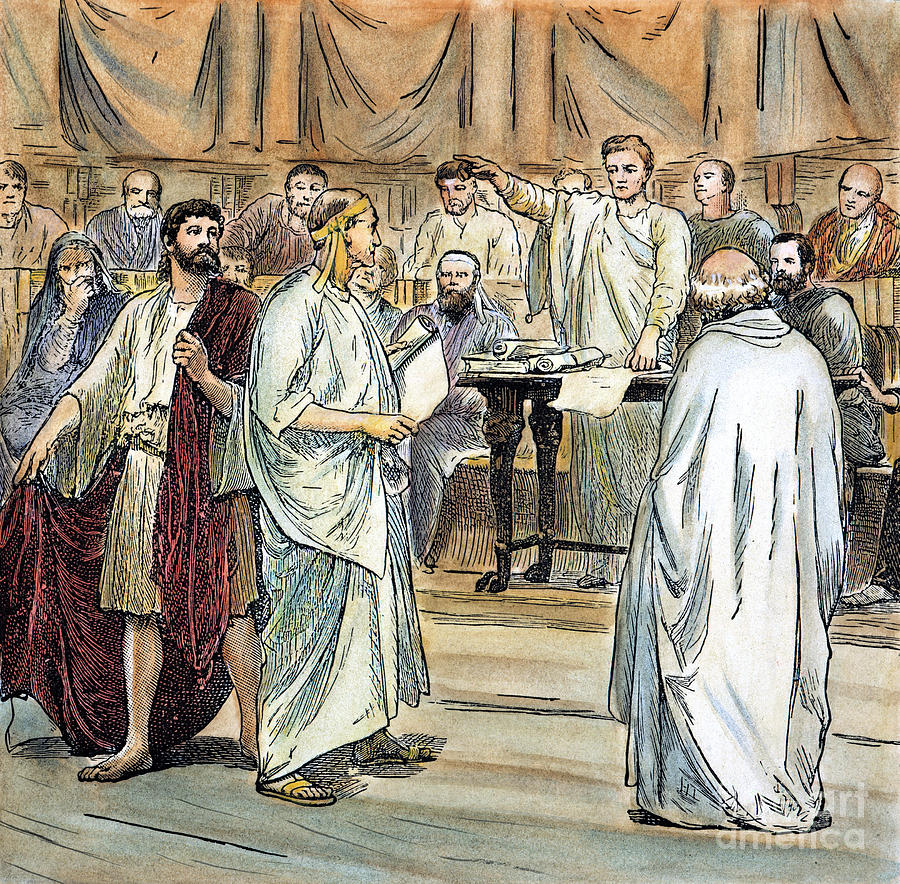
 four-letter word on some sites and blogs these days). While it’s true that religions generally have rituals, we have many secular ones as well. Getting a driver’s license tends to have ritual significance as a coming of age rite, graduations are heavily and careful prescribed activities (even with ritual garments, gestures, talismans, and music). Weddings, even at the court house, and on and on. The story of human life is punctuated with ritual.
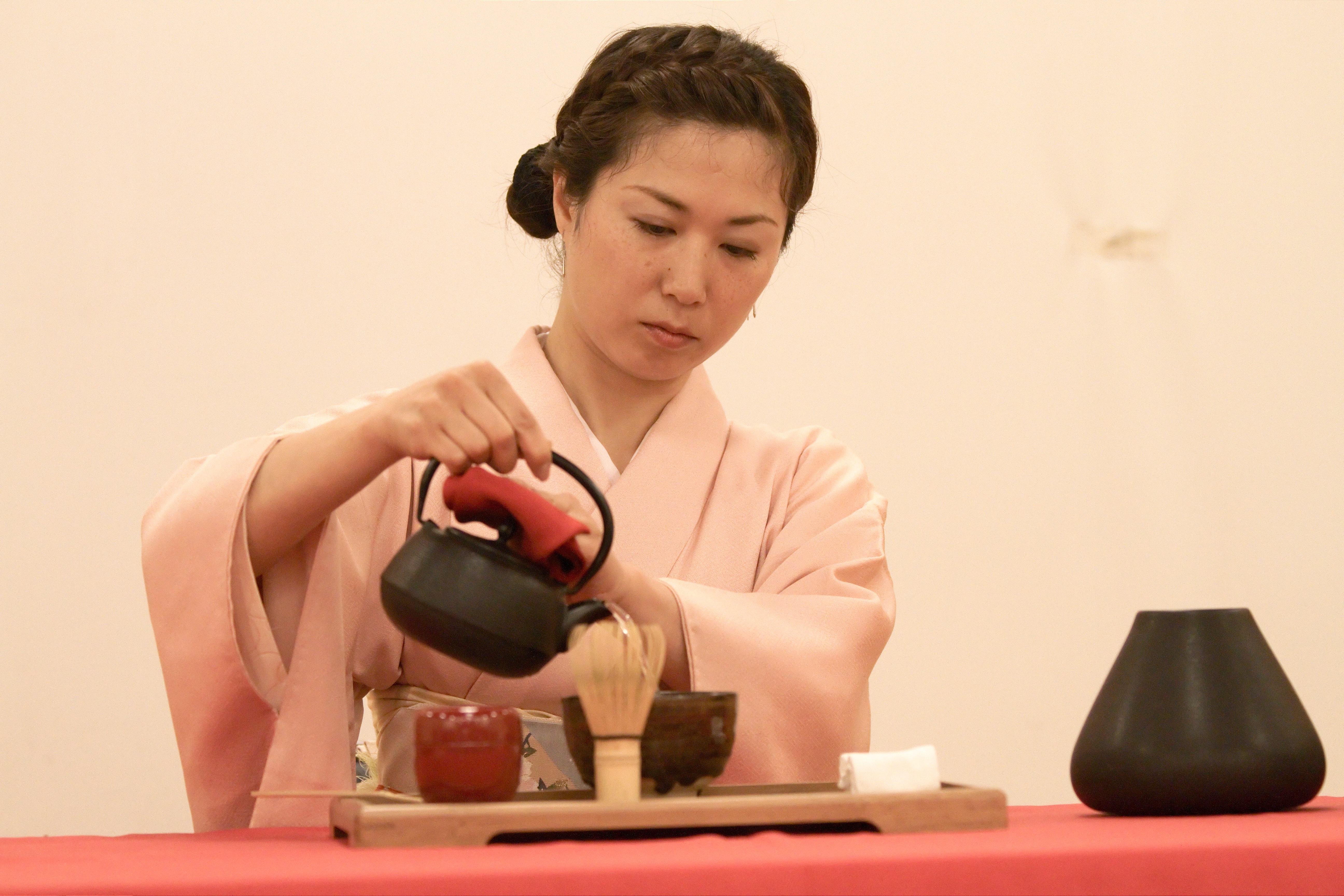 There are several reasons why a modern Stoic should consider ritualizing his or her practice. Ritual and symbolism speak to the human mind in a way that overt, language-based impressions do not. Rituals build a sense of seriousness and solemnity to activities; like the Japanese Tea Ceremony. Rituals help make sure that we are doing complex things in a prescribed manner. How many of us learned to tie our shoes and cross the street with ritualistic formalism? Maybe even a parable about a rabbit?
 If we want to learn to box, we start in a gym; we don’t go pick a fight with Ronda Rousey.


 Mountain Stoic
You must be logged in to post a comment.