On Robbin Williams and Suicide

Standard

Suicide if undertaken for the right reasons is not an evil in Stoicism. Socrates committed suicide, Seneca also. However, if it’s merely a means of escape from your obligations and trials, it’s not virtuous.

Seneca wrote “The wise man will live as long as he ought, not as long as he can.”

But if your life has ripened, like a fruit, and is best at this moment, then plucking it is reasonable. Or if continued existence would destroy your moral or rational nature, a sagacious person might undertake it.

Epictetus: “The door is always open.”

What Dreams May Come

That being said, most folks are not in that position, and if someone is troubled and suicide is a thought they are entertaining, then they should probably ask for help, as we would be obligated to give it as we were able.  We do not know under what pain he was living, and it’s difficult to “armchair quarterback” his decision.  We can look at the context, and the social roles he had.  His children are adults, his family secure.  He did excellent work, and he struggled (not always, but sometimes successfully) with his demons and flaws.

I don’t think anyone undertakes Robin’s decision easily. I hope he finds some solace and relief in what may come after. I hope he knew the lightness of heart that he brought to many.

This is the advice I gave to some friends on Facebook:

When someone we are attached to leaves us, rather than lament at losing him or her, instead think that he has returned home.

We never possessed them, we merely borrowed them for a time. When the owner of something we’ve borrowed asks for it back, no matter how, we should return it with gladness for having experienced it.

Kipling’s “The Palace.”

Quote

The Palace
1902

When I was a King and a Mason — a Master proven and skilled —
I cleared me ground for a Palace such as a King should build.
I decreed and dug down to my levels. Presently, under the silt,
I came on the wreck of a Palace such as a King had built.

There was no worth in the fashion — there was no wit in the plan —
Hither and thither, aimless, the ruined footings ran —
Masonry, brute, mishandled, but carven on every stone:
“After me cometh a Builder. Tell him, I too have known.”

Swift to my use in my trenches, where my well-planned ground-works grew,
I tumbled his quoins and his ashlars, and cut and reset them anew.
Lime I milled of his marbles; burned it, slacked it, and spread;
Taking and leaving at pleasure the gifts of the humble dead.

Yet I despised not nor gloried; yet, as we wrenched them apart,
I read in the razed foundations the heart of that builder’s heart.
As he had risen and pleaded, so did I understand
The form of the dream he had followed in the face of the thing he had planned.

* * * * *

When I was a King and a Mason — in the open noon of my pride,
They sent me a Word from the Darkness. They whispered and called me aside.
They said — “The end is forbidden.” They said — “Thy use is fulfilled.
“Thy Palace shall stand as that other’s — the spoil of a King who shall build.”

I called my men from my trenches, my quarries, my wharves, and my sheers.
All I had wrought I abandoned to the faith of the faithless years.
Only I cut on the timber — only I carved on the stone:
“After me cometh a Builder. Tell him, I too have known!”

MA School update

Standard

So, I’ve all but finished the first term in New Stoa’s Marcus Aurelius School.  The first term was logic, and we’re moving on to physics next.  The course thus far is interesting, and the readings and books are more in depth than the SES course.  So far, I’m enjoying it quite well.  I’m looking forward to the next term, which begins in early July.  The format of the course is altered slightly, and the change of pace is welcome.

If you haven’t stopped by and checked out the fine folks at New Stoa, I heartily suggest it.  The free SES course is a great place to start!

Stoic philosophy and the art of motorcycle maintenance

Standard

Today, I rode past a church which had on its sign “The one who makes you angry controls you.” Motorcycle riding offers a unique sort of period for contemplation, and this was excellent fodder for my ride.

I think that what the church meant was that we should not surrender our freedom to others, but I took a different, Stoic message from it.

The one who makes us angry controls us, by which we could mean our ruling faculty, our reason controls us and has the ability to make a judgement of being harmed which can result in anger.

Instead of worrying over whether our neighbor controls our actions, we should firmly look to controllong ourselves, since it is by means of a judgement that we are made angry… or not.

Voluntary austerity

Standard

So, in the vein of voluntary exposure to those things which we might not classify as indifferents, I was scheduled at work for 8 hours on, 8 hours off, then 12 hours on.  I have a 45-minute commute each day each direction.

I was scheduled to work from 2pm to 10pm, then to be back at work again in uniform, armed, and ready to go by 6am.  If I travel home (I live and work in two different cities) , I don’t get much sleep.  So, I was going to sleep at work, on a cot, in a back room. However, I was informed that for some reason (which was kind of made up) that I shouldn’t do that.  Not wanting to deal with the hassle, I decided to make the best of it.

So, I slept in my car in the parking lot.  This allowed me to sleep in until 0530 instead of getting up at 0430. It saved me travel time, and I got to bed about 45 minutes earlier than I would had I gone home.  All in all, turning what would have been about four hours’ sleep into darn near seven hours.

My knees and back aren’t thanking me much, this new vehicle isn’t nearly as comfortable to sleep in as my last one, but I now know that if I need to, I certainly can sleep there.  I also ate the same food for four straight meals, focused more on the fuel of the body than the preference for the tastes.

So, working my way through a 12-hr shift after the end of a 70-hour work week, I’m in better spirits than I might have first thought.

On philosophy and philology

Standard

Our modern conception of virtue is predicated on the Greco-Roman period of antiquity, but we find ourselves in an interesting position in relating to the vocabulary that we use to talk about these ideas. There are two main versions of the four cardinal virtues of which I am aware. They are “Temperance, Fortitude, Prudence, and Justice” and “Temperance, Courage, Prudence, and Justice.” These translations are interesting, and I’ll discuss them each in turn.

Temperance: σωφροσύνη (sōphrosynē): In English, temperance is generally understood to mean “moderation” esp. in the case of alcohol, but more truly in respect to all the passions or emotions. It is “the middle path.” However, in the Greek, sōphrosynē means something different. When translated to Latin, the word they used was ‘decorum,’ which the Romans graciously passed to us via the Normans in 1066 when they concurred England.

A better English translation would be “fittingness,” meaning that state of a critter fitted and suited to it appropriate functions in its particular context. When meeting your spouse’s boss, extra politeness would be fitting. When celebrating a birthday, the consumption of a moderate amount of alcohol would be fitting. When reprimanding a child in your care, a certain amount of firmness tempered by mercy and concern for his or her well-being is fitting.

Fortitude/Courage: ἀνδρεία (andreia): Fortitude and courage are related, but not directly interchangeable. Taking aside the social construction of gender, the Greek word here better translates as “manliness.” Courage can relate to physical and also to moral courage, the same can be said of fortitude. The difference here tends to be one of the school of thought of the translators and philosophers, but it is interesting to note what each much have thought “manliness” most entailed.

Prudence: φρόνησις (phronēsis): also comes to us from the Latin, prudentia. Meaning, in the native Greek wisdom, but having added to it knowledge. Not a whole lot of issues here.

Justice: δικαιοσύνη (dikaiosynē): sometimes Justice, Fairness, and in Christian traditions, often piety or righteousness. Not much of an issue here.

Consider also, that the word Virtue is often translated from the Greek arete (ἀρετή), when a better translation might be something like “excellence” or “a thing functioning according to its truest nature.”

Whenever we are dealing with such important ideas as morality and ethics, we often detach from them the conception that they are informed by and shaped by us, ourselves. The conception of virtue is appropriate for a certain people, of a certain time, in a certain place, speaking and thinking in a certain way. Just food for thought.

Be well, and be excellent.

Philosophical Graffiti

Image

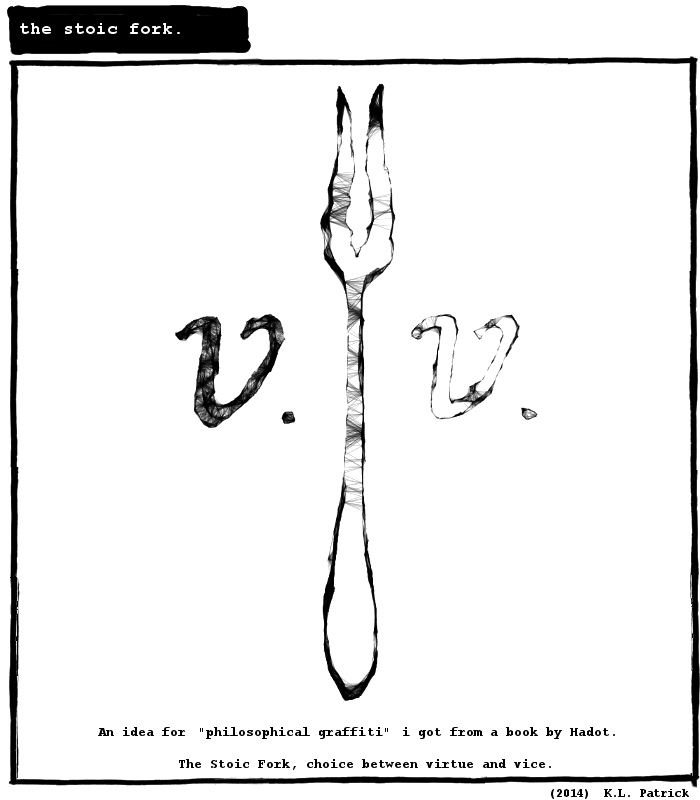
I’m reading Hadot’s “Philosophy as a way of life,” and in the introduction there is a discussion about iconography and ‘philosophical graffitti.’  I had this thought, what a neat project it would be to create philosophical graffiti?  Messages of wisdom in the language of the people, on the streets, visible and accessible.

Well, that though spun off to, “What would such a think look like?”  Which resulted in a post on my web-comic-diary-thing.  The post is below.


kevin_40link:  http://mountainscrawl.wordpress.com/