MMRP: Book I, Chapter 16

Standard

In Chapter 16 Marcus enters into the longest discussion of Book I yet, and shows us his father.  I’ve recently been reading about Epictetus’ sense of Roles which differ significantly from Cicero’s account, the more prevalent one.  In reading Marcus’ thoughts on his father, it seems to of two types of observations.  The first, being how the man executed his various roles: carefully, controlled, effectively, and with fairness.  The second being the manner in which the man carried on his daily life: a seeming paragon of Roman decorum.

When Stoicism ceased to be a Greek-speaking realm’s pheromone, and migrate to Rome, it underwent some changes.  Hellenistic philosophy sometimes had hard edges, that cut deeply into the lives of those that handled it.  In Rome, some of those edges were knocked down.  The Cynic’s παρρησία, while still tolerated even in the watered down Roman manner, was pushed aside for the decorum.  Marcus’ discussion of his father shows this, in the focus on his roles and bearing while executing his duties as a Roman.

It is a great loss for those of us studying the Stoics not much of the early Hellenistic Stoics remains.  I still hold out my hopes for a “Stoic Herculaneum” of sorts.

The last note, about Maximus and his sickbed, make me wonder what Marcus might remember of his own father.  Back in Chapter 2, you may remember that he mentions “of what I remember” and stories he’s heard.  A quick internet search tells me that Marcus would have been about three years of age when his father died.  Not everyone has memories of that time of their life.  I have a couple, and one even older, but that’s pretty uncommon.  I wonder if Marcus’ only memory of his father is of the man’s death?  That would be something.


Part of Michel Daw’s Reading Plan of Marcus’ Meditations.

MMRP: Book I, Chapters 12-15

Standard

The Stoic conception of the Sage has undergone some changes throughout time.  It has variously been an achievable human ideal but one of exception, seen as an achievable sort of “every-man’s virtue,” and an unachievable ideal used as a model against which to measure behavior.  We’ve talked about two of these on the blog, that I can recall readily.

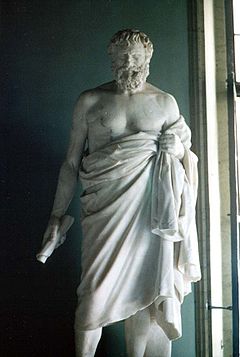
Chrysippus of Soli, Second Scholarch of the Stoa.

Chrysippus of Soli, Second Scholarch of the Stoa.

Marcus’ continued exercise stands as a reminder that we can find examples of appropriate actions (καθήκοντα) without going too far.  It is easy to look to people from whom we’re separated by great spans of time and space:  Epictetus, Diogenes, Zeno, and then to imagine ourselves so far from that ideal.  However, we can also look more closely to home: to mentors, teachers, family members, and the good folks we come across every day.  These folks may not be Sages, but it’s entirely possible that their actions and attitudes can provide a mirror for our own progress.

A co-worker may handle set backs, and tough management with a seemingly unnatural aplomb.  We can admire that, and seek to inculcate that same project from a Stoic perspective.  They may not take the same route to get there that we do, but the action is certainly appropriate to one making progress.

A family friend may handle the declining health and eventual loss of a parent with care, kindness, and genuine affection.  Such is certainly appropriate for us in our familial roles.

A good friend may decline dessert, have but one drink, exercise moderately, and choose good foods:  the very picture of moderation and self-control.  Certainly this is appropriate for the practicing Stoic?

Examples of “good behavior” abound, and (for those in the US), maybe especially needed during a period of general discourtesy and social tension.


Part of Michel Daw’s Reading Plan of Marcus’ Meditations.

MMRP: Book I, Chapters 8-11

Standard

Book I continues in Marcus’ exercise in gratitude, specifically of teachers and mentors.  The thing which stuck out at me for this section is that these teachers are in the past, but they appear to be quite a ways in the past, rather than just a year or even five ago at the time of the writing.

It’s been my experience that I didn’t fully recognize the teachers who made a lasting impression until much later.  The same is true for family members.  The formative effect of my grandfather wasn’t apparent to me until I saw his words, thoughts, and actions as things of myself as well.

The seeds of the people we become are planted deep and early, and it seems only when the bows have grown heartily that the core nature of it visible.

I mentioned to my wife recently that it seemed a great loss that she never got to meet my grandfather.  My mother overheard this and said, “Kevin makes sense if you knew my Dad.” This caught me by surprise, for as this relationship has become apparent to me, I was unaware that it was apparent to others.  Which is rather silly, in retrospect.

I wonder if Marcus had similar experiences, looking back on a life lived, and seeing the landmarks only afterwards, the people and beliefs which guided him to where he now stood?  I think that this must be the case when I re-read Book I.


Part of Michel Daw’s Reading Plan of Marcus’ Meditations.

MMRP: Book I, Chapters 1-7

Standard

Today kicks off Michel Daw’s project of the reading of Marcus’ Meditations. You can find the pdf of the plan here.

Book I is an exercise in gratitude. Marcus thanks and gives credit to those who helped shaped the man he has become. I begins first with family, noting their specific contribution to his rearing and formation. He moves on to teachers and philosophers, who helped inculcate in him early that philosophy is thing to do, a way of life, and not merely analytical and rhetorical exercise.

For this reading plan, I’m reading a new-to-me translation by Maxwell Staniforth (1964). Staniforth notes that the title of the work, which was never intended to be read by others let alone published globally and in many languages, is titled “Meditations” in the English world solely by convention. In the Greek (in which it was written, not Latin) it is ΤΩΝ ΕΙΣ ΕΑΥΤΟΝ, or “to himself” sometimes “The Emperor to Himself.”

Koine Greek was the language of philosophy in Rome, with a few key exceptions (Cicero, Seneca, et al.) Marcus was clearly proficient in the language, and the whole of the book is a compendium of philosophical exercises, or spiritual exercises if you like: ὑπομνήματα. This word, ὑπομνήματα, means something like “notes” or “reminders.”


I will begin this reading of Meditations with a Book I of my own.

To my grandfather and father I owe the appreciation of the example of hard work and the meaning of family ties. These men set an example in this arena which I have never met, but which was so great that even when I see myself fall short, I stand out among my colleagues and coworkers. Also to my grandfather, the love of music and stories.

To my mother I owe the belief that life must be meaningful, that the all-too-common settling for the average is a danger to be avoided. To her I also attribute the structure of my understanding of things divine; as well as my love of reading, writing, and great literature.

Two teachers of mine stand out in memory from my formative years: Dr. Seitz and Mr. Fields. These two provided me with the example of excellent instructors, passionate orators, and genuinely caring men. In an environment which is not overly conducive to such things, these two changed my perspective on more than just lecture material.

Two more recent teachers who have helped to shape my efforts in philosophy, carefully correcting errors and misapprehensions but also knowing when to step back and let me solve a problem or grow in my time: Erik Wiegardt and Chris Fisher.

To Yannos, Brendan, Germano and Chaz for always being willing soundboards, mutual advisers, friends, and teachers.

To several close friends: for supporting me and helping me rebuild when I myself could not see a way out of the ruins and ashes of my external endeavors.


Part of Michel Daw’s Reading Plan of Marcus’ Meditations.

Musonius-esque living, Cynicism, Hercules, and the Pseudo-Lucian.

Standard

I recently read “The Cynic,” by the Pseudo-Lucian.  This work is a dialogue between Lycinus and an unnamed paragon of Cynicism.  The dialogue has a Socratic feel, being mostly one of questions and answers.  Also, Lycinus begins with the (mistaken) belief that he already knows a thing or two about a thing or two.  Our Cynic, however, proves to him that he holds contradicting beliefs, which cannot stand with each other with integrity upon examination.

There is a marked difference, in my estimation, to the Socratic dialogues, in that the Cynic also believes he knows something.  These sorts of essays written under the auspices of other philosophers, often have a proselytizing component, as most of the Cynic Epistles did.  For this reason, it’s not surprising then that our Cynic is in fact teaching explicitly.

The Cynic explains after Lycinus’ first question, that he is no condition of want, his needs are fulfilled, and he is healthy.  Lycinus then jumps into a description which I think lines up well with the modern person’s misconstruing of preferred indifferents (προηγμένα) in Stoicism.  I’ve seen folks who seems to think the Stoic position prompts the pursuit of wealth, pleasure, and other things which a Cynic would call typhos (τυφώς), and then make similar arguments.  This is not the case, by my reading, although it may allow for projects in these realms secondary to virtue.  Yet, I still prefer that these projects ought to be built so as to train us for virtue, a point to which we will return shortly.

Lycinus’ position is wrapped up in a strange theological argument; that to deny the bounty of nature and the ability of our bodies to take pleasure in these things which are provided is in fact a sort of impiety.  Immediately after, however, he gets to the meat of it:  he doesn’t like to go without the things he like.

“To live without all these would be miserable enough even if one could not help it, as prisoners cannot, for instance; it is far more so if the abstention is forced upon a man by himself; it is then sheer madness.” Lycinus says.

The Cynic responds with a point which is well at home in the world of Stoicism, that the manner in which we use these things is not in and of itself valuable, but only instrumentally so.  The things are indifferent, but our intent and actions can have a moral component for our own virtue.  We cannot inculcate σωφροσύνη (moderation, sort of [Wiki], [MS on food] ) if we don’t actually act out the virtue.

The Cynics makes his point with a metaphor that should not be novel to a student of Stoicism.  We also see it in Epictetus: the dinner party:

Remember that you must behave in life as at a dinner party. Is anything brought around to you? Put out your hand and take your share with moderation. Does it pass by you? Don’t stop it. Is it not yet come? Don’t stretch your desire towards it, but wait till it reaches you. Do this with regard to children, to a wife, to public posts, to riches, and you will eventually be a worthy partner of the feasts of the gods. And if you don’t even take the things which are set before you, but are able even to reject them, then you will not only be a partner at the feasts of the gods, but also of their empire. For, by doing this, Diogenes, Heraclitus and others like them, deservedly became, and were called, divine. 

— Epictetus, Enchiridion 15

The Cynic takes it a bit further, expounding on the idea and pulling back the curtain on the illustration which in the Enchiridion is hinted at.

… [T]he hospitable entertainer is God, who provides this variety of all kinds that each may have something to suit him; this is for the sound, that for the sick; this for the strong and that for the weak; it is not all for all of us; each is to take what is within reach, and of that only what he most needs.

All of this goes to underscore the point that the Cynic’s goal is “enough” not a surfeit.   He explains that his cloak meets his needs, his feet fulfill their function unshod, his body is adorned as a man’s ought to be, and the needs of his stomach met easily.

It’s important that we also note a difference here between the Cynic school, our mother school, and the Stoic.  Cynicism was descended from the Cyrenaics, where pleasure is held to be a good.  It might seem strange at first that a school which held up ἡδονή (pleasure) as a good would chose to live as the Cynics did.  Yet we see a parallel in the Epicureans, who espoused a more meager sort of pleasure, a simple kind.  At this point our schools diverge, on the underlying moral values.  The reasoning, though, is similar as it’s presented here.  How we handle material, external, indifferent things has a moral component and matters in the practice and progress of our own virtue.

Image result for murexThe Cynic then proceeds to attach several luxuries in succession, pointing out the same rule, that a lack of want and glut are not the same.  Afterwards, he turns Lycinus’ false piety on its head, and discusses the same purple dye we see from Zeno through Epictetus to Marcus: the murex and its blood. He states that to misuse this creature, not as food, but to color their clothes for aesthetic reasons is an impiety.

It’s interesting to me how this little shellfish dances through the Stoic canon and related works.  If future Stoics are looking for an emblem of sorts, this little guy might make an interesting one.  An interesting spin on Epictetus’ be the purple, maybe?  I’ve chosen my own icon, but there is room for others.

After this, we get another look at one of Seneca’s Sages, Hercules.  In many ways, next to Socrates, Hercules is the patron of both the Cynics and Stoics, and Pseudo-Lucian shows us why.  He closes with a long monologue, no longer fielding questions, but teaching as if a lecture, or public pedagogue.  Image result for hercules statue lion

These externals that you pour contempt upon, you may learn that they are seemly enough not merely for good men, but for Gods, if you will look at the Gods’ statues; do those resemble you, or me? Do not confine your attention to Greece; take a tour round the foreign temples too, and see whether the Gods treat their hair and beards like me, or let the painters and sculptors shave them. Most of them, you will find, have no more shirt than I have, either. I hope you will not venture to describe again as mean an appearance that is accepted as godlike.

Most of this discourse would be at home in the lectures of Musonius or Epictetus.  The Cynic heritage which Zeno introduced into his philosophy continues to be of relevance.  To me, this pieces asks us to examine the externals of our lives and weight them against our moral training.  The manner in which we eat, dress, sleep, and comport ourselves is training: but it is training us towards virtue?  That is the operative question.  You may not need to wear a thread-bare and simple cloak (τρίβων) or lion’s skin.  You may not need to subsist on lupine beans (which are expensive where I live, but were cheap for Diogenes).  You may not need to live without home, spouse, or work.  But you may need to address how you do those things in light of our philosophy’s ideals.  I certainly do, and the Cynic seems to know that as well:

… [T[he fact being that you in your own affairs go quite at random, never acting on deliberation or reason, but always on habit and appetite. You are no better than people washed about by a flood; they drift with the current, you with your appetites.
Stoicism on Fire

Link

Image result for stoicism on fire podcast

Stoicism on Fire Podcast.

If you enjoy the writing of Chris Fisher at TraditionalStoicism, I want to point you towards his podcast, which is now in its 14th episode.

I think you’ll find the quality and effort that goes into the writing and podcast sets Chris apart from many online commentators.  His posts usually have 15+ citations, and are always well researched.

Stoicism on Fire fills a needed niche in the Online Stoa, and I hope you’ll give it a listen.

Currently Reading: Ethical Roles in Epictetus (B.E. Johnson)

Aside

Ethical Roles in Epictetus
by Brian Earl Johnson
In: Epoché: A Journal for the History of Philosophy 16 (2):287-316 (2012)

Abstract

Epictetus holds that agents can determine what is appropriate relative to their roles in life. There has been only piecemeal work on this subject. Moreover, current scholarship on Epictetus’s role theory often employs Cicero’s narrow and highly schematic role theory as a template for reconstructing Epictetus’s theory. I argue against that approach and show that Epictetus’s theory is more open-ended and is best presented as a set of criteria that agents must reflect upon in order to discover their many roles: their capacities, their social relations, their wishes, and even divine signs. Epictetus in Ancient Greek and Roman Philosophy.

ISBN(s) 1085-1968
DOI 10.5840/epoche20121628


This is an interesting read, but it’s behind a paywall, so no link.
Check your local university or inter-library loan for a copy.

On other people’s evils

Standard

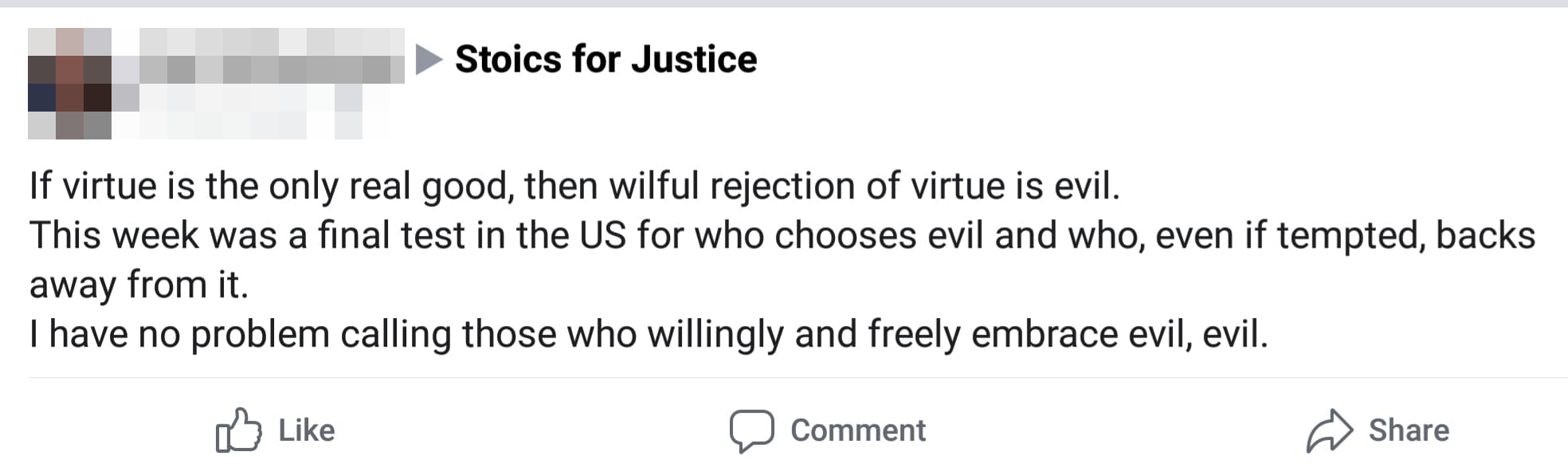
I saw this post in a Facebook group today, and I replied to it in a short way. I suggested the author must have misunderstood the nature of Good and Evil in Stoicism. To be clear, I think that the person’s response is actually indicative of a compassionate nature. However, strictly within stoicism that response is incorrectly placed and speaks to incorrect beliefs about the nature of Good and Evil, and thus an incorrect judgment/emotion as a result.  If this were just a random post on Facebook, I would not think it was a place to expand on these ideas.  Since it is taking place in a group at least nominally dedicated to the topic of Stoicism, it seems useful and reasonable to discuss it within that context.

I think that the post above is referencing an incident in current events in which it appears that U.S. immigration officials have been separating parents from children after they have illegally crossed the U.S. border for some number of years. There have been questions about the quality of those detainments and the morality of doing it at all. Regardless of one’s political persuasion, this discussion is important for a nation and a people to have, especially knowing it has been going on for quite some time.  (Aside:  breaking news at the time of this writing, the White House has announced that this practice will be terminated).

I do not intend to weigh in on the topic at hand, since it is a little bit off topic for the blog, but I do want to reference how this sort of current event is viewed through a Stoic lens. It is also not my intention to call out the original poster for their post, which is why I have redacted their name profile picture. I really want to address the philosophical issue at hand and not muddy it in some other way, or imply some sort of ad hominem against the poster. So, with those caveats in place…


Don’t be prideful with any excellence that is not your own. If a horse should be prideful and say, ” I am handsome,” it would be supportable. But when you are prideful, and say, ” I have a handsome horse,” know that you are proud of what is, in fact, only the good of the horse. What, then, is your own? Only your reaction to the appearances of things. Thus, when you behave conformably to nature in reaction to how things appear, you will be proud with reason; for you will take pride in some good of your own.

— Epictetus, Enchiridion 6.


In most people’s preliminary introduction into Stoicism, they read the Enchiridion in which we see the above quote. It is clear then from the beginning, that a Good must be solely up to us. However, the unspoken parallel there is that an Evil must also be only up to us.

We use these words, Good and Evil, casually in English and in everyday conversation but they both have clear and restricted definitions for the classical Stoics. Above all else (and I really mean all), Stoicism is concerned with virtue and an appropriately functioning προαίρεσις. There are two important axioms at play here which come to us from the ancients:

1. That virtue is the only good, and vice the only evil.

2. That the good and the evil have to be “up to us.” (ἐφ᾽ ἡμῖν).

The nature of Good and Evil in Stoicism runs counter to the average Westerner’s expectation. We are trained, compassionately, to see things in the world and say “what a tragedy, what an injustice!” These may very well be excellent avenues for us to form projects and attempt to influence the world for the betterment of our neighbors in the spirit of οἰκείωσις and cosmopolitanism.  But Evils, they are not.

Famine, war, disease, starvation, improper handling of criminals, and children whose parents move them from one place to another and are then mistreated: all of these things seem unfortunate to us, and present themselves as inustices, as evils.  Keeping in mind that we may still choose to act to influence them to some degree, they are not, however, actual Evils from the Stoic perspective.

This is the kind of statement that might make someone think “then the Stoics are wrong,” or “then this isn’t for me.” Either of which might be true, but let us look at the issue from that perspective first, and for the moment delay judgment (ἐποχή).

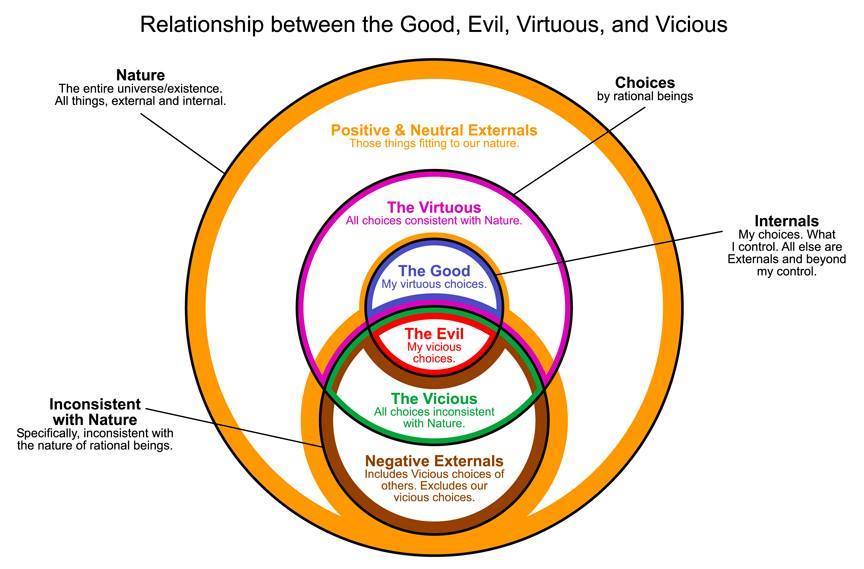
The left chart (click to embiggenate) shows the world divided by a couple of rules. Roughly speaking, they are things which are in accordance with nature and those not in accordance with nature, and things which are up to us and things which are not up to us. It is a bit more complicated than that, but if you will permit me to use some license here and overly simplify it, it will make it easier to highlight the substance of the division that were talking about.  Most folks will draw parallels to “positive things” and “negative things,” and that might be okay for this instance, but is still a little squishy.

With that in mind, an Evil has to be both against the nature of things, and up to us. Nature is also a difficult topic in Stoicism, but in this case we are talking specifically about humankind’s social nature.  So let’s shelve that issue for later, and focus on this social component.  Furthermore, according to this taxonomy when we see a “negative” thing if it is done by others it is an external and therefore a dispreferred indifferent (ἀπροηγμένα), and when done by us is a moral evil. The very same action has two different moral classifications and philosophical classifications depending on the agent or actor.  If we take the size of the various circles as indicative of frequency of occurrence, we see that these moral questions, while at the core and thus most important, are not the majority of impressions.

This seems nitpicky, and in a sense it is. However, when we as προκόπτωντες are attempting to make progress in our practice so philosophy, it behooves us to think of them correctly within the school that we have subscribed to.

Again, to reiterate, this does not imply passivity or that we must simply allow those things to go on as they are. If we feel a moral imperative to get involved and change the state of things, that is a prohairetic action (προαιρετικός) which contains a moral component and this is a valid avenue for us to act.  “It’s wrong for me to do nothing about this.”  This is fine, as long as you realize that your ability to influence it lies solely in the motivation and intent aspects.  You may well be thwarted along the way, and fail.  This is why the Dichotomy of Control is still a better Stoic position than the so-called Trichotomy.

Despite that, the thing which occurs is not Evil from a Stoic perspective. It could be, if and only if, you were the one making the plan/program or actively doing the thing which is repulsive to your conscience. It may be, that your action or inaction in this case, has a moral component for you. To choose a project one way of the other would have moral effects on you. In which case it would be to your own Good or Evil to act in accordance with that.

The Stoic lens can seem to be a strange one, distorting more than it focuses.  But for the practiced user, its ability to finely focus a narrow field is invaluable.  Part of using it appropriately and correctly is using the proper terms and connotations of the things we are observing.  It is very difficult, maybe impossible, to test impressions well if the measure is skewed by incorrect labels and markings.  The Good and the Evil need to be accurately calibrated, and that is the point of this of discussion.  In keeping those marks firm and accurate, we have benchmarks as moral actors for our intent.

What I learned from a year without Stoicism.

Standard

As I set pen to paper (as it were), it happens that it has been almost a year to the day since I wrote this. A few weeks after that posted however, not explicitly but functionally, I left the practice of philosophy as a way of life. The cosmos has a sense of humor, it seems, and sometimes it’s a little twisted

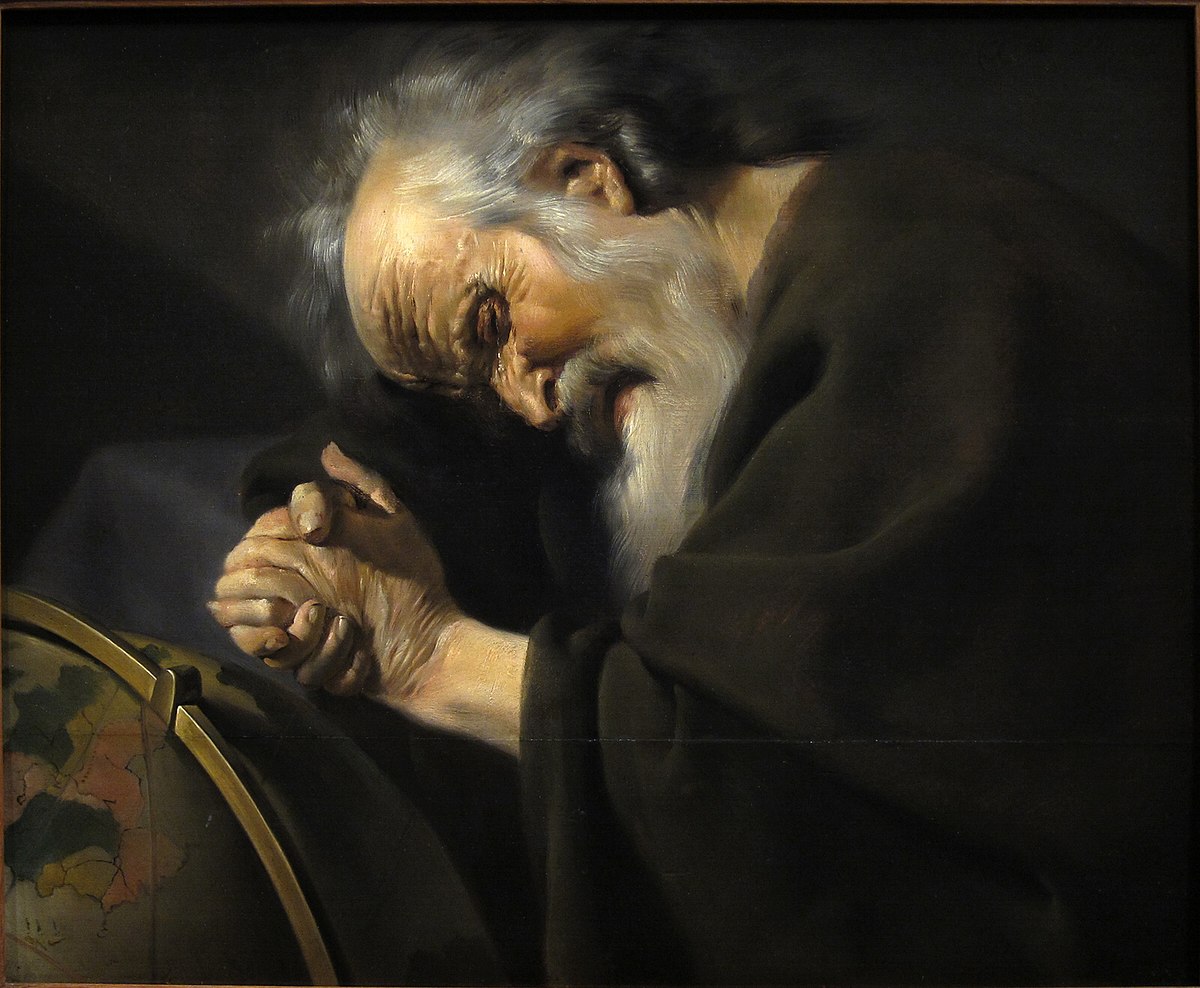
Image result for heraclitus

I fell away from philosophy for a variety of reasons, but all of them circled around one issue. I was frustrated with what seemed like a lack of progress. I looked back on earlier periods of my life when I was less occupied with the workings of the mind and soul, and with rose colored glasses, I lamented the loss of happier times. I remember fondly pleasures and simpler days.looked at the Stoic communities on the internet that had stagnated, some which had become toxic and pandering to the narcissistic. Others had withered or lost their way. I saw a slew of newcomers swayed by (to my mind) wrong interpretations, some intention biases, and people capitalizing not on providing accurate useful content but clicks, memes, bumpersticker philosophy, and branding.

I did not identify it at the time, but I had had a crisis of philosophy (of faith?). So I stopped, and I went another way.

Suffice it to say, the crops borne of these seeds of questioning have yielded a bitter harvest. Without focusing too much on the particulars, let us just say that the error of my thinking is now been made clear. A Facebook notification that my friend Yannos had made a post took to me a comment he wrote, and helped to cue me back towards our practices.

This got me thinking of why I unconsciously left philosophy, it was for this very reason. I didn’t win, or get the prize at the end. However, upon inspection, I had changed greatly, and for the better. The greater change, though, was a negative one; and it had occurred when I left. A slow but constantly slide downward. After a year, I am so far away from where I was, I feel like a different person, living a different life.

When I was a Stoic, or at least one who wishes to be a Stoic, I took responsibility for myself. I worked on things I could control. I was compassionate towards towards others. I had a mission of sorts, even if imperfectly formed.


When you have remitted your attention for a short time, do not imagine this, that you will recover it when you choose; but let this thought be present to you, that in consequence of the fault committed to-day your affairs must be in a worse condition for all that follows.

— Epictetus, Discourses IV.12


Boy, isn’t this the truth.

The biggest challenge is undoing the habits I’ve formed. I’ve lost the perception of that space where judgments are made between perception and emotion. I have to forcefully remind myself to keep our practices in mind and actually do them.

So, all that being said, here is the bullet point list of things I learned with a year away from philosophy:

  • Whether or not the Stoic position of emotions being judgments or the result of judgments is true, it’s useful. This is especially noted in the absence of the practice.
  • A rich inner life of questioning impressions provides a valuable strategy for managing those impressions. Failure to manage them puts you at their mercy, of which they seem to have none. For me, the Dichotomy of Control is the best model I have yet experienced for personal well being.
  • A focus on externals puts your well being in the hands of things external, not your own. This is begging for trouble.
  • Focusing on externals may not bring you the achievement of externals, but focusing on the προαίρεσις will bring about its proper function.
  • A προαίρεσις will keep doing its job without explicit instructions, but you might not like the result.
  • Whether or not you take the position that virtue is the only good as an axiom, as an existential choice, or an article of faith, it’s now clear to me that a focus on externals begs for unhappiness.

It may not be much, and the cost was high. But there is the product of my year as a Stoic Apostate. Now, we will see if I can regain what I lost. Hope to see you on the way there. I do not want to make any big pronouncements, or state grand goals. I want merely to set my feet back on the path.


Then show me one in the moulding, one who has set his feet on the path. Do me this kindness, do not grudge an old man like me a sight I never saw till now.”

— Epictetus, Discourses II.19