For those interested in Stoicism’s influence in the Roman church.
https://www.academia.edu/1230620/Augustine_and_the_Stoic_Tradition
For those interested in Stoicism’s influence in the Roman church.
https://www.academia.edu/1230620/Augustine_and_the_Stoic_Tradition
Some things are in our control and others not. Things in our control are opinion, pursuit, desire, aversion, and, in a word, whatever are our own actions. Things not in our control are body, property, reputation, command, and, in one word, whatever are not our own actions.
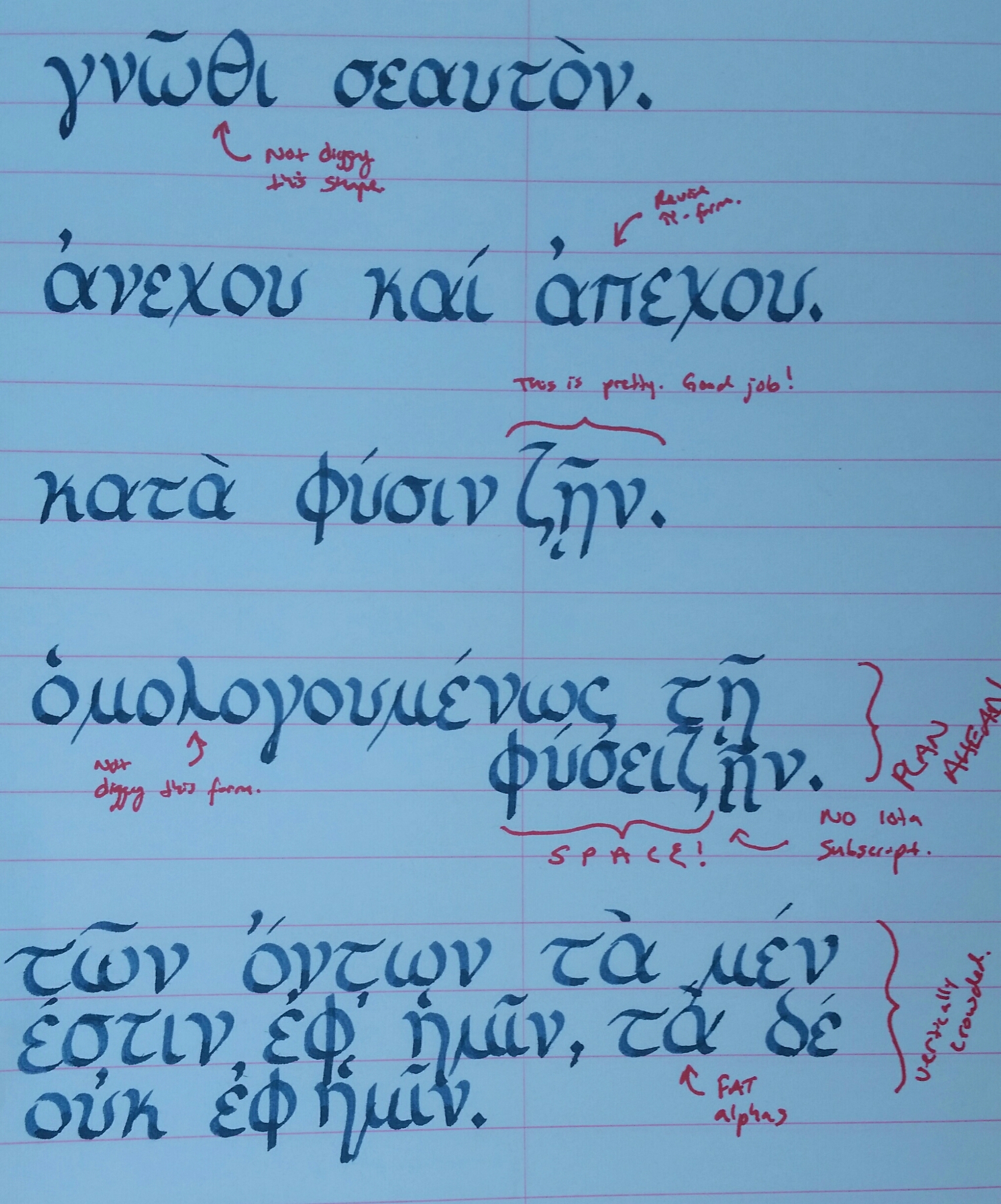
In Enchiridion 1, Epictetus through Arrian discusses which things are “up to us,” (ἐφ᾽ ἡμῖν). He does not provide a definition, although we can use the short hand and definitive prohairetic things. Instead, Epictetus gives us a list of examples, whereby we can infer the general rule or type of things he’s discussing.
He ends this list, which I interpret not to be a closed class, with what’s often translated as “whatever are our own actions/works.” Oftentimes, this word ἔργα (erga) is translated as actions, works, deeds, etc. A literal reading is often “works.”
It is not the person who eagerly listens to and makes notes of what is
spoken by the philosophers who is ready for philosophizing, but the
person who is ready to transfer the prescriptions of philosophy to his
deeds (erga) and to live in accord with them.— Arius Didymus
I came across another interesting translation which uses “whatever we bring about.” That’s an interesting take, probably closer to the spirit of the passage in Ench.1. As Stoics, we’re more concerned with the intent of a thing than its results in the world. We’re more concerned about how we handle judgments and impressions than how the results of those go out from us. “Whatever we bring about” then encompasses these internal things, our actual focus, better than do the English words “works,” “actions,” or “deeds.”
Nam si exaudit rationem sequiturque qua ducitur, iam non est ira, cuius proprium est contumacia; si vero repugnat et non ubi iussa est quiescit sed libidine ferocia-que provehitur, tam inutilis animi minister est quam miles qui signum receptui neglegit. Itaque si modum adhiberi sibi patitur, alio nomine appellanda est, desit ira esse, quam effrenatam indomitamque intellego.
For if anger listens to reason and follows where reason leads, then it is already not anger, of which obstinacy is a proper quality; if, however, it fights back and does not become quiet when it has been ordered, but is carried forward by its desire and ferocity, then it is as useless a servant of the soul as a soldier who disregards the signal for falling back. And thus, if it suffers a measure to be applied to itself, then it must be called by a different name, and it ceases to be anger, which I understand to be unrestrained and untamable.
— Seneca, De ira 1.9.2–3
“Men seek retreats for themselves, houses in the country, sea-shores, and mountains; and thou too art wont to desire such things very much. But this is altogether a mark of the most common sort of men, for it is in thy power whenever thou shalt choose to retire into thyself. For nowhere either with more quiet or more freedom from trouble does a man retire than into his own soul…”
μετάνοια is often translated as “conversion” in the wake of the Christianization of the West. Marcus uses this word to describe his coming to Philosophy. It is more than mere “change of mind,” but also a turning inward, a soul-change as well.
It has been my experience that there are many ‘conversions’ for one on the philosophical path, a constant turning inward and reorienting.
Lately, I’ve gotten awful wrapped up in externals. Things which are rightly by our school things indifferent. And my progress has suffered for it. A philosophical backsliding that is staggering. Today, when I needed it the most, from an unlikely source (for me), I received the reminder that “we are what we eat.” This is true physically as it is spiritually, or philosophically, of you’d rather.
I sat and listened while someone noted that we can monitor our speech, and by watching what comes out in words, actions, deeds, we can get a clue to what’s been going in.
For me, these past several seasons, it has not been a dialogue of virtue, of justice, of fittingness, of wisdom, and of courage. My words have been that of the complainer, the bitter one, the ingrate. Precisely the person that Marcus warns himself, and us, to be prepared to meet every day:
“When you wake up in the morning, tell yourself: the people I deal with today will be meddling, ungrateful, arrogant, dishonest, jealous and surly. They are like this because they can’t tell good from evil.”
This has been me for months. This hasn’t become a premeditatio, but a description of myself. At work, at home, with friends. If it is correct that the soul is colored by the thoughts we entertain, I’ve been working on the quite the dye-job.
At every impression, every judgment lies the opportunity to change. Today, however, I choose to not be the asshole.That call to μετάνοια is present. This ability to change, to make a decision contrary to our urges, instincts, habits, and lifestyle is the core ability for Stoics.
That is my intent today; to turn inward, rededicate myself to my practice and progress.
“[Q]ualities which we ought to possess become better and more desirable the more extensive they are: if justice is a good thing, no one will say that it would be better if any part were subtracted from it; if bravery is a good thing, no one would wish it to be in any way curtailed: consequently the greater anger is, the better it is, for whoever objected to a good thing being increased? But it is not expedient that anger should be increased: therefore it is not expedient that it should exist at all, for that which grows bad by increase cannot be a good thing.”
— Seneca, On Anger.
Translations?
This got posted in one of the larger Facebook groups last week. I’ve been listening to it in the car on my daily commute the past few days and found it to be well worth the time.
The author discusses several problems in interpretation of spiritual exercises in a Philosophy descended from Socrates, where virtue is a kind of knowledge, and knowledge is sufficient for virtue. I found the arguments compelling.
Also, the author addresses three spiritual exercises, the Three Disciplines of Epictetus, and distils and describes them well.
https://curve.carleton.ca/5522dbc5-785b-4ab3-a873-4e6297c59068
Depending on which sections of the Stoic-internet you frequent, you may have a range of ideas about Stoicism and religion.
In some, there is the ahistorical idea that the Stoics were closet atheists, in others theists of various stripes, maybe pantheists, deists, or panentheists.
I’m interested in Stoic theology, a decidedly minority position on the internet today. And this got shared in one of the groups the other day, and I thought I’d pass it along.
It’s a Master’s thesis on Stoicism as a religion. Dangerous waters indeed, no?
“How long, then, will you delay to demand of yourself the noblest improvements, and in no instance to transgress the judgments of reason? You have received the philosophic principles with which you ought to be conversant; and you have been conversant with them. For what other master, then, do you wait as an excuse for this delay in self-reformation? You are no longer a boy, but a grown man. If, therefore, you will be negligent and slothful, and always add procrastination to procrastination, purpose to purpose, and fix day after day in which you will attend to yourself, you will insensibly continue to accomplish nothing, and, living and dying, remain of vulgar mind. This instant, then, think yourself worthy of living as a man grown up and a proficient. Let whatever appears to be the best, be to you an inviolable law. And if any instance of pain or pleasure, glory or disgrace, be set before you, remember that now is the combat, now the Olympiad comes on, nor can it be put off; and that by one failure and defeat honor may be lost – or won. Thus Socrates became perfect, improving himself by everything, following reason alone. And though you are not yet a Socrates, you ought, however, to live as one seeking to be a Socrates.”
— Epictetus, Enchirdion 51.
 Mountain Stoic
You must be logged in to post a comment.