Short selection: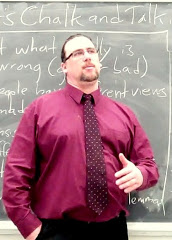
- Habits and Practice
- Training (Askesis)
- Attention or Mindfulness
- Dealing with Appearances
- Inconsistency and Moral Failings
- Stubbornness or Obstinancy
- False Peace and Leisure as Ends
Entire list: Orexis Dianoētikē.
“Are monks and hippies and poets relevant? No, we are deliberately irrelevant. We live with an ingrained irrelevance which is proper to every human being. The marginal man accepts the basic irrelevance of the human condition, an irrelevance which is manifested above all by the fact of death. The marginal person, the monk, the displaced person, the prisoner, all these people live in the presence of death, which calls into question the meaning of life. He struggles with the fact of death in himself, trying to seek something deeper than death; because there is something deeper than death, and the office of the monk or marginal person, the meditative person or the poet is to go beyond death even in this life, to go beyond the dichotomy of life and death and to be therefore, a witness to life.”
What makes a marginal person?
http://mertoninasia.blogspot.com.au/2008/10/relevance-of-irrelevant.html
XLVI. To Plato, the Sage, greetings (p. 177)
So the rich appetites of Plato are compared to the gluttony of sheep, ever eating. This harkens to the “wealth is not in having many possessions, but few desires” line we hear in Cynic and Stoic sources. I do especially like the parting shot and mic drop of “But if this does not convince you, then practice fondness of pleasure and mock us for not knowing much.” Boom.
XLVII. To Zeno, do well (p. 179)
This is a pretty pessimistic outlook, and its interesting how much this changed with Stoicism, esp. Musonius for whom family life is a form of piety.
XLVIII. To Rhesus, greetings (p. 179)
This is a strange little quip of a letter. “Dude wants to see some horses, he doesn’t eat much, please oblige.”
This is part of the Cynic Epistles Reading Plan.
Seneca,
This is an issue which I’ve been concerned with for some time. You give the excellent example here, and I think this also ties into Musonius some, as we’ll see.
The bull is filled when he feeds over a few acres; and one forest is large enough for a herd of elephants. Man, however, draws sustenance both from the earth and from the sea. What, then? Did nature give us bellies so insatiable, when she gave us these puny bodies, that we should outdo the hugest and most voracious animals in greed? Not at all. How small is the amount which will satisfy nature? A very little will send her away contented. It is not the natural hunger of our bellies that costs us dear, but our solicitous cravings.
Folks look at the diet prescription Musonius lays out. It make sense to me that a passion which we encounter not rarely, but for most westerners, three times a day should draw our immediate attention. Of course, Musonius notes (Lectures XVIIIA and XVIIIB that we handle it every day, sometimes twice! Ooops. Already starting from a disadvantaged position, it seems.
The passion of food, then, is a reasonably an opportune place for us to apply our attention. Musonius asks the question (Lecture V, Lecture VI), how can we learn self-control unless we actually practice being self-controlled? This is why practice must come with theory.
Of course, you’re reading the letter of an overweight would-be Stoic. The point still stands, and coupled with lessons of the previous week are poignant.
Thank you for the letter, and the reminder that I need.
Farewell.
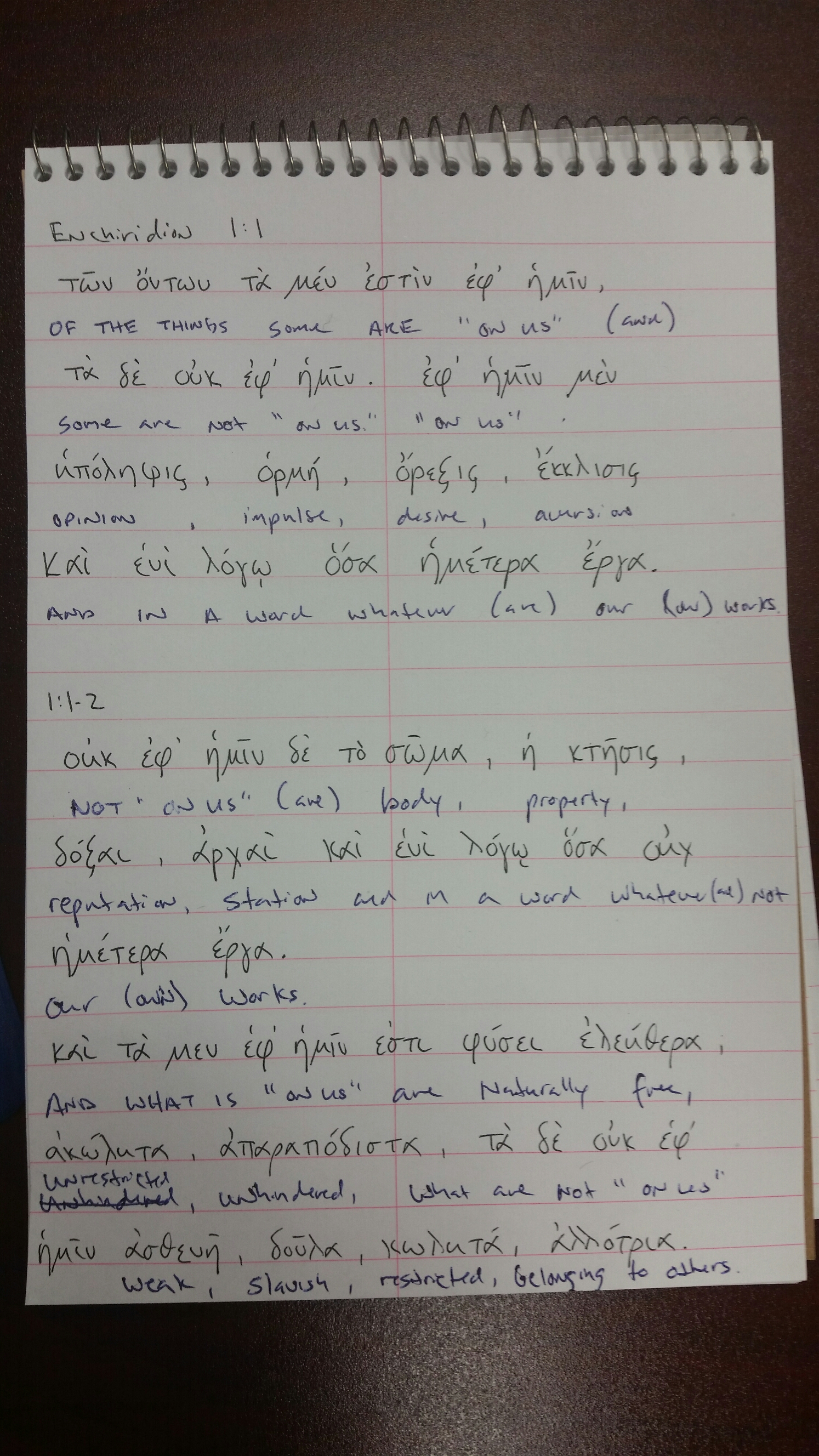
A reading of Epictetus’ Enchiridion 1 in the native Koine with modern Greek pronunciation by Jean Efpraxiadis.
XLI. To Melesippus (p. 173)
Whoa. It’s not controversial to state that not everyone *will* be virtuous, but it’s another thing entirely to say that not every *is capable* of virtue. And to think, the Stoics are considered elitists!
XLII. To the wise Melesippe, greetings (p. 173)
Oh, Diogenes, flouting the νόμος.
XLIII. To the Maroneans, do well (p. 173)
**Even though** Hipparchia is a woman, she’ s a good figure to name a city after. <rolls_eyes>. I wonder if there would have been a “Cynic temperance movement” a la the WCTU in the 1920s and 1930s. I suppose they wouldn’t have used the state in horrifying way, rather they’d have pointed out the absurdity of the drunkards. We probably would have avoided the rise of the mafia, and NFA ’34, though…
XLIV. To Metrocles, do well (p. 175)
I don’t recall ever seeing “manual labor” as taking the place of interpersonal romantic activities. Crates and Hipparchia come to mind as two Cynics who continued to engage in martial relations of a sort.
It’s interesting that the Ps-Diogenes is here advocating, effectively, a form of celibacy. Maybe Diogenes’ Cynic really did anticipate the future priestly classes.
XLV. To Perdiccas, do well (p. 175)
Here, the Ps-Diogenes, friend of the gods, warns someone threatening him that only bad things would result from killing him. I wonder how this meshes with the issue of Diogenes beating up an interlocutor, and also his public shaming of those who assaulted him? I’m not sure if those stories are here, but I’ll keep my eye out for them.
This is part of the Cynic Epistles Reading Plan.
Seneca,
“[W]hy is it that folly holds us with such an insistent grasp? It is, primarily, because we do not combat it strongly enough, because we do not struggle towards salvation with all our might; secondly, because we do not put sufficient trust in the discoveries of the wise, and do not drink in their words with open hearts; we approach this great problem in too trifling a spirit.”
Here, this is the reason. We have many and many modern Stoics who discount the words of the very people the profess to follow. “No, no, they didn’t really mean we should do these things. It’s all tricks and lifehacks for dealing with modern stress.” Bah.
But what’s worse, those who would discount out of hand the teachings or those who see that the teachings are needed, but don’t do it anyway?
““You call me a man of sense, but I understand how many of the things which I crave are useless, and how many of the things which I desire will do me harm. I have not even the knowledge, which satiety teaches to animals, of what should be the measure of my food or my drink. I do not yet know how much I can hold.””
Clearly then, the latter. Which is the camp I’m firmly in. I can clearly see that explicit recommendations are laid out… I’m just not doing them.
“But how can a man learn, in the struggle against his vices, an amount that is enough, if the time which he gives to learning is only the amount left over from his vices? None of us goes deep below the surface. We skim the top only, and we regard the smattering of time spent in the search for wisdom as enough and to spare for a busy man.”
It seems that there can be no “part-time philosophers.” Most of us, myself included, our tourists. That’s an untenable situation, one which will either result in our buckling down and really getting to work, or moving on to a different hobby at some point.
Thank you for the letter today, it’s an excellent mirror which shows a dingy reflection.
Farewell.
XL. Diogenes the Cynic to Alexander (p. 169)
Here, we see some of the proto-anarchist tinge to the Ps-Diogenes. Likening tyrants to children, to the diseased, to those fearfully hiding behind walls. He points that they (and specifically Alexander) hire men to watch after their health, but where are those who watch after their souls?
“For it is quite enough for them to be wicked by themselves; but, by giving a salary besides to very wicked men, you present them with the opportunity of doing no good. And you yourself have a hand at doing things like this and worse.”
This is part of the Cynic Epistles Reading Plan.
Seneca,
We Stoics are often misconstrued a would-be emotionless automatons. The confusion likes in our wishing to be rid of our πάθη, when the common conception is that ‘passion’ is a good thing, enlivening. We seek a state called ἀπάθεια, too easily misunderstood as the common sort amotivational apathy. By the time we get around to discussing εὐπάθη, the average listener already has their mind made up. Robots.
Your letter today remarks on this distinction, here between ‘pleasure’ and ‘joy.’ The joy of the Sage, then, an unshakeable, rational elation of the spirit in the face of human existence and the breadth of the cosmos is as different from the base pleasures of vice than anything else we can imagine.
Thank you for the letter.
Farewell.
 Mountain Stoic
You must be logged in to post a comment.